Biography
Introduction: A Pillar of Early Somali Independence
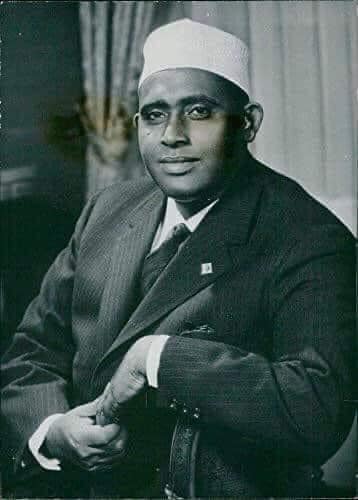
Abdirashid Ali Shermarke† stands as a central figure in the formative years of the Somali Republic. Serving as the nation's Second President (1967-1969), his tenure was a critical, albeit brief, chapter in Somalia's post-independence journey. A seasoned politician and intellectual, Shermarke's career was deeply intertwined with the struggle for sovereignty and the complex challenges of nation-building. His most notable achievement was becoming the first Somali head of state to ascend to the presidency through a democratic parliamentary election, marking a significant moment in the country's young democratic process. His leadership, focused on modernization, education, and navigating Cold War geopolitics, was tragically cut short by his assassination in 1969, an event that precipitated a military coup and dramatically altered Somalia's political trajectory. The story of Abdirashid Ali Shermarke† is thus essential to understanding the hopes and upheavals of early independent Somalia.
Early Life & Education: Forging an Intellectual Foundation
Abdirashid Ali Shermarke was born in 1919 in the town of Harardhere, in the Mudug region of central Somalia, then under Italian colonial administration. He hailed from the Majerteen clan, a sub-clan of the larger Darod clan family. From an early age, he demonstrated a keen intellect and a propensity for learning, which set him on a path distinct from many of his contemporaries.
His formal education began in local Islamic schools (Qur'anic Duksi), but his quest for knowledge soon led him to secular institutions. He attended primary and secondary schools in Mogadishu and later in the northern region of Somaliland. Shermarke's academic prowess earned him a coveted scholarship to study abroad, a rare opportunity at the time. In the late 1940s, he traveled to Rome, Italy, where he enrolled at the prestigious University of Rome "La Sapienza". There, he pursued a degree in political science, immersing himself in Western political thought and administrative systems. This educational experience in Europe was profoundly formative, equipping him with a modern, secular outlook on governance and statecraft that would later define his political approach. He returned to Somalia in the early 1950s as one of the nation's most highly educated figures, fluent in Italian, Arabic, and Somali, and ready to contribute to his homeland's impending independence.
Career & Major Achievements: From Prime Minister to President
Abdirashid Ali Shermarke's political career began in earnest in the lead-up to Somalia's independence. He was a founding member of the Somali Youth League (SYL), the first modern political party in Somalia that championed anti-colonialism and national unity. His education and skills quickly propelled him into leadership roles.
Prime Ministership and Nation-Building
Following the unification of the former British Somaliland and Italian Somaliland into the Somali Republic on July 1, 1960, Shermarke was appointed as the country's first Prime Minister by President Aden Abdullah Osman Daar. He held this position from 1960 to 1964. His premiership was focused on the monumental task of consolidating a unified state from two territories with different colonial legacies, legal systems, and administrative cultures. Key initiatives during this period included:
- Establishing foundational government institutions and a national civil service.
- Promoting economic development plans and seeking international aid and investment.
- Advocating for a standardized Somali orthography to foster national literacy and unity.
- Navigating the delicate politics of pan-Somalism and border disputes with neighboring Ethiopia and Kenya.
Presidency and the Democratic Transition
In the 1967 presidential election, a landmark event in Somali Politics & Government, Abdirashid Ali Shermarke was elected as the nation's second President by the National Assembly, succeeding his predecessor in a peaceful democratic transfer of power. His presidency, though lasting only two years, was marked by several significant efforts:
- Foreign Policy Pragmatism: He sought to moderate Somalia's foreign policy, moving away from overt confrontation with Ethiopia over the Ogaden region. He engaged in diplomatic talks, notably with Kenyan President Jomo Kenyatta in Arusha (1967), aiming to reduce regional tensions.
- Focus on Development: Shermarke continued to prioritize educational expansion and infrastructure projects, viewing them as critical for long-term stability and progress.
- Cold War Navigation: He maintained Somalia's non-aligned stance but worked to balance relationships with both the Soviet Union and the Western bloc to secure development aid.
Personal Life, Assassination, and Legacy
Abdirashid Ali Shermarke was known as a reserved, intellectual, and devout Muslim. He was married and had several children. His personal demeanor was often described as sober and thoughtful, reflecting his academic background. He was deeply committed to the idea of a unified Somali nation-state, transcending clan divisions—a principle he championed throughout his career.
Tragically, his life and presidency ended abruptly on October 15, 1969. While on an official visit to the northern city of Las Anod, President Abdirashid Ali Shermarke was assassinated by one of his own bodyguards. The motive remains shrouded in mystery, often attributed to personal grievance or broader political conspiracy. His assassination sent shockwaves through the nation and created a profound power vacuum.
Just six days later, on October 21, 1969, the Somali Army, led by Major General Mohamed Siad Barre, seized power in a bloodless coup, citing the political corruption and instability that culminated in the president's murder. This marked the end of Somalia's nascent democratic experiment and the beginning of a 22-year military dictatorship.
The legacy of Abdirashid Ali Shermarke† is complex. He is remembered as a symbol of Somalia's early democratic hopes and as a capable administrator who helped steer the young republic through its first difficult decade. His assassination is widely seen as the pivotal event that derailed Somalia's constitutional governance. Historians often reflect on his tenure as a "what could have been" moment in Somali history, representing a path of moderate, educated leadership that was violently cut short, altering the destiny of the nation.
Historical Significance and Remembrance
While discussions of personal wealth were not prominent in the context of his public service, Abdirashid Ali Shermarke's "capital" was his education and intellectual contribution to the state. Unlike some contemporaries, he was not known for amassing private business ventures or significant personal commercial holdings. His life was dedicated to public service within the sphere of Executive Leadership. His primary focus was on building state institutions and national capacity rather than personal financial success. In modern terms, his legacy is his service, and his name remains etched in Somali history books, airports, and major avenues, including the Mogadishu International Airport which bore his name for many years. His story continues to be a critical subject of study for anyone seeking to understand the roots of modern Somali statehood and its subsequent challenges.
For further reading on this period of Somali history, credible sources include the Encyclopædia Britannica, academic works like "A History of Modern Somalia" by I.M. Lewis, and historical archives from the United Nations and the CIA's Freedom of Information Act Electronic Reading Room which contain declassified documents from the era.
Frequently Asked Questions
What is Abdirashid Ali Shermarke†'s estimated net worth?
Net worth details for Abdirashid Ali Shermarke† are currently being updated.
What is Abdirashid Ali Shermarke†'s role and nationality?
Abdirashid Ali Shermarke† is a Second President (1967-1969) from Somalia.
How did Abdirashid Ali Shermarke† make their money?
Abdirashid Ali Shermarke† built their fortune primarily through Abdirashid Ali Shermarke was a political leader who served as President of Somalia until his assassination in 1969, and there is no information or credible basis to attribute any significant personal wealth or modern net worth to him..
How old is Abdirashid Ali Shermarke†?
Abdirashid Ali Shermarke† was born in 1919 (107 years old).
Which category is Abdirashid Ali Shermarke† listed under?
Abdirashid Ali Shermarke† is featured under the Politics & Government category on NetWorth Africa.
How is Abdirashid Ali Shermarke†'s net worth calculated?
NetWorth Africa estimates financial valuations using publicly available stock equity holdings, company ownership records, real estate assets, and verified market data.
Net Worth Analysis
Abdirashid Ali Shermarke was a political leader who served as President of Somalia until his assassination in 1969, and there is no information or credible basis to attribute any significant personal wealth or modern net worth to him.
Quick Stats
Related People

Aaron Motsoaledi
LP; Minister of Home Affairs • South Africa

Abane Ramdane†
FLN Leader & Strategist • Algeria

Abdalla Hamdok
Ex-Prime Minister • Sudan

Abdallah Kigoda
Ex-Minister of Natural Resources • Tanzania