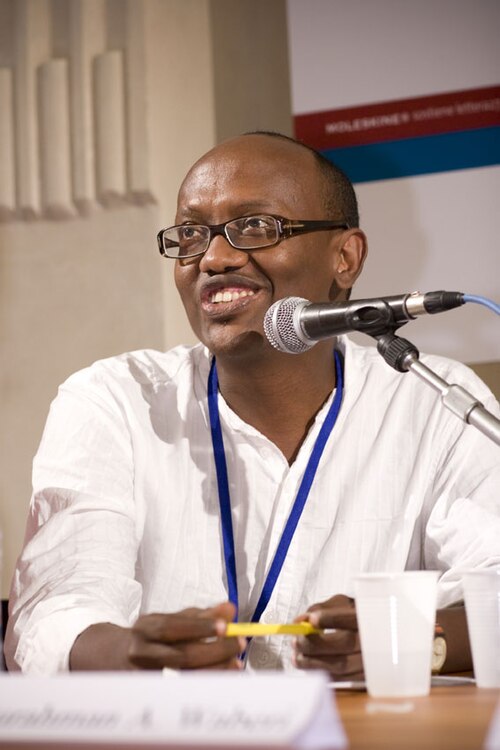
Financial Breakdown
Asset Distribution
Assets vs Liabilities
Assets
Liabilities
Disclaimer: These financial estimates are based on publicly available information and should be considered approximate. Last updated: 12/31/2025
Biography
Introduction: A Pioneering Voice from the Horn of Africa
Abdourahman Waberi stands as one of the most significant literary figures to emerge from the Horn of Africa. Born in 1965 in Djibouti, Waberi has carved out an international reputation as a novelist, essayist, poet, and academic, bringing the nuanced realities of his homeland and continent to a global audience. Often hailed as "the leading literary voice of his generation" from Djibouti, his work is celebrated for its poetic density, sharp political insight, and innovative narrative forms. A key achievement in the career of Abdourahman Waberi was being awarded the prestigious Prix Albert Bernard in 1996 for his first major work, Le Pays sans ombre (The Land Without Shadows), which immediately established him as a formidable new voice in Francophone literature. His writing, deeply rooted in the specific landscape and history of Djibouti, transcends geographical boundaries to address universal themes of exile, memory, colonialism, and identity.
Early Life & Education: Formative Years in a Crossroads Nation
Abdourahman Waberi was born in 1965 in Djibouti City, the capital of what was then the French Territory of the Afars and the Issas. Growing up in this small, strategically located nation at the mouth of the Red Sea exposed him to a rich tapestry of cultures, languages, and histories from an early age. Djibouti's position as a cultural and commercial crossroads, marked by Somali, Afar, Arab, and French influences, profoundly shaped his worldview. His early education took place locally, immersing him in the Francophone system while remaining connected to his native Somali heritage.
In 1985, at the age of twenty, Abdourahman Waberi moved to France on a scholarship to continue his studies. This experience of migration—a theme that would become central to his writing—provided both distance and perspective on his homeland. He earned a degree in English and later completed a Master's degree in English literature at the University of Caen Normandy. His academic pursuits were complemented by a deep engagement with the works of postcolonial thinkers and writers from Africa and the Caribbean, including Aimé Césaire, Édouard Glissant, and Nuruddin Farah. These formative years, straddling the worlds of Djibouti and France, equipped Waberi with the linguistic dexterity and critical framework to begin his literary career, allowing him to write about Djibouti with both intimacy and analytical rigor.
Career & Major Achievements: Mapping a Literary Landscape
The career of Abdourahman Waberi is marked by a prolific and diverse output that includes novels, short story collections, essays, and poetry. His debut, the short story collection Le Pays sans ombre (1994), was a literary cartography of Djibouti, painting its arid, sun-scorched landscape and complex social fabric with vivid, metaphorical language. Its critical success was confirmed with the Prix Albert Bernard from the Académie des Sciences d'Outre-Mer in 1996. He followed this with Cahier nomade (1996) and Balbala (1997), which together formed a loose "Djibouti trilogy," solidifying his reputation.
Breakthrough Novels and International Recognition
Waberi's novelistic prowess reached new heights with Transit (2003) and Passage des larmes (The Passage of Tears, 2009). The latter, a poignant exploration of exile and return, won the Prix Louis-Guilloux and the Prix Éthiophile. Perhaps his most internationally recognized novel is In the United States of Africa (2006), a daring work of speculative fiction that inverts the global order, imagining a world where Africa is the dominant superpower and Europe is a destitute region whose refugees seek asylum in the affluent African north. This satirical masterpiece showcased Waberi's ability to use inventive narrative to critique post-colonial power dynamics and Western perceptions of Africa.
Literary Themes and Style
Throughout his work, Abdourahman Waberi consistently engages with several interconnected themes:
- Memory and History: Excavating the layered past of Djibouti, from the colonial era to independence.
- Exile and Belonging: Navigating the psychological terrain of the diaspora.
- Language and Power: Writing in French while consciously subverting it to express a distinctly Djiboutian reality.
- The African Condition: Offering nuanced portraits that counter monolithic stereotypes of the continent.
His style is known for its poetic compression, rich imagery, and a blend of realism with allegory. Beyond his fiction, Waberi is a respected essayist and critic, contributing to major publications like Le Monde and Le Nouvel Observateur. He has also been a vocal advocate for other African writers, co-editing important anthologies such as L'Afrique répond à Sarkozy: Contre le discours de Dakar (2008).
Academic and Cultural Impact
Abdourahman Waberi's influence extends into academia. He has taught French and Francophone literature at George Washington University in the United States and currently holds a professorship at the European Graduate School in Switzerland. His scholarly work further bridges the gap between creative writing and critical theory, influencing a new generation of students and writers interested in postcolonial studies and world literature.
Personal Life & Legacy: The Man Behind the Words
While Abdourahman Waberi maintains a relatively private personal life, it is known that he divides his time between France, where he is a respected figure in literary circles, and his teaching commitments abroad. He is married and is a father. His personal interests are deeply intertwined with his intellectual pursuits—a passion for music, cinema, and the visual arts often surfaces in the intertextual richness of his writing. Waberi is also known for his mentorship of younger African writers and his engagement in cultural diplomacy, often participating in international literary festivals and forums.
The legacy of Abdourahman Waberi is multifaceted. Primarily, he has put Djibouti on the global literary map. Before his emergence, the nation's presence in world literature was minimal. Through his evocative prose, he has given his homeland a mythic and historical texture for readers worldwide. Secondly, as a public intellectual, he contributes thoughtfully to conversations on migration, multiculturalism, and the future of Africa. His work ensures that the specific experiences of small nations are not forgotten in broader discussions of Arts & Culture. For aspiring writers from similar contexts, Waberi's career is a powerful testament to the possibility of crafting a unique, authentic voice that resonates on the world stage while remaining firmly rooted in a local reality.
Net Worth & Literary Career
As with many literary authors, the precise net worth of Abdourahman Waberi is not publicly disclosed. His financial success is derived from multiple streams within the Arts & Culture sector. Primary sources include:
- Book Royalties: From his numerous novels and essay collections published by major French houses like Gallimard and Actes Sud, and translated into over a dozen languages.
- Academic Salary: A steady income from his professorial positions at universities in the United States and Switzerland.
- Literary Prizes: Monetary awards from the several prestigious prizes he has won throughout his career.
- Speaking Engagements & Contributions: Honorariums from lectures, festival appearances, and contributions to newspapers and journals.
While not a commercial "bestseller" in the mass-market sense, Abdourahman Waberi occupies a respected and secure position within the ecosystem of international literature and academia. His "business" is the business of ideas, cultural critique, and storytelling—a venture in which his capital is measured more in critical acclaim and lasting influence than in purely financial terms. His career exemplifies how a dedicated novelist and intellectual can build a sustainable life through a combination of creative output, teaching, and public engagement.
Frequently Asked Questions
What is Abdourahman Waberi's estimated net worth?
Abdourahman Waberi has an estimated net worth of $1.0 Million.
What is Abdourahman Waberi's role and nationality?
Abdourahman Waberi is a Novelist from Djibouti.
How did Abdourahman Waberi make their money?
Abdourahman Waberi built their fortune primarily through As a critically acclaimed but not commercially blockbuster novelist from Djibouti, his wealth is estimated based on typical earnings in literary arts, not business..
How old is Abdourahman Waberi?
Abdourahman Waberi was born in 1965 (61 years old).
Which category is Abdourahman Waberi listed under?
Abdourahman Waberi is featured under the Arts & Culture category on NetWorth Africa.
How is Abdourahman Waberi's net worth calculated?
NetWorth Africa estimates financial valuations using publicly available stock equity holdings, company ownership records, real estate assets, and verified market data.
Net Worth Analysis
As a critically acclaimed but not commercially blockbuster novelist from Djibouti, his wealth is estimated based on typical earnings in literary arts, not business.
Quick Stats



Related People
Abasse Ndione
Novelist & Playwright • Senegal
Abdel Rahman al-Abnudi†
Poet (Egypt-Sudan) • Sudan
Abdelkrim Ghallab†
Novelist & Journalist • Morocco
Abdellah Taïa
Novelist & Filmmaker • Morocco