Biography
Introduction: The Embodiment of Algerian Liberation
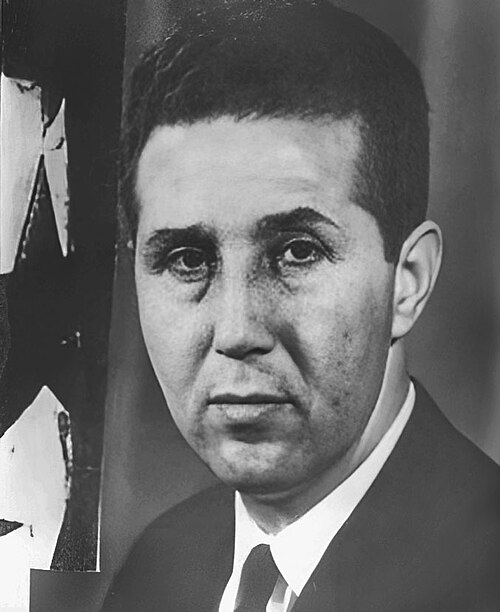
Ahmed Ben Bella† stands as a colossus in the modern history of Algeria and a seminal figure in the global anti-colonial movement. As the First President of Algeria from 1963 to 1965, he symbolized the hard-fought victory of a nation after 132 years of French rule. His life story is inextricably woven into the fabric of Algeria's struggle for freedom, transitioning from a decorated soldier in the French army to a revolutionary leader imprisoned for his beliefs, and finally to the helm of a nascent state. Ben Bella's key achievement was his pivotal role in founding the Front de Libération Nationale (FLN) in 1954, the organization that spearheaded the brutal and transformative Algerian War of Independence. His presidency, though brief, was a defining period of socialist-oriented nation-building, pan-Arab advocacy, and non-aligned diplomacy, setting a course that would influence Politics & Government in Algeria and across the African continent for decades.
Early Life & Education: From Rural Roots to Military Service
Ahmed Ben Bella was born on December 25, 1916, in the small town of Maghnia, near the Moroccan border in northwestern Algeria. His family were farmers of modest means, and his early life was shaped by the realities of colonial Algeria, where native Algerians faced systemic discrimination and limited opportunities. Ben Bella's formal education was cut short, but his intellectual and political awakening came through other channels. A gifted football player, he even played for Olympique de Marseille's reserve team in 1939-1940, an experience that exposed him to life in metropolitan France.
His true formative years, however, were spent in military uniform. He was conscripted into the French Army in 1937. During World War II, he served with distinction in the French 5th Infantry Division, earning the Croix de Guerre for bravery in 1940. After France's fall, he joined a Moroccan regiment under General de Lattre de Tassigny, fighting in the Italian campaign and receiving the Médaille Militaire for his actions at the Battle of Monte Cassino in 1944. These experiences honed his tactical skills but also deepened his resentment towards colonial inequality, as he risked his life for a freedom that his own people did not enjoy. The 1945 Sétif and Guelma massacre, where thousands of Algerian civilians were killed by French authorities and settlers, was a final, traumatic catalyst that solidified his commitment to the independence cause.
Career & Major Achievements: Revolutionary and Head of State
The Path to Revolution and Imprisonment
Upon returning to Algeria after the war, Ahmed Ben Bella† immediately engaged in militant Politics & Government. He was elected municipal councillor for Maghnia in 1945 but soon realized constitutional avenues were futile. He joined the underground Organisation Spéciale (OS), a secret armed group, and in 1949 masterminded a bold raid on the Oran post office to secure funds for the movement. Arrested in 1950, he escaped from prison in 1952 and fled to Cairo, Egypt. There, alongside other exiled leaders like Mohamed Boudiaf and Hocine Aït Ahmed, he played an instrumental role in forming the Comité Révolutionnaire d'Unité et d'Action (CRUA), which evolved into the FLN. On November 1, 1954, the FLN launched coordinated attacks across Algeria, marking the start of the war.
Ben Bella's strategic role was crucial in securing international support, particularly from Arab states. However, in a dramatic turn of events in 1956, the French intercepted a plane carrying him and four other FLN leaders (Aït Ahmed, Mohamed Boudiaf, Mohamed Khider, and Mostefa Lacheraf) from Morocco to Tunisia. He was imprisoned in France for the remainder of the war, becoming a powerful symbol of the Algerian cause. His captivity lasted until the Évian Accords ceasefire in March 1962.
Presidency and the Building of a Nation
Following a bitter internal power struggle after independence in July 1962, Ben Bella emerged as Algeria's first prime minister and then was elected as the First President of Algeria in 1963. His presidency was characterized by ambitious, if chaotic, socialist reforms and a prominent international profile. Key domestic policies included:
- Agrarian Revolution: Launching a program of autogestion (self-management), where abandoned French farms were collectivized and run by workers' committees.
- Nationalization: Consolidating state control over key sectors and establishing a single-party state under the FLN.
- Social Reforms: Implementing mass literacy campaigns and expanding healthcare access.
On the world stage, Ahmed Ben Bella† became a leading voice of the Non-Aligned Movement, Third World socialism, and pan-Arabism. He forged close ties with Cuba's Fidel Castro, Egypt's Gamal Abdel Nasser, and Ghana's Kwame Nkrumah. His government hosted the iconic 1965 "Afro-Asian Seminar" in Algiers, a hub for revolutionary movements from Africa, Asia, and the Americas. However, his rule grew increasingly personalized and authoritarian, alienating former comrades and failing to address deep economic challenges. On June 19, 1965, his defense minister and close ally, Houari Boumédiène, orchestrated a bloodless coup, deposing Ben Bella and placing him under house arrest for the next 15 years.
Personal Life, Later Years & Legacy
After his release in 1980, Ben Bella lived in exile in Europe for a decade before returning to Algeria in 1990. In his later years, he remained a vocal, though less influential, political and moral figure. He founded a small opposition party, the Mouvement pour la Démocratie en Algérie (MDA), and became a critic of the military-backed government and the violence of the 1990s civil war. He also embraced a more pronounced Islamic identity, framing his early socialism within Islamic principles. Personally, he was known for his charisma, stubborn conviction, and simple lifestyle. Ahmed Ben Bella passed away on April 11, 2012, at the age of 95, and was buried in Algiers with full state honors.
The legacy of Ahmed Ben Bella† is complex and multifaceted. He is universally revered as one of the historic "nine chiefs" of the revolution, an indispensable liberator of Algeria. His presidency, though cut short, established the socialist and non-aligned orientation of the early Algerian state and amplified the country's voice on the global stage. However, his tenure also demonstrated the difficulties of translating revolutionary fervor into effective governance and planted seeds of the authoritarianism that would characterize Algerian Politics & Government. He remains a potent symbol of anti-colonial resistance, a founding father whose life encapsulates the triumphs and tribulations of modern Algeria's birth.
Net Worth & Business Ventures
Unlike many post-independence leaders, Ahmed Ben Bella† was not associated with significant personal wealth or private business ventures. His life was fundamentally dedicated to political and revolutionary activity, first in the struggle for independence and then in state leadership. His economic policies as president were explicitly socialist, focusing on nationalization and collective ownership rather than private enterprise. Following his overthrow in 1965 and subsequent 15-year detention, he had little opportunity or inclination for financial accumulation. In his later years after returning from exile, he lived a modest life. Any assessment of his "net worth" is therefore not a measure of financial success but of his political capital and enduring status as a symbol of Algerian sovereignty. His legacy is one of ideological commitment, not commercial or business achievement, firmly placing his life's work within the realm of revolutionary Politics & Government and national liberation.
Sources and further reading: The life and career of Ahmed Ben Bella are documented in historical texts on the Algerian War, such as Alistair Horne's "A Savage War of Peace," and through archival resources from the Algerian government and international press. His role is also detailed in studies on the Non-Aligned Movement and post-colonial African leadership.
Frequently Asked Questions
What is Ahmed Ben Bella†'s estimated net worth?
Net worth details for Ahmed Ben Bella† are currently being updated.
What is Ahmed Ben Bella†'s role and nationality?
Ahmed Ben Bella† is a First President of Algeria from Algeria.
How did Ahmed Ben Bella† make their money?
Ahmed Ben Bella† built their fortune primarily through Ahmed Ben Bella was a political leader, not a business figure, and lived modestly. He passed away in 2012, so he has no personal net worth in 2024..
How old is Ahmed Ben Bella†?
Ahmed Ben Bella† was born in 1916 (110 years old).
Which category is Ahmed Ben Bella† listed under?
Ahmed Ben Bella† is featured under the Politics & Government category on NetWorth Africa.
How is Ahmed Ben Bella†'s net worth calculated?
NetWorth Africa estimates financial valuations using publicly available stock equity holdings, company ownership records, real estate assets, and verified market data.
Net Worth Analysis
Ahmed Ben Bella was a political leader, not a business figure, and lived modestly. He passed away in 2012, so he has no personal net worth in 2024.
Quick Stats
Related People

Aaron Motsoaledi
LP; Minister of Home Affairs • South Africa

Abane Ramdane†
FLN Leader & Strategist • Algeria

Abdalla Hamdok
Ex-Prime Minister • Sudan

Abdallah Kigoda
Ex-Minister of Natural Resources • Tanzania