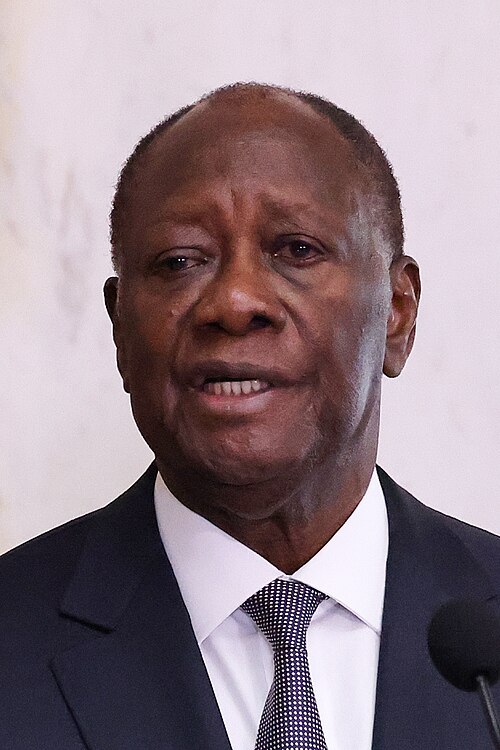
$70M
Estimated Net Worth
As of 2024 • high confidence
Financial Breakdown
Asset Distribution
Assets vs Liabilities
Assets
Disclaimer: These financial estimates are based on publicly available information and should be considered approximate. Last updated: 12/29/2025
Biography
Introduction: The Economist Turned Statesman
Alassane Dramane Ouattara, widely known as ADO, is a pivotal figure in modern Ivorian and West African history. Serving as the President of Côte d'Ivoire since 2011, his tenure marks a period of significant economic recovery and political stabilization following a decade of civil conflict. A former senior official at the International Monetary Fund (IMF), Ouattara brought a unique technocratic expertise to the Executive Presidency of Ivory Coast. His most notable achievement has been presiding over one of Africa's fastest-growing economies in the 2010s, transforming the nation's infrastructure and restoring its standing on the international stage. The journey of Alassane Ouattara, from an international economist to the leader of a nation once deeply divided, is a central narrative in the Politics & Government of post-colonial West Africa.
Early Life & Education: Foundations of a Technocrat
Alassane Ouattara was born on January 1, 1942, in Dimbokro, then part of French West Africa. He hails from the predominantly Muslim north, a background that would later become a point of political contention. His early education was robust, leading him to the Drexel Institute of Technology (now Drexel University) and later the University of Pennsylvania in the United States. It was here that he laid the groundwork for his future in economics, earning a Master's degree in 1967 and a Ph.D. in Economics in 1972. His doctoral dissertation focused on the financial policies of the West African Economic and Monetary Union, foreshadowing his lifelong engagement with regional economic structures.
These formative years in America equipped Alassane Ouattara with a strong command of macroeconomic theory and policy, shaping his worldview as a pragmatic economist. He began his professional career not in the volatile arena of Ivory Coast politics, but within the hallowed, data-driven halls of international finance. This educational and early professional path distinguished him from many of his political contemporaries, establishing his reputation as a brilliant technocrat long before he formally entered the political fray.
Career & Major Achievements: From IMF to the Presidency
International Financial Career
Ouattara's rise was first witnessed on the global stage. In 1968, he joined the International Monetary Fund (IMF) as an economist. His competence saw him rise rapidly, and by 1984 he was appointed as the Director of the African Department. His deep understanding of West African economies made him an invaluable resource. In a parallel and highly significant role, he served as the Governor of the Central Bank of West African States (BCEAO) from 1990 to 1993, managing the CFA franc currency for eight nations.
His first major foray into Ivorian Politics & Government came during a national crisis. In 1990, President Félix Houphouët-Boigny, facing economic turmoil and pressure for reform, appointed the internationally respected Alassane Ouattara as Prime Minister. In this role, he implemented stringent structural adjustment programs, stabilizing the economy but also attracting criticism for austerity measures. After Houphouët-Boigny's death in 1993, a contentious constitutional dispute over Ouattara's eligibility to run for president—centered on allegations about his nationality—initiated a period of political exclusion and rising north-south tensions that contributed to eventual civil war.
The Path to the Presidency and National Reconciliation
After a decade in political wilderness and a brief return to the IMF as Deputy Managing Director, Ouattara's moment arrived. The long-delayed 2010 presidential election pitted him against incumbent Laurent Gbagbo. When the Independent Electoral Commission declared Alassane Ouattara the winner, Gbagbo refused to concede, leading to a five-month violent stalemate that claimed over 3,000 lives. Ouattara was finally inaugurated as President of Côte d'Ivoire on April 11, 2011, following Gbagbo's arrest by pro-Ouattara forces backed by UN and French military intervention.
His achievements in office are substantial:
- Economic Resurgence: He leveraged his financial expertise to revive the Ivorian economy. Between 2012 and 2019, Côte d'Ivoire averaged over 8% GDP growth, becoming one of the world's fastest-growing economies. Major infrastructure projects, including highways, bridges, and the massive Henri Konan Bédié Bridge in Abidjan, were launched.
- Political Stabilization: Despite boycotts and tensions, his administration oversaw the gradual reintegration of the country. The 2015 election, which he won with nearly 84% of the vote, was a step toward normalization, though opposition challenges persisted.
- Social and Institutional Reforms: His government invested in education and health, and established institutions like the Commission Dialogue, Vérité et Réconciliation (CDVR) to address the wounds of the post-election crisis.
A deeply controversial chapter was his decision to run for a third term in 2020, arguing that a 2016 constitutional reset allowed him to start a new mandate count. His victory in that election, which was marred by opposition boycotts and unrest, secured his continued leadership but raised debates about democratic succession in the nation's Executive Presidency.
Personal Life & Legacy
Alassane Ouattara is married to Dominique Ouattara (née Folloroux), a prominent businesswoman and philanthropist known for her work in child welfare through her foundation. He is a father of two children from a previous marriage. Known for his reserved and disciplined demeanor, a legacy of his central banking days, he is often described as more comfortable with economic data than political rallying. His personal interests are private, but his public life is defined by a professorial approach to governance.
The legacy of Alassane Ouattara is complex and still unfolding. He will undoubtedly be remembered as the president who engineered Côte d'Ivoire's remarkable economic comeback, restoring its status as an economic powerhouse in Francophone West Africa. He stabilized a nation emerging from civil war and oversaw a period of significant urban development. However, his legacy is also intertwined with the contentious politics of identity and eligibility that fueled past conflicts, and his decision to seek a third term has sparked concerns about democratic consolidation. Historians will likely view him as the indispensable technocrat who brought fiscal stability but whose tenure also highlighted the enduring challenges of national unity and constitutional governance in Ivory Coast.
Net Worth & Business Ventures
While exact figures are not publicly verified and often subject to speculation, Alassane Ouattara is considered one of the wealthiest leaders in Africa. His substantial net worth is primarily attributed to his long and high-ranking career in international finance, notably his senior positions at the IMF and the BCEAO, which commanded significant international salaries and benefits for decades. Additionally, his marriage to Dominique Ouattara, who has interests in hospitality and other business sectors, contributes to the family's financial portfolio. Unlike some leaders, his wealth accumulation is largely viewed through the lens of a successful global technocratic career rather than domestic business empire-building, though the intersection of political power and family business interests has occasionally been a topic of discussion among observers of Ivorian Politics & Government.
This biography is compiled from publicly available information and credible news sources including the BBC, Reuters, African Development Bank reports, and IMF historical records. For the most current information, please refer to official government portals of Côte d'Ivoire.
Net Worth Analysis
Net Worth: $70 million
Quick Stats
Related People
Aaron Motsoaledi
LP; Minister of Home Affairs
Abane Ramdane†
FLN Leader & Strategist
Abdalla Hamdok
Ex-Prime Minister
Abdallah Kigoda
Ex-Minister of Natural Resources