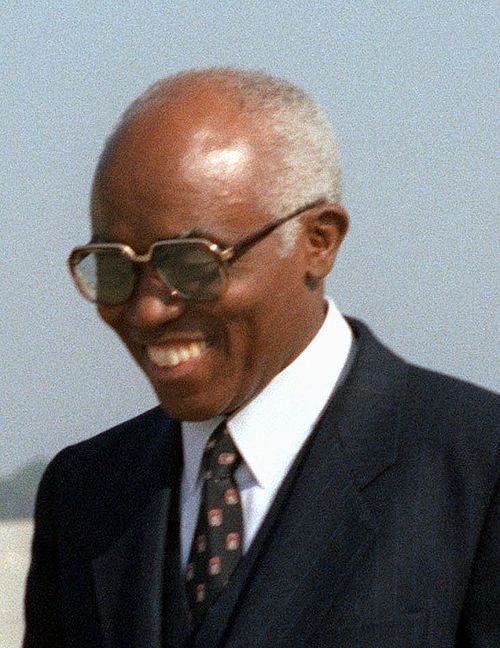
Biography
Introduction: The Founding Father
Aristides Maria Pereira (1923-2011) stands as a monumental figure in the history of Cape Verde and West Africa. He is best known as the nation's First President (1975-1991), a title he held for 16 formative years following independence from Portugal. A quiet yet resolute leader, Aristides Pereira† was instrumental in guiding the archipelago from the throes of colonial rule and a war for liberation to becoming a stable, sovereign nation. His key achievement lies in his foundational leadership alongside Prime Minister Pedro Pires, establishing the political and administrative institutions of the new republic and fostering a sense of unified Cape Verdean identity. His tenure in Politics & Government during the Independence Era set the course for the country's future democratic development and remains a cornerstone of its national story.
Early Life & Education: Forging a Technocrat
Aristides Pereira† was born on November 17, 1923, on the island of Boa Vista, in what was then the Portuguese colony of Cape Verde. His early life was shaped by the harsh realities of the São Vicente island, where his family moved, and the pervasive droughts and famines that plagued the archipelago. These experiences instilled in him a profound understanding of the struggles faced by his people. Unlike many revolutionary leaders of his time, Pereira's path was that of a skilled technician. He pursued a practical education in telecommunications, earning a diploma as a radio-telegraph technician. This technical background would later influence his meticulous and pragmatic approach to governance.
His formative political experiences began not in Cape Verde, but in Portuguese Guinea (now Guinea-Bissau), where he was posted for work in 1947. It was there, witnessing and experiencing the injustices of colonial rule alongside his compatriots, that his nationalist consciousness was fully awakened. In Bissau, he forged a crucial lifelong partnership with Amílcar Cabral, another Cape Verdean intellectual who would become the visionary theorist of the liberation movement. The discrimination faced by Cape Verdeans within the colonial system and the growing desire for self-determination were the catalysts that transformed the telecommunications engineer into a dedicated political organizer.
Career & Major Achievements: From Liberation to Leadership
The career of Aristides Pereira† is inextricably linked to the fight for freedom and the arduous task of nation-building. His major achievements can be divided into two pivotal phases: his role in the liberation struggle and his presidency.
The Liberation Struggle (1956-1974)
In 1956, Pereira co-founded the African Party for the Independence of Guinea and Cape Verde (PAIGC) alongside Amílcar Cabral. Serving as the party's Secretary-General, he was the organizational backbone of the movement. While Cabral was the charismatic frontman and military strategist, Pereira managed the party's clandestine networks, diplomacy, and internal administration, often operating from exile in Conakry, Guinea. His steady hand was critical after the assassination of Amílcar Cabral in 1973. Pereira assumed the leadership of the PAIGC, steering the party through this crisis and ensuring the continuation of the struggle, which culminated in Guinea-Bissau's independence in 1973 and paved the way for Cape Verde's own freedom.
Presidency and Nation-Building (1975-1991)
On July 5, 1975, Cape Verde achieved independence. The National Assembly unanimously elected Aristides Pereira† as the country's first President. Facing a nation with scant natural resources, widespread poverty, and a legacy of colonial neglect, his achievements were foundational:
- Institutional Foundation: He oversaw the creation of the new republic's constitution and state institutions, emphasizing legal and administrative order.
- Political Stability: In a region often marked by coups, Pereira maintained remarkable political stability for 16 years, establishing a tradition of peaceful governance.
- Non-Aligned Foreign Policy: He skillfully navigated the Cold War, securing development aid from both Eastern and Western blocs while avoiding becoming a proxy state.
- Facing the 1980s Crises: The rupture with Guinea-Bissau after the 1980 coup and severe droughts tested his leadership. He responded by transforming the PAIGC into the African Party for the Independence of Cape Verde (PAICV) and focusing on economic pragmatism.
- Transition to Multiparty Democracy: In a defining act of statesmanship, he acquiesced to constitutional reforms in 1990 that introduced a multiparty system. He stood in the first competitive presidential election in 1991 and, upon his defeat to António Mascarenhas Monteiro, peacefully transferred power, cementing Cape Verde's democratic credentials.
Personal Life, Legacy & Later Years
Known for his modest, austere, and discreet demeanor, Aristides Pereira† was often described as the "quiet president." This personality stood in contrast to the flamboyant styles of some contemporary African leaders. He was married to Carlina Pereira, and his personal integrity was never questioned, setting a standard for public conduct. After leaving office, he remained a respected elder statesman, offering counsel but never interfering in the political process. His later years were spent in reflection and writing.
The legacy of Aristides Pereira† is profound. He is revered as the father of the Cape Verdean nation. His greatest legacy is the stable and democratic state he helped create. By prioritizing institution-building over personal rule and accepting electoral defeat, he embedded democratic norms that have made Cape Verde a model of governance in Africa. The international airport on his native island of Boa Vista bears his name (Aristides Pereira International Airport), a fitting tribute to the man who connected his isolated islands to the world. He passed away on September 22, 2011, in Coimbra, Portugal, but is remembered as the essential founding father whose pragmatic stewardship turned the dream of independence into a functioning, resilient nation.
Net Worth & Business Ventures
Unlike many long-serving heads of state, Aristides Pereira† was not associated with personal wealth accumulation or private business ventures. His life before, during, and after the presidency was marked by a notable lack of ostentation. As a liberation movement leader and later as president of a poor, developing nation, his focus was squarely on public service and national development. There are no credible reports or estimates of a significant personal net worth attributed to him. His "wealth" was considered to be the respect he commanded and the stability he bequeathed to Cape Verde. This reputation for personal integrity and financial modesty remains a key part of his historical image, underscoring his dedication to the public good over personal gain throughout his career in Politics & Government.
Sources & Further Reading: For more information on the life of Aristides Pereira and the history of Cape Verde, credible resources include the Encyclopædia Britannica, academic publications on Lusophone African history, and the official documentation of the African Party for the Independence of Cape Verde (PAICV).
Frequently Asked Questions
What is Aristides Pereira†'s estimated net worth?
Aristides Pereira† has an estimated net worth of $500,000.
What is Aristides Pereira†'s role and nationality?
Aristides Pereira† is a First President (1975-1991) from Cape Verde.
How did Aristides Pereira† make their money?
Aristides Pereira† built their fortune primarily through Aristides Pereira was a political leader, not a business figure, and served as President of Cape Verde, a country with a modest economy; there are no credible reports of significant personal wealth, and he is not on any billionaire list..
How old is Aristides Pereira†?
Aristides Pereira† was born in 1923 (103 years old).
Which category is Aristides Pereira† listed under?
Aristides Pereira† is featured under the Politics & Government category on NetWorth Africa.
How is Aristides Pereira†'s net worth calculated?
NetWorth Africa estimates financial valuations using publicly available stock equity holdings, company ownership records, real estate assets, and verified market data.
Net Worth Analysis
Aristides Pereira was a political leader, not a business figure, and served as President of Cape Verde, a country with a modest economy; there are no credible reports of significant personal wealth, and he is not on any billionaire list.
Quick Stats
Related People
Aaron Motsoaledi
LP; Minister of Home Affairs • South Africa
Abane Ramdane†
FLN Leader & Strategist • Algeria
Abdalla Hamdok
Ex-Prime Minister • Sudan
Abdallah Kigoda
Ex-Minister of Natural Resources • Tanzania