Financial Breakdown
Asset Distribution
Assets vs Liabilities
Assets
Disclaimer: These financial estimates are based on publicly available information and should be considered approximate. Last updated: 12/30/2025
Biography
Introduction: The Conscience of a Nation
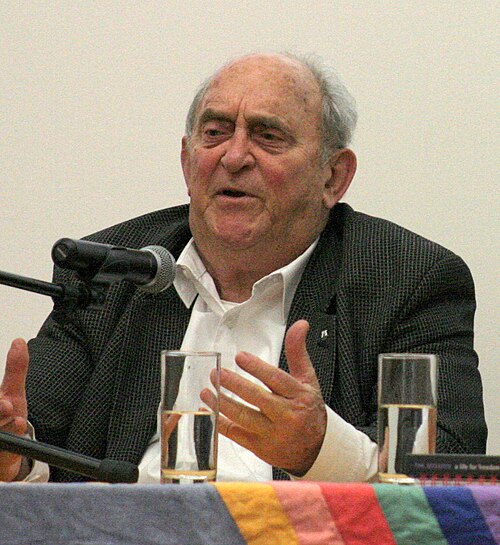
Denis Goldberg† stands as one of the most pivotal and unique figures in the struggle against apartheid in South Africa. A White ANC Activist of Jewish heritage, his life was a powerful testament to the principle that the fight for freedom transcends race. Born into relative privilege in a system designed to benefit people of his skin color, Goldberg chose instead to risk everything for a non-racial, democratic future. His key achievement was his unwavering commitment, which led him to become one of the most famous political prisoners of the apartheid era. As a key operative in the armed wing of the African National Congress (ANC), his arrest and subsequent life sentence at the historic Rivonia Trial alongside Nelson Mandela cemented his place in the annals of liberation history. Denis Goldberg's story is not just one of political activism, but of profound moral courage in the face of a brutal regime.
Early Life & Education: Forming a Conscience
Denis Theodore Goldberg was born on April 11, 1933, in Cape Town, South Africa, to a secular Jewish family with Lithuanian roots. His parents, Sam and Annie Goldberg, were working-class immigrants who instilled in him a strong sense of social justice and opposition to fascism, having fled persecution in Europe. This family background was a crucial early influence on his worldview.
Goldberg's political consciousness was awakened not in university lecture halls initially, but through direct experience. He studied civil engineering at the University of Cape Town, one of the few institutions offering a semblance of multi-racial contact at the time. It was here, and through his early work as a construction engineer, that he witnessed the stark, dehumanizing realities of apartheid firsthand. He saw the deliberate, state-engineered poverty of Black South Africans and the systemic violence of the regime. These experiences radicalized him. In 1957, at the age of 24, he joined the South African Communist Party (SACP) and soon after the African National Congress, recognizing that only a fundamental overthrow of the system could bring justice. His technical skills would later become invaluable to the liberation movement.
Career & Major Achievements: Engineer of the Revolution
Denis Goldberg's career as an activist was defined by strategic action and immense personal sacrifice. He quickly moved from participant to key organizer.
Underground Work and Operation Mayibuye
Following the Sharpeville Massacre in 1960 and the banning of the ANC and SACP, Goldberg went underground. He became a vital technical expert for uMkhonto we Sizwe (MK), the newly formed armed wing of the ANC. His engineering knowledge was directed towards developing non-electric explosive devices and other logistical needs for the sabotage campaign against government infrastructure. He worked closely with other Rivonia trialists like Walter Sisulu and Govan Mbeki at the movement's secret headquarters, Liliesleaf Farm in Rivonia. Here, he was deeply involved in discussions around Operation Mayibuye, a controversial plan for guerrilla warfare, though historical accounts debate the extent of his involvement in its formulation.
The Rivonia Trial and 22 Years in Prison
On July 11, 1963, police raided Liliesleaf Farm, arresting Goldberg and several other core leaders. This led to the infamous Rivonia Trial, which began in October 1963. Charged with four counts of sabotage and conspiracy to overthrow the government, Goldberg faced the death penalty. In a trial that captured world attention, he, along with Nelson Mandela, Walter Sisulu, and others, used the dock to articulate their vision for a free South Africa. On June 12, 1964, he was found guilty and sentenced to life imprisonment. A poignant moment echoed through the courtroom: as he was led down to the cells, he called out to his mother, "Life! Life is wonderful!" His words were a defiant message of hope.
As the only white male convicted in the Rivonia Trial, he was separated from his comrades and sent to Pretoria Central Prison instead of Robben Island. He endured 22 years of solitary confinement and harsh conditions, yet remained politically active, educating fellow prisoners and constantly campaigning for better treatment. His release on February 28, 1985, after intense international pressure, was a significant moment in the anti-apartheid movement.
Exile and Continued Struggle
Upon his release, Denis Goldberg was forced into exile. He relocated to London, where he became a tireless international spokesperson for the ANC. He served as the ANC's representative in London, a key figure in the British Anti-Apartheid Movement, and as a personal aide to ANC President Oliver Tambo. His work focused on lobbying foreign governments, raising funds, and ensuring the apartheid regime remained a pariah on the global stage. He played a crucial role in maintaining the momentum of the international solidarity movement throughout the 1980s.
Personal Life & Legacy: The Humanist
Denis Goldberg's personal life was profoundly shaped by his political commitments. He married Esmé Bodenstein in 1954, and they had two children, Hilary and David. His imprisonment placed an enormous strain on his family, a sacrifice shared by countless anti-apartheid activists. After his release and exile, his family joined him in London. Esmé passed away in 2000.
In his later years, Goldberg remained deeply engaged in humanitarian and cultural projects. Following his return to South Africa in 2002, he was critical of corruption within the post-apartheid government but never wavered in his support for the democratic project. His enduring legacy is multifaceted:
- Moral Beacon: He embodied the principle that fighting injustice is a universal duty, regardless of race.
- The Houtkamp Trust & Community Heart: He founded the Community Heart charity to support development projects in impoverished areas, focusing on education and arts.
- Promotion of Arts & Culture: He was a passionate advocate for the arts as a tool for social healing and development.
Denis Goldberg† passed away on April 29, 2020, in Cape Town, just after his 87th birthday. His death was met with an outpouring of tributes, recognizing him as a true hero of the liberation struggle. His life story continues to inspire new generations to stand up against racism and inequality.
Net Worth & Business Ventures
Denis Goldberg's life was not one measured by financial accumulation but by social capital and sacrifice. There is no public record or indication of significant personal wealth or business ventures in the traditional sense. His career as an engineer was cut short by his underground activism and subsequent imprisonment. During exile, he worked for the ANC, an organization reliant on donor funding. Any income or resources he accessed in his later years were primarily directed towards his charitable foundation, Community Heart. His "wealth" lay in his immense moral authority, his legacy as a freedom fighter, and the profound respect he commanded nationally and internationally. He lived modestly, dedicating his pension and any funds from book sales and speaking engagements to support the community projects he championed, truly embodying the ethos of a life in service to others.
For further reading on the life of Denis Goldberg and the Rivonia Trial, credible sources include the South African History Online archive, his autobiography "The Mission: A Life for Freedom in South Africa", and records from the Nelson Mandela Foundation.
Frequently Asked Questions
What is Denis Goldberg†'s estimated net worth?
Net worth details for Denis Goldberg† are currently being updated.
What is Denis Goldberg†'s role and nationality?
Denis Goldberg† is a White ANC Activist from South Africa.
How did Denis Goldberg† make their money?
Denis Goldberg† built their fortune primarily through Denis Goldberg was a political activist and life-long public servant, not a businessperson; he dedicated his life to the anti-apartheid struggle and lived modestly..
How old is Denis Goldberg†?
Denis Goldberg† was born in 1933 (93 years old).
Which category is Denis Goldberg† listed under?
Denis Goldberg† is featured under the Politics & Government category on NetWorth Africa.
How is Denis Goldberg†'s net worth calculated?
NetWorth Africa estimates financial valuations using publicly available stock equity holdings, company ownership records, real estate assets, and verified market data.
Net Worth Analysis
Denis Goldberg was a political activist and life-long public servant, not a businessperson; he dedicated his life to the anti-apartheid struggle and lived modestly.
Quick Stats
Related People

Aaron Motsoaledi
LP; Minister of Home Affairs • South Africa

Abane Ramdane†
FLN Leader & Strategist • Algeria

Abdalla Hamdok
Ex-Prime Minister • Sudan

Abdallah Kigoda
Ex-Minister of Natural Resources • Tanzania