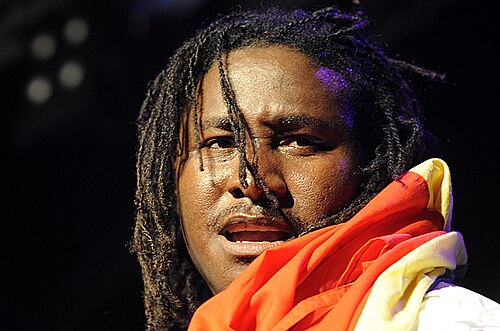
$2M
Estimated Net Worth
As of 2024 • medium confidence
Financial Breakdown
Asset Distribution
Assets vs Liabilities
Assets
Liabilities
Disclaimer: These financial estimates are based on publicly available information and should be considered approximate. Last updated: 12/31/2025
Biography
Introduction: The Voice of a Generation
In the vibrant landscape of global Entertainment, few figures have shaped a genre and a continent's consciousness as profoundly as Didier Awadi. Born in Dakar, Senegal, in 1969, Awadi is universally recognized as a foundational Hip Hop Pioneer in Africa. He rose to fame as the frontman of the groundbreaking group Positive Black Soul (PBS) in the early 1990s, becoming one of the first African rap acts to gain international acclaim. More than just a musician, Didier Awadi is a philosopher, historian, and activist who uses his art as a weapon for Pan-African unity, political awareness, and social justice. His key achievement lies in seamlessly blending traditional Senegalese sounds with hard-hitting hip-hop beats, all while delivering lyrics that educate and empower, cementing his status as a cultural icon and the moral compass of African rap.
Early Life & Education: The Roots of Revolution
Didier Awadi was born on 23 August 1969 in Dakar, the bustling capital of Senegal. Growing up in a post-independence Africa, he was immersed in a rich cultural and political environment. His formative years were influenced by the strong griot (traditional West African storyteller and historian) tradition of Senegal, as well as the burgeoning global hip-hop movement emanating from the United States. Artists like Public Enemy and their politically charged music had a particularly deep impact on the young Awadi, showing him the potential of rap as a tool for social commentary.
He pursued his education in Dakar, where his intellectual curiosity began to flourish. It was during his time at university that his passion for music and activism converged. In the late 1980s, alongside his friend and fellow musician Doug E. Tee (Doug E. Tidiane), Didier Awadi began to conceptualize a new musical project. They sought to create a sound that was authentically Senegalese yet globally relevant, a voice for the African youth. This vision would directly lead to the formation of Positive Black Soul in 1989, a group that would forever change the course of Senegal's Entertainment scene. His education, therefore, was not confined to the classroom; it was a synthesis of street knowledge, African history, and global black consciousness.
Career & Major Achievements: Building a Hip Hop Empire
The PBS Era and International Breakthrough
With Positive Black Soul, Didier Awadi achieved monumental success. The group's 1992 hit "Boul Falé" became an anthem across Francophone Africa. Their innovative fusion of mbalax rhythms with rap captivated audiences. PBS's major achievements include:
- Signing with the international label Island Records in the mid-1990s.
- Releasing the landmark album "Salaam" in 1995, which brought African hip-hop to a worldwide stage.
- Collaborating with international stars like MC Solaar and Sinead O'Connor.
- Performing at major venues globally, becoming the face of a new, confident African musical generation.
Solo Career and the "Presidents d'Afrique" Project
After PBS disbanded in the early 2000s, Didier Awadi embarked on a monumental solo career. He founded his own independent label, Studio Sankara, in Dakar, asserting artistic and economic control—a radical act in itself. His solo work deepened his political focus. His magnum opus is the "Presidents d'Afrique" series, a ambitious hip-hop project started in the 2000s that samples speeches of iconic African liberation leaders like Patrice Lumumba, Thomas Sankara, and Nelson Mandela, setting them to powerful music.
- Key Album: "Les Autres… Présidents d'Afrique" (2009) is a critically acclaimed double album from this project.
- Mission: The project aims to educate African youth about their history and inspire a new wave of Pan-African thought.
Impact and Recognition
The impact of Didier Awadi is immeasurable. He paved the way for every Francophone African rapper who followed. His influence extends beyond music:
- He is a sought-after speaker on African culture and politics at universities and global forums.
- His music is studied in academic circles for its lyrical content and social significance.
- He has nurtured countless young artists through his Studio Sankara, acting as a mentor and producer.
- He remains a constant voice for democracy and accountability in Senegal and across Africa, often engaging directly with political discourse.
Personal Life & Legacy: The Man Behind the Music
While fiercely protective of his private life, Didier Awadi is known to be a dedicated family man and a deeply intellectual individual. His personal interests are an extension of his public work: he is an avid reader of history and philosophy, constantly researching for his musical projects. His philanthropy is integrated into his art; he uses his platform and resources to support social causes, youth empowerment programs, and cultural preservation initiatives in Senegal.
The legacy of Didier Awadi is that of a pathfinder. He demonstrated that African hip-hop could be both commercially successful and intellectually rigorous. He redefined the role of the musician in society, proving that an artist can be a leader and an educator. His lasting impact is heard in the lyrics of a new generation of socially conscious rappers across the continent who see him as the standard-bearer. He transformed hip-hop from an imported American genre into a powerful, localized tool for African expression and liberation, ensuring his place as one of the most important figures in modern African Entertainment and cultural history.
Net Worth & Business Ventures: Independence as a Model
While the exact net worth of Didier Awadi is not publicly disclosed, his financial success is rooted in a philosophy of artistic and economic independence. His primary business venture is the founding and operation of Studio Sankara, his independent record label and production studio based in Dakar. This venture allows him full creative control and a direct revenue stream from his music, merchandise, and productions for other artists.
His income is diversified through:
- Music Sales & Streaming: Royalties from a vast catalog of albums spanning PBS and his solo career.
- Concert Tours: He is a major draw at festivals and concerts across Africa and Europe, commanding significant performance fees.
- Production Work: Leveraging Studio Sankara to produce for other artists.
- Speaking Engagements: His expertise commands fees at conferences and institutions.
This biography is compiled from reputable sources in music journalism and African cultural studies, including interviews, documentaries, and profiles from platforms like RFI Musique, Afropop Worldwide, and major news publications covering Senegalese and Pan-African arts.
Net Worth Analysis
As a pioneering but non-commercial Senegalese musician and activist, his wealth is not comparable to major business figures; estimates from African entertainment sources suggest a net worth in the low millions from his career.
Quick Stats
Related People
2Baba (Innocent Idibia)
Veteran Artist & Activist
Aar Maanta
Singer & Composer
Abdel Aziz al-Mubarak
Oud Master
Abdel Halim Hafez†
Legend; “Nightingale”; “The Dark-Skinned Nightingale”