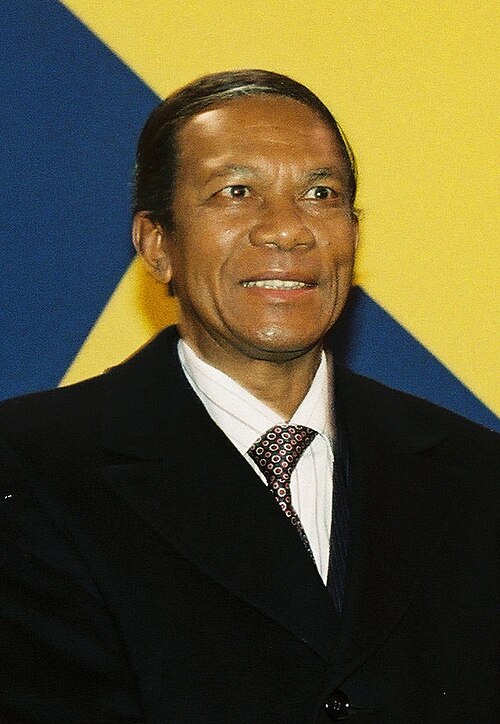
Financial Breakdown
Asset Distribution
Assets vs Liabilities
Assets
Liabilities
Disclaimer: These financial estimates are based on publicly available information and should be considered approximate. Last updated: 12/29/2025
Biography
Introduction: A Defining Figure in Malagasy Politics
Didier Ratsiraka† stands as one of the most pivotal and controversial figures in the modern history of Madagascar. Serving as the island nation's President for two non-consecutive periods—from 1975 to 1993 and again from 1997 to 2002—his tenure fundamentally shaped the country's political, economic, and social trajectory for decades. A former naval officer, Ratsiraka rose to power in the turbulent post-colonial era and swiftly implemented a radical socialist revolution, earning him the nickname the "Red Admiral." His key achievement was the establishment of the Democratic Republic of Madagascar in 1975, orienting the country firmly towards the Soviet bloc and implementing policies of nationalization and collectivization. His legacy is a complex tapestry of early nationalist fervor, severe economic decline, and a lasting impact on the structure of Malagasy Politics & Government.
Early Life & Education: From Coastal Village to the French Navy
Didier Ratsiraka was born on November 4, 1936, in Vatomandry, a town on the eastern coast of Madagascar, then a French colony. He belonged to the Betsimisaraka ethnic group, one of the island's largest. His early life was marked by the dual influences of Malagasy culture and French colonial administration. Demonstrating academic promise, he pursued his secondary education at the prestigious Lycée Henri-IV in Paris. His aptitude in sciences led him to the French Naval Academy in Lanvéoc-Poulmic, Brittany, and later to the École d'Application des Corps Combattants.
This military education was a formative experience, shaping his disciplined and authoritative leadership style. He served as a naval officer in the French navy, including postings during the Franco-Algerian War. This experience provided him with a unique perspective on military strategy and geopolitics, setting him apart from other Malagasy politicians of his generation. His rise within the military establishment of the newly independent Madagascar was rapid; by 1970, he had become the country's Minister of Foreign Affairs, where he began to articulate a more independent and non-aligned foreign policy stance, foreshadowing his later revolutionary turn.
Career & Major Achievements: Revolution, Decline, and Return
The Socialist Revolution (1975-1993)
Didier Ratsiraka's ascent to supreme power followed a period of political instability. In June 1975, he was appointed President by the military directorate. He quickly moved to consolidate authority through a national referendum in December 1975, which approved a new constitution and his presidency with over 96% of the vote. This marked the birth of the Democratic Republic of Madagascar and the official launch of the "Socialist Era". Ratsiraka's ideology, outlined in his "Red Book" (Boky Mena), was a blend of Marxism-Leninism, traditional Malagasy values, and Catholic social doctrine, known as "Ratsirakism".
His major policies during this period included:
- Nationalization: Key industries, banks, and services were brought under state control.
- Agricultural Collectivization: An attempt to reorganize rural production into cooperatives.
- Alignment with the Eastern Bloc: Forging close ties with the USSR, North Korea, and Libya, while distancing from France and the West.
- Promotion of Malagasy Language: A move to decolonize culture and education.
The Second Presidency and Controversial Exit (1997-2002)
After a period in the political wilderness, Didier Ratsiraka made a remarkable comeback, winning the 1996 presidential election and returning to power in 1997. His second term was markedly different, characterized by a embrace of neoliberal economic reforms and privatization under the guidance of the IMF and World Bank. Despite this shift, his rule was plagued by allegations of corruption and growing political polarization.
The climax of his career came with the 2001 presidential election. Facing a strong challenge from Marc Ravalomanana, the results were fiercely disputed. Both men declared victory and inaugurated themselves as president, leading to a devastating eight-month political crisis that split the country geographically and brought the economy to a standstill. After violent confrontations and a loss of international support, Ratsiraka fled Madagascar in July 2002, going into exile in France. He returned in 2011 but never regained political power, remaining a symbolic figure of a past era.
Personal Life, Legacy, and Lasting Impact
Outside of politics, Didier Ratsiraka was known as a family man and a devout Catholic. His personal interests were shaped by his naval background; he was an avid reader of history and military strategy. In his later years, he presented himself as an elder statesman, though he faced legal challenges, including a conviction in absentia for embezzlement (later overturned).
The legacy of Didier Ratsiraka is profoundly dualistic. On one hand, he is remembered as a fierce nationalist who sought to assert Madagascar's sovereignty and cultural identity on the world stage, breaking from the Francophone sphere. On the other, his economic mismanagement is widely blamed for plunging the country into decades of poverty, and his final act—the contested 2001 election—institutionalized a pattern of political crisis in Malagasy Politics & Government. He fundamentally shaped the nation's institutions, its foreign policy alignments, and its political discourse. The infrastructure projects initiated during his rule, often with Eastern bloc support, remain part of Madagascar's landscape, as do the scars of economic decline and political division.
Net Worth & Business Ventures
Assessing the net worth of Didier Ratsiraka is challenging due to the opaque nature of finances during his rule and the allegations of corruption that followed. During his presidencies, especially the first, the state-controlled economy meant that personal wealth was often intertwined with control of public resources. Following his ouster in 2002, the new government accused him and his inner circle of siphoning state funds, alleging that tens of millions of dollars were transferred overseas. His assets in Madagascar were subject to seizure, and international warrants were issued. While in exile, he lived comfortably in France, but the exact extent of his personal fortune remained undisclosed. Unlike some leaders, he was not widely known for owning large, identifiable international business ventures; his economic power was derived primarily from his political position within the structure of the Malagasy state during his time in office.
Sources: Encyclopædia Britannica, BBC News profiles, African Biographics, and historical records of Malagasy political history. For further reading, credible sources can be found via Encyclopædia Britannica and BBC News archives.
Frequently Asked Questions
What is Didier Ratsiraka†'s estimated net worth?
Net worth details for Didier Ratsiraka† are currently being updated.
What is Didier Ratsiraka†'s role and nationality?
Didier Ratsiraka† is a Ex-President (1975-1993; 1997-2002) from Madagascar.
How did Didier Ratsiraka† make their money?
Didier Ratsiraka† built their fortune primarily through Didier Ratsiraka was a former president with no credible public reports of significant personal wealth; his legacy is tied to political power, not business fortune..
How old is Didier Ratsiraka†?
Didier Ratsiraka† was born in 1936 (90 years old).
Which category is Didier Ratsiraka† listed under?
Didier Ratsiraka† is featured under the Politics & Government category on NetWorth Africa.
How is Didier Ratsiraka†'s net worth calculated?
NetWorth Africa estimates financial valuations using publicly available stock equity holdings, company ownership records, real estate assets, and verified market data.
Net Worth Analysis
Didier Ratsiraka was a former president with no credible public reports of significant personal wealth; his legacy is tied to political power, not business fortune.
Quick Stats
Related People
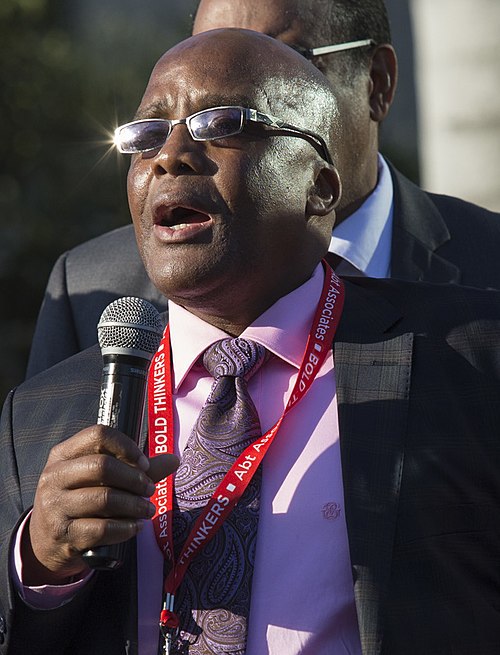
Aaron Motsoaledi
LP; Minister of Home Affairs • South Africa
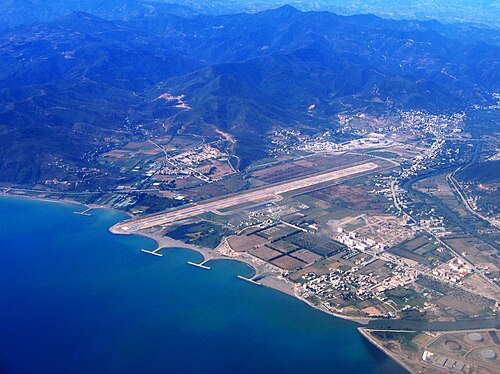
Abane Ramdane†
FLN Leader & Strategist • Algeria
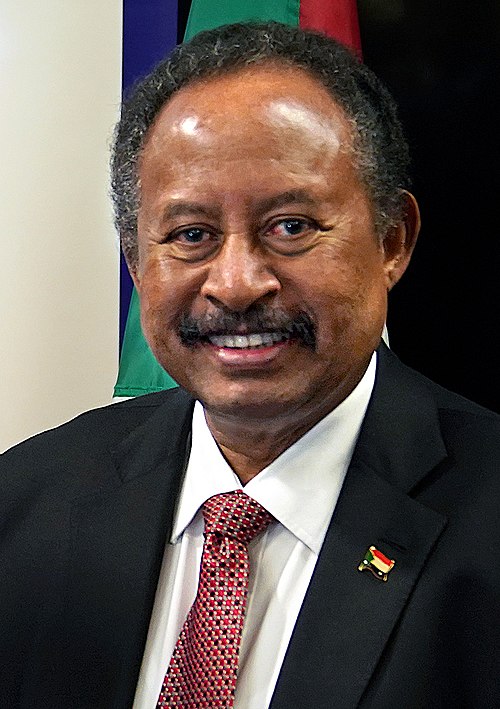
Abdalla Hamdok
Ex-Prime Minister • Sudan
Abdallah Kigoda
Ex-Minister of Natural Resources • Tanzania