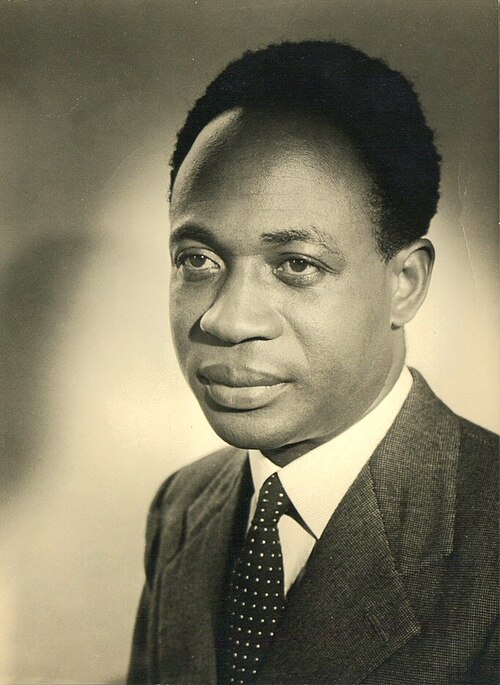
Biography
Introduction: The Architect of Ghana's Independence
Dr. Kwame Nkrumah† stands as a colossus in the annals of African history, revered as the First President of the Republic of Ghana and its founding father. His life's work was dedicated to the liberation and unification of the African continent, making him one of the most influential figures in the 20th-century Politics & Government landscape. As the leader who spearheaded Ghana's independence from British colonial rule on March 6, 1957, Nkrumah transformed the Gold Coast into the first sub-Saharan African nation to achieve sovereignty in the post-colonial era. His famous declaration, "The independence of Ghana is meaningless unless it is linked up with the total liberation of the African continent," encapsulates his visionary Pan-Africanism. This biography explores the journey of the man who became a symbol of hope and a beacon for anti-colonial movements across Africa and the diaspora.
Early Life & Education: The Making of a Revolutionary
Kwame Nkrumah was born on September 21, 1909, in Nkroful, in the southwestern region of the Gold Coast (now Ghana). His early education at Catholic mission schools revealed a sharp intellect, leading him to train as a teacher in Accra. A pivotal moment came in 1935 when he sailed to the United States for higher education, a journey that would shape his political consciousness. Over the next decade, Nkrumah earned multiple degrees, including a Bachelor of Arts in Economics and Sociology from Lincoln University and a Master of Science in Education and a Master of Arts in Philosophy from the University of Pennsylvania.
It was during these formative years in America, amidst the Great Depression and the rise of Black political thought, that Nkrumah immersed himself in the works of Marcus Garvey, W.E.B. Du Bois, and Karl Marx. He organized among African students and diasporic communities, honing his skills as an orator and activist. In 1945, he moved to London to study law and immediately plunged into the radical Pan-African scene. He served as a key organizer of the seminal Fifth Pan-African Congress in Manchester, collaborating with giants like George Padmore and W.E.B. Du Bois. This period cemented his resolve: the total liberation and unity of Africa were not just ideals but achievable political goals.
Career & Major Achievements: From Activist to Head of State
Returning to the Gold Coast in 1947, Dr. Kwame Nkrumah† was invited to serve as General Secretary of the United Gold Coast Convention (UGCC). His mass mobilization tactics quickly galvanized the populace, leading to his imprisonment by colonial authorities in 1948. Undeterred, he broke from the UGCC in 1949 to found the more radical Convention People's Party (CPP), with the powerful slogan "Self-Government Now." Through the CPP's campaign of "Positive Action"—a blend of non-violent protests, strikes, and political agitation—Nkrumah applied immense pressure on the British. This strategy proved successful, leading to elections that saw the CPP win a landslide victory. While still in prison, Nkrumah was elected to parliament and was released to become Leader of Government Business, and later, Prime Minister in 1952.
The Path to Independence and Presidential Leadership
On that historic midnight of March 6, 1957, Dr. Kwame Nkrumah† proclaimed Ghana's independence to a jubilant crowd in Accra. As the new nation's Prime Minister, he embarked on an ambitious program of modernization and socialist-oriented development. In 1960, Ghana became a republic, and Nkrumah was elected its First President; WR (with overwhelming republican support). His administration achieved remarkable feats:
- Industrialization & Infrastructure: Massive projects like the Akosombo Dam (creating Lake Volta), the Tema Harbour, and new roads, schools, and hospitals were launched to propel economic self-sufficiency.
- Social Investment: Free primary education was introduced, and the University of Ghana, Legon, was expanded. The Ghana Education Trust built numerous teacher training colleges and secondary schools.
- Pan-African Leadership: Nkrumah used Ghana's resources to support liberation movements across Africa. He hosted the All-African People's Conference in 1958 and was a founding father of the Organization of African Unity (OAU) in 1963, tirelessly advocating for a continental union government.
- Non-Aligned Stance: He became a prominent leader in the Non-Aligned Movement, navigating the Cold War by seeking support from both Eastern and Western blocs for Ghana's development.
Challenges and Overthrow
Despite these achievements, Nkrumah's later years in power were marked by growing challenges. Economic difficulties, coupled with his government's increasing authoritarian tendencies—such as the Preventive Detention Act of 1958 and the declaration of a one-party state in 1964—eroded his popular support. While on a state visit to North Vietnam and China in February 1966, his government was overthrown by a military coup. Dr. Kwame Nkrumah† spent his remaining years in exile in Guinea, where President Sékou Touré made him honorary co-president. He continued to write and theorize about African unity until his death from cancer in Bucharest, Romania, on April 27, 1972.
Personal Life, Legacy & Lasting Impact
While intensely dedicated to his political mission, Dr. Kwame Nkrumah† was a private man. He married an Egyptian Coptic librarian, Fathia Rizk, in 1957, and they had three children. His personal interests were largely intellectual, centered on reading, writing, and philosophical discourse. He authored several key books on colonialism and African unity, including "Africa Must Unite" and "Neo-Colonialism: The Last Stage of Imperialism."
Nkrumah's legacy is profound and multifaceted. In Ghana, he is officially celebrated as the nation's founder, with his birthday (September 21) commemorated as Founders' Day. His visage is on the currency, and his memorial park and mausoleum in Accra are national landmarks. Globally, he is remembered as the foremost advocate of Pan-Africanism, whose ideas inspired generations of leaders from Nelson Mandela to Thomas Sankara. His warnings about neo-colonialism—the continued economic and political exploitation of independent nations—remain critically relevant. Despite the controversies of his later rule, Dr. Kwame Nkrumah† ignited a flame of political independence that spread across Africa, forever changing the continent's destiny.
Financial Context and Posthumous Recognition
Discussing the net worth of a revolutionary figure like Dr. Kwame Nkrumah† is complex and diverges from traditional business metrics. His life was not dedicated to personal wealth accumulation but to national and continental development. As Prime Minister and President, his official salary and state provisions supported his lifestyle. The significant financial resources of the state were channeled into public projects and, controversially, into supporting liberation movements and Pan-African institutions, which he viewed as investments in Africa's future.
Upon his overthrow, his assets were seized by the new government, and he lived modestly in exile. His true "wealth" lies in the enduring infrastructure and ideological foundation he bequeathed to Ghana and Africa. Today, his name and image carry immense symbolic value, representing the struggle for sovereignty and unity. Institutions like the Kwame Nkrumah University of Science and Technology (KNUST) and countless streets, squares, and awards across Africa bear his name, a testament to a legacy that transcends material valuation. His writings continue to be seminal texts, studied worldwide, ensuring his intellectual contributions remain a permanent part of the global discourse on freedom and development.
Sources and further reading on the life of Dr. Kwame Nkrumah† can be found through reputable historical archives, including the Encyclopædia Britannica, the Official Kwame Nkrumah Memorial Park & Mausoleum, and academic publications from the University of Ghana and other institutions of African studies.
Frequently Asked Questions
What is Dr. Kwame Nkrumah†'s estimated net worth?
Net worth details for Dr. Kwame Nkrumah† are currently being updated.
What is Dr. Kwame Nkrumah†'s role and nationality?
Dr. Kwame Nkrumah† is a First President; WR from Ghana.
How did Dr. Kwame Nkrumah† make their money?
Dr. Kwame Nkrumah† built their fortune primarily through Dr. Kwame Nkrumah, the first President of Ghana, died in 1972. His legacy is political and historical, not financial, and he was not a business figure with a contemporary net worth..
How old is Dr. Kwame Nkrumah†?
Dr. Kwame Nkrumah† was born in 1909 (117 years old).
Which category is Dr. Kwame Nkrumah† listed under?
Dr. Kwame Nkrumah† is featured under the Politics & Government category on NetWorth Africa.
How is Dr. Kwame Nkrumah†'s net worth calculated?
NetWorth Africa estimates financial valuations using publicly available stock equity holdings, company ownership records, real estate assets, and verified market data.
Net Worth Analysis
Dr. Kwame Nkrumah, the first President of Ghana, died in 1972. His legacy is political and historical, not financial, and he was not a business figure with a contemporary net worth.
Quick Stats
Related People
Aaron Motsoaledi
LP; Minister of Home Affairs • South Africa
Abane Ramdane†
FLN Leader & Strategist • Algeria
Abdalla Hamdok
Ex-Prime Minister • Sudan
Abdallah Kigoda
Ex-Minister of Natural Resources • Tanzania