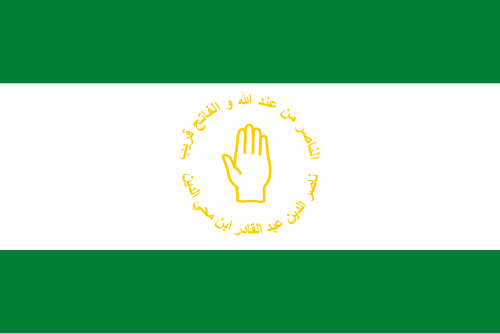
Biography
Introduction: The Lion of the Desert
Emir Abdelkader† (1808-1883) stands as the towering figure of early Algerian resistance and a foundational symbol of the modern Algerian nation. Recognized globally as a National Hero & Resistance Leader, he led a formidable 15-year struggle against the French colonial invasion beginning in 1830. More than just a military commander, Emir Abdelkader† was a statesman, scholar, and Sufi mystic who established a sophisticated, proto-state in the interior of Algeria. His significance transcends the battlefield; he is revered for his chivalry, intellectual depth, and unwavering commitment to justice and religious tolerance. His legacy is a complex tapestry woven from military defiance, political innovation, and profound humanitarian principles, securing his place as one of the 19th century's most remarkable leaders in the Politics & Government sphere of the Muslim world and beyond.
Early Life & Education: Forging a Leader
Born on September 6, 1808, near the town of Mascara in what was then the Ottoman Regency of Algiers, Emir Abdelkader† was born into a respected religious family. His father, Muhyi al-Din al-Hasani, was a sheikh of the Qadiri Sufi order and claimed descent from the Prophet Muhammad. This lineage imbued the young Abdelkader with both spiritual authority and social standing. His early education was traditional and rigorous, focusing on the core Islamic sciences:
- Theology (Ilm al-Kalam) and Islamic Jurisprudence (Fiqh)
- Memorization of the Quran, becoming a Hafiz at a young age
- Arabic grammar, rhetoric, and poetry
- Philosophy, history, and mathematics
Beyond formal study, a formative experience was the Hajj (pilgrimage to Mecca) he undertook with his father in 1825. The journey, which lasted two years, exposed him to the broader intellectual and political currents of the Arab world. He traveled through Egypt, witnessing the modernizing reforms of Muhammad Ali Pasha, and engaged with scholars in the Hejaz. These experiences broadened his perspective beyond his tribal origins, preparing him for the monumental role he would soon assume upon his return to an Algeria in crisis following the French capture of Algiers in 1830.
Career & Major Achievements: The Resistance and the State
The French invasion created a power vacuum and widespread disarray. In 1832, tribes in the region of Oran elected the 24-year-old Emir Abdelkader† as their leader (Emir), drawn to his religious credibility and unifying potential. Thus began his epic career as a Resistance Leader.
Military Resistance and Guerrilla Warfare
Facing a superior European army, Emir Abdelkader† mastered the tactics of guerrilla warfare. He organized a mobile, highly disciplined cavalry force that could strike French supply lines and outposts before melting into the countryside. His most significant military victories, such as the Battle of Macta in 1835, stunned the French and galvanized Algerian support. Despite eventual setbacks due to the French "scorched earth" tactics under General Thomas Bugeaud, his military campaign from 1832 to 1847 remains a cornerstone of Algerian national identity.
Building the Emirate: A State in Wartime
His greatest achievement was arguably administrative. Between 1834 and 1838, he consolidated power and created a functional Islamic state, or Emirate. This was a monumental feat in the Resistance Era. Key structures of his state included:
- A Centralized Administration: He divided his territory into eight khalifas (provinces), each governed by a loyal deputy.
- A Professional Army: Moving beyond tribal levies, he created a standing army of approximately 2,000 infantry and 8,000 cavalry, with arsenals and textile factories for uniforms.
- Economic Independence: He established a treasury (bait al-mal), levied taxes, and minted his own currency to fund the state.
- Justice and Education: He instituted Islamic courts and founded schools and libraries, emphasizing his role as a scholar-king.
This state-building demonstrated that his vision extended beyond mere rebellion to sovereign governance.
The Humanitarian and International Figure
After his surrender in 1847, broken by a French promise of exile in the East, he was instead imprisoned in France for five years. His release came after he famously intervened to save the lives of thousands of Christians during the 1860 sectarian violence in Damascus. Leading his Algerian companions, he provided sanctuary in his own home and negotiated safe passage for over 12,000 people, including the French consul and many Christian clergy. This act earned him international acclaim, medals from France and the Vatican, and praise from figures like Abraham Lincoln. It cemented his legacy as a global symbol of religious tolerance and chivalry.
Personal Life & Legacy: The Enduring Spirit
Despite the pressures of war and statecraft, Emir Abdelkader† remained deeply committed to his spiritual life as a Qadiri Sufi. He wrote extensively on philosophy, religion, and poetry, viewing his political and military struggles through a lens of spiritual jihad. In captivity, his faith provided solace and intellectual freedom. After his release from French prison and his move to Damascus in 1855, he devoted himself to scholarship and teaching until his death on May 26, 1883.
His legacy is profound and multi-faceted. In Algeria, he is the undisputed father of the nation, whose resistance prefigured and inspired the eventual war of independence (1954-1962). His remains were repatriated to Algeria in 1966 and interred in a grand mausoleum. Globally, he is remembered as a bridge between civilizations—a Muslim leader who defended Christians, a warrior who was also a man of peace and letters. His life is studied as a model of principled resistance, ethical leadership, and interfaith dialogue. The Emir Abdelkader† narrative is central to Algeria's historical consciousness in the Politics & Government domain, representing the first great assertion of Algerian sovereignty in the modern era.
Net Worth & Historical Context of Wealth
Assessing the net worth of a 19th-century figure like Emir Abdelkader† in modern terms is challenging and anachronistic. His wealth was not personal but intrinsically tied to his role as Emir and the treasury of the state he led. During the height of his Emirate (1834-1838), he controlled significant resources derived from:
- Agricultural Taxes (Zakat and Ushr): Levied on the productive lands under his control.
- Customs Duties: Collected on trade passing through his territories.
- Treasury of the State (Bait al-Mal): This fund financed the army, administration, and public works.
Following his surrender and imprisonment, his personal wealth was effectively confiscated. The French government later granted him a pension. In his later years in Damascus, he lived a life of modest comfort supported by this pension and gifts from admirers, focusing on scholarship rather than material accumulation. His true "wealth" lies in his enduring legacy as a symbol of national identity, resistance, and humanitarian virtue, which holds immeasurable value for Algeria and the world.
Further reading on the life of Emir Abdelkader† can be found through reputable historical sources and academic publications focusing on Algerian history and 19th-century colonial resistance.
Frequently Asked Questions
What is Emir Abdelkader†'s estimated net worth?
Net worth details for Emir Abdelkader† are currently being updated.
What is Emir Abdelkader†'s role and nationality?
Emir Abdelkader† is a National Hero & Resistance Leader from Algeria.
How did Emir Abdelkader† make their money?
Emir Abdelkader† built their fortune primarily through Emir Abdelkader was a 19th-century religious and military leader, not a contemporary figure with a measurable financial net worth in the modern sense..
How old is Emir Abdelkader†?
Emir Abdelkader† was born in 1808 (218 years old).
Which category is Emir Abdelkader† listed under?
Emir Abdelkader† is featured under the Politics & Government category on NetWorth Africa.
How is Emir Abdelkader†'s net worth calculated?
NetWorth Africa estimates financial valuations using publicly available stock equity holdings, company ownership records, real estate assets, and verified market data.
Net Worth Analysis
Emir Abdelkader was a 19th-century religious and military leader, not a contemporary figure with a measurable financial net worth in the modern sense.
Quick Stats
Related People
Aaron Motsoaledi
LP; Minister of Home Affairs • South Africa
Abane Ramdane†
FLN Leader & Strategist • Algeria
Abdalla Hamdok
Ex-Prime Minister • Sudan
Abdallah Kigoda
Ex-Minister of Natural Resources • Tanzania