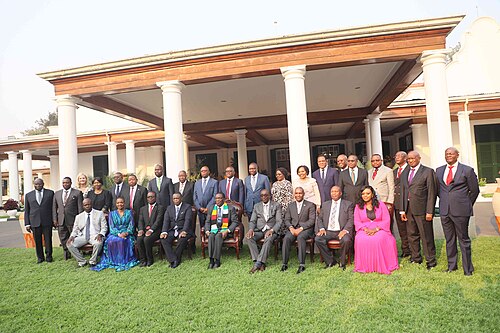
$90M
Estimated Net Worth
As of 2024 • medium confidence
Financial Breakdown
Asset Distribution
Assets vs Liabilities
Assets
Disclaimer: These financial estimates are based on publicly available information and should be considered approximate. Last updated: 12/29/2025
Biography
Introduction: The "Crocodile" of Zimbabwean Politics
Emmerson Dambudzo Mnangagwa is a central and enduring figure in the Politics & Government of Zimbabwe, serving as the nation's third President of Zimbabwe since November 2017. His rise to the executive presidency marked a significant political transition, ending the nearly four-decade rule of Robert Mugabe. Known by his nom de guerre "Ngwena" (The Crocodile), a symbol of shrewdness and resilience in Zimbabwean lore, Emmerson Mnangagwa's career spans the entirety of Zimbabwe's post-colonial history. A key achievement of his presidency has been the push for a "Zimbabwe is Open for Business" agenda, aiming to attract foreign investment and stabilize the country's struggling economy after years of international isolation. His tenure, however, remains a subject of intense debate, balancing promises of reform against persistent challenges in governance, human rights, and economic performance.
Early Life, Education, and Formative Struggle
Emmerson Mnangagwa was born on September 15, 1942, in the Zvishavane district of Southern Rhodesia (now Zimbabwe). His early life was steeped in the anti-colonial struggle. At the age of 15, his family relocated to Northern Rhodesia (Zambia), where his political consciousness was awakened. He received his secondary education at Hodgson Technical College in Lusaka and later at the renowned Munali Secondary School. It was during this period that he became actively involved in nationalist politics, joining the Zimbabwe African People's Union (ZAPU).
In 1963, Emmerson Mnangagwa underwent military training in Egypt and China, aligning himself with the Zimbabwe African National Union (ZANU). Upon returning to Rhodesia in 1965 to fight in the liberation war, he was captured, tortured, and sentenced to death by the colonial government. He avoided execution due to being under the age of 21 and instead endured a decade of imprisonment at the notorious Salisbury Maximum Security Prison (now Harare Central Prison). It was here he forged a close, lifelong alliance with fellow inmate Robert Mugabe. After his release in 1975, he continued his education abroad, earning a Bachelor of Laws from the University of London and a Master of Laws from the University of Zambia, credentials that would underpin his future political and legal authority.
Career & Major Achievements: From Security Chief to President
The political career of Emmerson Mnangagwa is a chronicle of accumulating power within the ZANU-PF party and the state apparatus. Following Zimbabwe's independence in 1980, he held a series of critical security and ministerial roles:
- Minister of State for Security (1980-1988): In this pivotal role, Mnangagwa oversaw the country's intelligence services during the Gukurahundi conflict, a period for which he has faced significant criticism and allegations of involvement in human rights abuses.
- Minister of Justice, Legal and Parliamentary Affairs (1989-2000): He played a key role in shaping Zimbabwe's legal framework and was instrumental in the controversial land reform program initiated in 2000.
- Speaker of Parliament (2000-2005) and Minister of Rural Housing (2005-2009): He navigated the turbulent political landscape of the 2000s, maintaining his position as a key Mugabe loyalist.
- Minister of Defense (2009-2013) and First Vice President (2014-2017): His appointment as Vice President solidified his status as Mugabe's presumed successor, a position that ultimately led to his dismissal in November 2017, triggering a military intervention.
The 2017 Transition and Presidency
Mnangagwa's dismissal, seen as an effort to clear a path for Mugabe's wife, Grace, to succeed him, catalyzed a seismic shift. With military backing, Emmerson Mnangagwa returned from brief exile, and Mugabe resigned under pressure. On November 24, 2017, Mnangagwa was inaugurated as President of Zimbabwe. His major stated achievements and initiatives include:
- "Zimbabwe is Open for Business": A flagship policy aimed at reversing economic isolation, re-engaging with international financial institutions, and attracting foreign direct investment.
- Political Transition: Successfully overseeing the first transfer of power in independent Zimbabwe, albeit within ZANU-PF, and winning a disputed general election in 2018.
- Infrastructure Projects: Pursuing various high-visibility projects, including the expansion of the Robert Gabriel Mugabe International Airport and the construction of the new Parliament building in Mount Hampden.
- Anti-Corruption Drive: Launching a high-profile anti-corruption commission, though critics argue it has been used selectively against political opponents.
Despite these efforts, his presidency has been challenged by persistent hyperinflation, currency instability, high unemployment, and allegations of authoritarian practices, including the suppression of political opposition and civil society.
Personal Life, Philanthropy, and Legacy
Emmerson Mnangagwa is a private family man, married to Auxillia Mnangagwa, the First Lady of Zimbabwe, who is active in philanthropic work through her Angel of Hope Foundation focusing on health and women's issues. He has several children. A survivor of a 2018 assassination attempt at a political rally in Bulawayo, the event underscored the volatile nature of Zimbabwen politics. His personal interests are rarely publicized, with his public image being almost entirely defined by his political persona.
The legacy of Emmerson Mnangagwa is still being written. Supporters view him as a pragmatic leader steering a difficult economic recovery and a necessary break from the Mugabe era. Detractors see continuity in the style of governance, citing human rights concerns and economic management. His lasting impact will likely be judged on his ability to deliver tangible economic improvement for ordinary Zimbabweans and to foster a genuinely more open and democratic political environment. His role in both the early independence period and the post-2017 era ensures he will remain a defining figure in the nation's history.
Net Worth and Business Interests
While no official figure exists, Emmerson Mnangagwa is widely considered to be one of the wealthiest individuals in Zimbabwe. His net worth is speculated to be in the hundreds of millions of dollars, accrued over decades at the apex of political power. His business interests and those of his family are believed to be extensive, spanning sectors such as mining, agriculture, and transportation. These holdings are often opaque, linked to a complex network of state contracts and private enterprises. The Mnangagwa family's substantial wealth stands in stark contrast to the widespread poverty in the country, fueling criticism and allegations of state capture and crony capitalism. Transparency regarding presidential assets and business dealings remains a significant public issue in Zimbabwean Politics & Government.
This biography of Emmerson Mnangagwa is compiled from publicly available information and reports from credible international news and historical sources covering Zimbabwe and its political landscape.
Net Worth Analysis
Emmerson Mnangagwa (Zimbabwe) Net Worth: $90 million
Quick Stats
Related People
Aaron Motsoaledi
LP; Minister of Home Affairs
Abane Ramdane†
FLN Leader & Strategist
Abdalla Hamdok
Ex-Prime Minister
Abdallah Kigoda
Ex-Minister of Natural Resources