$5M
Estimated Net Worth
As of 2024 • medium confidence
Financial Breakdown
Asset Distribution
Assets vs Liabilities
Assets
Disclaimer: These financial estimates are based on publicly available information and should be considered approximate. Last updated: 12/29/2025
Biography
Introduction: The Mathematician Turned Statesman
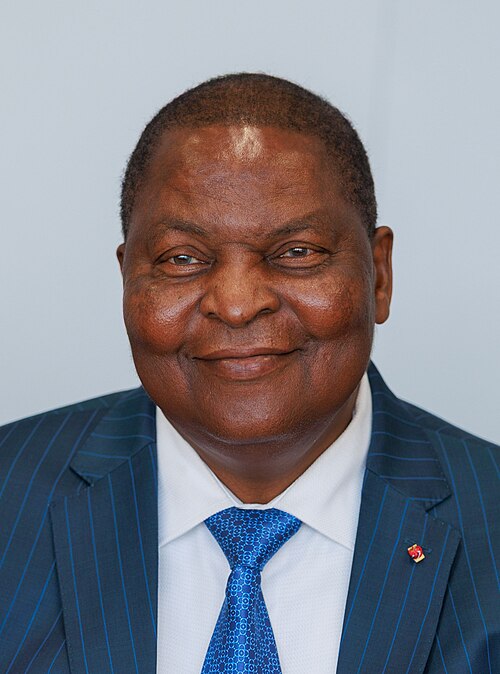
Faustin-Archange Touadéra is a prominent figure in Politics & Government of the Central African Republic (CAR), serving as the nation's President since March 2016. His rise to the highest office is a unique narrative of transition from academia to executive leadership. A former mathematics professor and university rector, Faustin-Archange Touadéra first entered high-level politics as Prime Minister under President François Bozizé from 2008 to 2013. His key achievement lies in navigating the CAR's complex and fragile political landscape, marked by persistent sectarian conflict and instability. Winning a democratic election in 2016 and securing re-election in 2020, President Touadéra's tenure has been defined by efforts to broker peace with armed groups, strengthen state authority with international support, and oversee a contentious but strategic security partnership with the Russian Wagner Group. His leadership continues to shape the trajectory of one of Africa's most challenging political environments.
Early Life and Education: Foundations of a Scholar
Faustin-Archange Touadéra was born in 1957 in Bangui, the capital of what was then the Central African Republic under French colonial rule. Details of his early family life are relatively private, but his academic prowess became evident from a young age. He pursued his education with a focus on the sciences, laying the groundwork for a future dedicated to academia. Touadéra attended the University of Bangui, where he earned a degree in mathematics. His intellectual pursuits then took him abroad for advanced studies, a common path for promising Central African scholars.
He furthered his education in Cameroon at the University of Yaoundé before achieving the pinnacle of his academic training in Europe. Faustin-Archange Touadéra obtained two doctoral degrees: one in mathematics from the University of Lille I in France, and another, a Doctor of Science in mathematics, from the University of Yaoundé I. This formidable educational background established him as a respected academic long before his entry into Politics & Government. His formative experiences in the rigorous, logic-driven world of mathematics would later be cited as an influence on his methodical, if often criticized, approach to national politics and conflict resolution.
Career and Major Achievements: From University to the Presidency
The career of Faustin-Archange Touadéra can be distinctly divided into his academic service and his political ascent.
Academic Leadership and Entry into Politics
For decades, Touadéra was a fixture at the University of Bangui. He served as a lecturer, professor, and ultimately as the Rector of the university from 2004 to 2008. His reputation as a competent and non-partisan administrator caught the attention of President François Bozizé, who appointed him as Prime Minister in January 2008. As Prime Minister, Touadéra was tasked with overseeing the government's day-to-day operations during a period of relative but fragile stability. He held this position for five years, one of the longest tenures in CAR's turbulent history, until Bozizé's government was overthrown by the Séléka rebel coalition in March 2013.
Presidential Elections and First Term (2016-2020)
Following a tumultuous transition period and a national dialogue, Touadéra emerged as a presidential candidate in the 2015-2016 elections. Positioning himself as a technocrat capable of unifying the nation, he won the second round of voting on February 14, 2016, with 62.7% of the vote, defeating his rival Anicet-Georges Dologuélé. His first term as President of CAR was dominated by the immense challenge of stabilizing a country where large swathes of territory were controlled by myriad armed factions. A major achievement was the signing of the Khartoum Peace Agreement in February 2019 between the government and 14 armed groups. This accord, though fragile and often violated, represented a significant diplomatic effort to end the cycle of violence. His government also relied heavily on a UN peacekeeping mission (MINUSCA) and, increasingly, on military instructors from Russia.
Second Term and Evolving Security Strategy
Faustin-Archange Touadéra was re-elected in December 2020 with 53.9% of the vote, though the election was marred by insecurity and opposition claims of irregularities. His second term has been characterized by a decisive and controversial shift in security policy. Following a major rebel offensive on Bangui in early 2021, which was repelled with crucial assistance from Rwandan forces and Russian paramilitaries, Touadéra's government deepened its alliance with the Russian Wagner Group. This partnership has enabled the Central African Armed Forces (FACA) to regain control of key towns and mining areas, but it has drawn intense international criticism over human rights abuses and the ceding of strategic economic assets. Under his leadership, the CAR also adopted Bitcoin as legal tender in 2022, a bold and unconventional economic move.
Key milestones of his presidency include:
- Overseeing the first peaceful democratic transition of power in CAR's history upon his initial election in 2016.
- Brokering the 2019 Khartoum Peace Agreement, a landmark (if imperfect) roadmap for national reconciliation.
- Constitutional reform efforts, culminating in a 2023 referendum that approved a new constitution allowing him to run for a third term.
- Significant, if uneven, territorial reconquest of state authority from armed groups since 2021.
Personal Life, Legacy, and Lasting Impact
Faustin-Archange Touadéra is known to be a private and deeply religious man, a practicing Catholic in a country with a diverse religious landscape. He is married and has children. His personal demeanor is often described as calm, reserved, and professorial—a stark contrast to the volatile nature of Central African Republic politics. This demeanor contributes to his image as a steady, if sometimes inscrutable, leader amidst chaos. Unlike many of his predecessors, he has not been personally associated with grand corruption, though his administration has faced such allegations, particularly concerning natural resource deals with foreign partners.
The legacy of Faustin-Archange Touadéra is still being written and remains highly contested. Supporters view him as a stabilizing force who has pragmatically leveraged international alliances to reclaim national sovereignty and territory. They credit him with maintaining a democratic façade and providing a degree of governance in impossible circumstances. Critics, however, argue that his reliance on Russian mercenaries has traded short-term security gains for long-term dependency and has isolated the CAR from traditional Western partners. His lasting impact will likely be judged on whether his tenure leads to a sustainable peace and functional state institutions, or entrenches a new model of authoritarian governance backed by foreign security forces. His push for a third term suggests a desire to cement his political control for years to come.
Net Worth and Business Ventures
As a career academic and public servant, Faustin-Archange Touadéra's financial profile is not that of a typical business magnate. There is no verifiable or detailed public information regarding his personal net worth, and he has not been known to engage in significant private business ventures outside of his state salary. His wealth, as with many heads of state in similar contexts, is a subject of speculation but not transparent disclosure. It is important to note that the economy of the Central African Republic is one of the world's poorest and least developed, heavily reliant on foreign aid and the export of raw materials like diamonds and timber. Any discussion of presidential wealth in such an environment is inherently sensitive. The primary financial controversies surrounding his administration have focused on state contracts and resource concessions granted to foreign security partners, rather than on his personal business holdings, which appear to be minimal or non-existent.
Net Worth Analysis
As a public servant from one of the world's poorest countries, his wealth is not publicly documented and is assumed to stem from his salary and position, not private business holdings.
Quick Stats
Related People

Aaron Motsoaledi
LP; Minister of Home Affairs

Abane Ramdane†
FLN Leader & Strategist

Abdalla Hamdok
Ex-Prime Minister

Abdallah Kigoda
Ex-Minister of Natural Resources