$1B
Estimated Net Worth
As of 2024 • low confidence
Financial Breakdown
Asset Distribution
Assets vs Liabilities
Assets
Liabilities
Disclaimer: These financial estimates are based on publicly available information and should be considered approximate. Last updated: 12/30/2025
Biography
Introduction: A Prominent and Controversial Figure
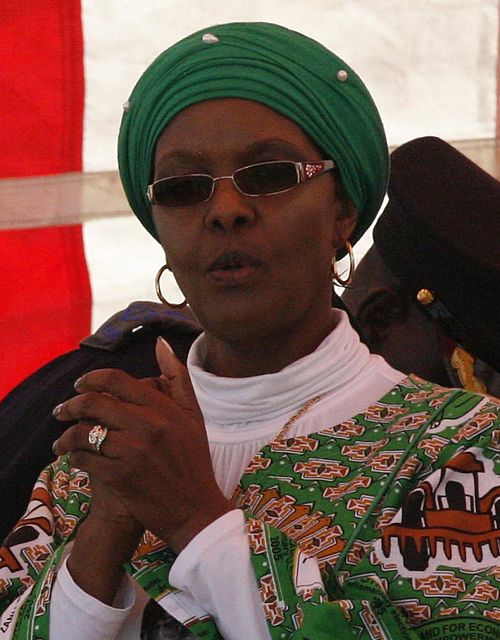
Grace Mugabe, born in 1965, is a Zimbabwean public figure who served as the First Lady of Zimbabwe from 1996 to 2017 during the presidency of her husband, Robert Mugabe. Her journey from a clerical worker to one of the most powerful and polarizing women in the nation's Politics & Government landscape is a story of ambition, influence, and controversy. As the Ex-First Lady, Grace Mugabe became notable not only for her proximity to power but also for her own political aspirations, her high-profile philanthropic endeavors, and her often headline-grabbing public statements. Her key achievement, as framed by her supporters, was her rise to lead the Zimbabwe African National Union–Patriotic Front (ZANU–PF) Women's League and her vocal, albeit contentious, advocacy for women's political participation. However, her legacy is inextricably tied to allegations of extravagance, political violence, and her role in the internal party dynamics that led to her husband's ouster.
Early Life and Education
Grace Marufu was born on July 23, 1965, in Benoni, South Africa, to immigrant parents from Zimbabwe (then Rhodesia). Her early years were spent in a modest setting, and she later moved to Zimbabwe. Little is widely documented about her earliest childhood. Her formative years were marked by the Zimbabwean War of Liberation, a context that would later shape the political environment she entered.
Her formal education began in Zimbabwe. She attended a secretarial college, which equipped her with the skills that led to her first known job. In the early 1980s, Grace Mugabe began working as a typist at the President's office in Harare. It was in this role that she first encountered Robert Mugabe, who was then married to his first wife, Sally Hayfron. This professional relationship evolved over more than a decade into a personal one. During this period, Grace Mugabe also pursued further education. She earned a Bachelor of Arts in English and a Bachelor of Education from the University of Zimbabwe. Later, in a remarkably short timeframe, she obtained a PhD in Sociology from the same university in 2014. The awarding of this doctorate, completed in just a few months, attracted significant skepticism and criticism from academic circles and the public, raising questions about privilege and the integrity of academic institutions.
Career and Major Achievements
Grace Mugabe's career is a complex tapestry woven from her roles as a political figure, a party official, and a public advocate.
Rise as First Lady and Political Ascendancy
Following her marriage to Robert Mugabe in 1996, after the death of his first wife, Grace Mugabe's public profile transformed. Initially, she focused on philanthropic projects, most notably the establishment of the Grace Mugabe Foundation and the construction of an orphanage in Mazowe. However, her involvement in Politics & Government intensified dramatically in the 2010s. In 2014, she was elected as the Secretary of the ZANU–PF Women's League, a powerful position within the ruling party. This role launched her into the heart of Zimbabwean political power struggles. She began using large political rallies, known as "Meet the People" tours, to deliver fiery speeches that often attacked perceived enemies within and outside the party. Her rhetoric earned her the nickname "Gucci Grace" from critics, referencing her lavish lifestyle, and "DisGrace" from opponents, while supporters hailed her as "Amai" (Mother) and a champion of the party's legacy.
Advocacy and Controversy in Women's Rights
Within the subcategory of Women's Rights, Grace Mugabe's role is deeply paradoxical. On one hand, as head of the Women's League, she formally advocated for greater representation of women in political and economic spheres. She publicly encouraged women to stand up for leadership positions and was a visible example of a woman in a high echelon of power in a male-dominated political environment. On the other hand, her advocacy was frequently overshadowed by her personal conduct and the sources of her wealth. Her infamous 2003 shopping spree in Paris, estimated at $120,000, while Zimbabwe faced economic collapse, became a symbol of elite excess. Furthermore, her alleged involvement in violent assaults, including a widely reported 2009 incident in Hong Kong and a 2017 alleged assault of a model in Johannesburg, severely damaged her credibility as a figure of moral authority or a genuine advocate for women's safety and dignity.
The "Generation 40" and the 2017 Succession Battle
Grace Mugabe's most direct foray into high-stakes politics was her central role in the ZANU–PF succession battle. She became the face of the "Generation 40" (G40) faction, which sought to succeed the aging Robert Mugabe, opposing the faction loyal to then-Vice President Emmerson Mnangagwa. In late 2017, her political maneuvering reached its peak. She publicly called for Vice President Mnangagwa's dismissal, famously stating she would never allow him to "rule this country." Her husband acquiesced, firing Mnangagwa in November 2017. This action triggered a military intervention ("Operation Restore Legacy") that led to Robert Mugabe's resignation. Grace Mugabe's political career effectively ended with her husband's fall from power. She was expelled from ZANU–PF and has since receded from active political life in Zimbabwe.
Personal Life and Legacy
Grace Mugabe's personal life has been a subject of intense public fascination and scrutiny. She was Robert Mugabe's second wife, and their relationship, which began while he was still married, has been a source of controversy. Together, they had three children: Bona, Robert Peter Jr., and Chatunga. Her interests have often been associated with luxury, including extensive real estate, a vast collection of diamonds and watches, and a reputed love for high-end fashion. Despite the controversies, her philanthropic work, particularly the orphanage project, is cited by some as a positive aspect of her tenure as First Lady.
The lasting impact and legacy of Grace Mugabe are multifaceted and contentious. She remains a figure who:
- Exemplified the potential for personal accumulation of wealth and power within a political system.
- Highlighted the complex and often compromised nature of women's political advocacy in authoritarian contexts.
- Played a pivotal, if ultimately self-defeating, role in the internal dynamics that ended the 37-year rule of Robert Mugabe.
- Became a global symbol of the perceived profligacy and impunity of Zimbabwe's ruling elite during a period of national economic hardship.
Her story is a compelling chapter in modern Zimbabwean history, reflecting themes of gender, power, corruption, and political transition.
Net Worth and Business Ventures
While no official figures exist, Grace Mugabe is widely believed to have amassed considerable wealth during her time as First Lady. Estimates of her net worth have varied wildly in media reports, but she is consistently listed among the wealthiest individuals in Zimbabwe. Her financial success is attributed to a network of business ventures and assets, many of which were reportedly acquired through political connections and patronage. Key holdings have included:
- Extensive real estate portfolio: This includes multiple luxury properties in Harare, such as the infamous "Gracelands" mansion, a $5 million-plus residence in the affluent Borrowdale suburb, and a large dairy farm in Mazowe.
- Commercial interests: She has been linked to businesses in agriculture, mining, and property development. Her family's ownership of the Gushungo Dairy Estate is one of the most visible examples.
- Luxury assets: Reports have detailed her ownership of a vast collection of jewelry, luxury vehicles, and valuable real estate outside of Zimbabwe, including in South Africa and the Far East.
These assets have frequently been at the center of allegations of state corruption and illicit wealth accumulation, making the business dealings of Grace Mugabe a focal point for critics of the Mugabe regime's governance. Following the 2017 coup, some of these assets have been subject to legal challenges and attempts at seizure by the new administration.
Net Worth Analysis
Estimates based on her role as former First Lady of Zimbabwe and extensive reported business interests and assets, though no official verified figure exists.
Quick Stats
Related People

Aaron Motsoaledi
LP; Minister of Home Affairs

Abane Ramdane†
FLN Leader & Strategist

Abdalla Hamdok
Ex-Prime Minister

Abdallah Kigoda
Ex-Minister of Natural Resources