Financial Breakdown
Asset Distribution
Assets vs Liabilities
Assets
Disclaimer: These financial estimates are based on publicly available information and should be considered approximate. Last updated: 12/29/2025
Biography
Introduction: The Steady Hand of Namibian Democracy
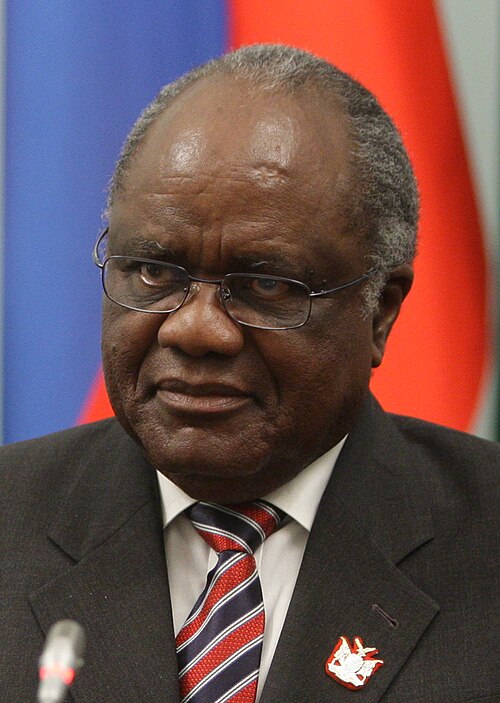
Hifikepunye Pohamba stands as a defining figure in modern Namibian history, renowned for his pivotal role in shaping the nation's post-independence trajectory. Serving as the second President of the Republic of Namibia from 2005 to 2015, Pohamba's decade in office was marked by a steadfast commitment to national reconciliation, economic development, and the consolidation of democratic governance. His leadership, often described as humble, consultative, and pragmatic, earned him immense respect both domestically and internationally. A key achievement that encapsulates his legacy was being awarded the prestigious Mo Ibrahim Prize for Achievement in African Leadership in 2014, a testament to his exceptional governance, commitment to human rights, and successful efforts in combating corruption. This biography delves into the life and career of Hifikepunye Pohamba, exploring his journey from anti-colonial activist to a revered statesman in the Politics & Government landscape of Southern Africa.
Early Life & Education: Forging a Freedom Fighter
Hifikepunye Lucas Pohamba was born on August 18, 1935, in Okanghudi, a village in the Ondobe constituency of the Ohangwena Region, then part of South West Africa under South African apartheid rule. His early life was rooted in the rural north, an experience that deeply informed his understanding of the land and its people—a theme that would later become central to his presidency. His formal education was limited, attending the Holy Cross Mission School at Onamunama, but the political education he received was profound.
The formative experiences for the young Hifikepunye Pohamba were the injustices of the colonial system. He worked as a clerk in the Tsumeb copper mine, where he witnessed firsthand the racial and economic disparities enforced by apartheid. This environment fueled his political awakening. In 1959, he joined the Ovamboland People's Organization (OPO), which soon evolved into the South West Africa People's Organization (SWAPO). His activism led to harassment by the authorities, and in 1961, he fled into exile to dedicate himself fully to the liberation struggle. His early exile years were spent in Tanganyika (now Tanzania) and further studies in the Soviet Union, where he received military and political training, preparing him for a lifetime of service to Namibia's independence cause.
Career & Major Achievements: From Liberation to Leadership
The career of Hifikepunye Pohamba is inextricably linked with the history of SWAPO and the birth of Namibia. After years in exile, holding various administrative and diplomatic positions for the liberation movement, he returned to Namibia in 1989 to campaign for SWAPO in the first UN-supervised elections. Following independence on March 21, 1990, President Sam Nujoma appointed him to several critical cabinet positions, showcasing his trust and Pohamba's administrative competence.
Ministerial Roles and Political Ascent
Pohamba served as Namibia's first Minister of Home Affairs (1990-1995), where he oversaw the monumental task of issuing new national documents. He later served as Minister of Fisheries and Marine Resources (1995-1997) and, most notably, as Minister of Lands, Resettlement and Rehabilitation (1997-2000 and 2001-2005). In this challenging portfolio, he began implementing Namibia's land reform program, a sensitive issue he would later prioritize as president.
Presidency (2005-2015): A Decade of Consolidation
Chosen by founding President Sam Nujoma as his successor, Hifikepunye Pohamba won the November 2004 presidential election with a overwhelming 76.4% of the vote. He was sworn in on March 21, 2005. His presidency focused on several key pillars:
- National Reconciliation and Unity: He actively promoted a spirit of inclusivity, reaching out to former opposition parties and communities that felt marginalized, strengthening the social fabric of the young nation.
- Anti-Corruption Drive: Declaring "zero tolerance" on corruption, he established the Anti-Corruption Commission (ACC) and empowered it to investigate high-profile cases, significantly improving Namibia's governance ratings.
- Land Reform: Continuing his work from the lands ministry, he pursued a "willing seller, willing buyer" model for commercial farmland redistribution, aiming to address historical inequities while maintaining agricultural productivity.
- Economic Management: His tenure saw consistent economic growth, prudent fiscal management, and significant investments in infrastructure, particularly in expanding the road network and building the massive Neckartal Dam.
- Foreign Policy: He maintained Namibia's non-aligned stance while fostering strong relations with regional partners, China, and Western nations.
Re-elected in 2009 with an increased mandate of 75.25%, President Pohamba honored the constitutional two-term limit, setting a powerful precedent for democratic transition in Africa. His peaceful handover of power to Hage Geingob in 2015 was a hallmark of his commitment to democratic institutions.
Personal Life & Legacy: The Humble Statesman
Known for his unassuming and calm demeanor, Hifikepunye Pohamba cultivated an image of a "man of the people." He is married to Penexupifo Pohamba (née Pandeni), and the couple has multiple children. His personal interests have always been closely tied to his roots; he is known to be a man who values family, quiet reflection, and connection to his rural homeland.
His philanthropic focus has been largely channeled through his official duties and support for SWAPO Party initiatives, though he maintains a low profile regarding personal charity. The lasting impact of Hifikepunye Pohamba is profound. He is credited with consolidating Namibia's democracy, institutionalizing governance, and providing a stable, scandal-free administration during a critical period of nation-building. The 2014 Mo Ibrahim Prize not only recognized his individual excellence but also shone a light on Namibia as a beacon of good governance in Africa. His legacy is one of stability, integrity, and a deep, quiet patriotism that steered Namibia with a steady hand.
Net Worth & Business Ventures
As is common with many former liberation struggle figures turned statesmen, the precise net worth of Hifikepunye Pohamba is not publicly disclosed and remains a private matter. His financial standing is understood to be derived primarily from a lifetime of public service salaries, a presidential pension, and potentially prudent personal investments. Unlike some African leaders, his tenure was not associated with allegations of personal wealth accumulation through state resources. In fact, his anti-corruption drive was a hallmark of his presidency. Any business interests he may have are considered to be modest and managed privately. His public image is firmly that of a servant-leader rather than a business magnate, aligning with his reputation for humility and integrity throughout his career in Politics & Government. His financial legacy, like his political one, is viewed as one of propriety and alignment with the ethical standards he promoted as the Ex-President (2005-2015) of Namibia.
Sources: The information in this biography is compiled from reputable public records, including the official biography from the Government of the Republic of Namibia, the Mo Ibrahim Foundation, and documented historical accounts of Namibia's liberation struggle and political history, such as those from the BBC and Encyclopedia.com.
Frequently Asked Questions
What is Hifikepunye Pohamba's estimated net worth?
Hifikepunye Pohamba has an estimated net worth of $5.0 Million.
What is Hifikepunye Pohamba's role and nationality?
Hifikepunye Pohamba is a Ex-President (2005-2015) from Namibia.
How did Hifikepunye Pohamba make their money?
Hifikepunye Pohamba built their fortune primarily through The Mo Ibrahim Prize for Achievement in African Leadership comes with $5 million cash award which will be given to Pohamba over a period of 10 years. He will also get an annual $200,000 stipend after the end of the first payout over the 10 years until he passes away..
How old is Hifikepunye Pohamba?
Hifikepunye Pohamba was born in 1935 (91 years old).
Which category is Hifikepunye Pohamba listed under?
Hifikepunye Pohamba is featured under the Politics & Government category on NetWorth Africa.
How is Hifikepunye Pohamba's net worth calculated?
NetWorth Africa estimates financial valuations using publicly available stock equity holdings, company ownership records, real estate assets, and verified market data.
Net Worth Analysis
The Mo Ibrahim Prize for Achievement in African Leadership comes with $5 million cash award which will be given to Pohamba over a period of 10 years. He will also get an annual $200,000 stipend after the end of the first payout over the 10 years until he passes away.
Quick Stats
Related People

Aaron Motsoaledi
LP; Minister of Home Affairs • South Africa

Abane Ramdane†
FLN Leader & Strategist • Algeria

Abdalla Hamdok
Ex-Prime Minister • Sudan

Abdallah Kigoda
Ex-Minister of Natural Resources • Tanzania