Financial Breakdown
Asset Distribution
Assets vs Liabilities
Assets
Disclaimer: These financial estimates are based on publicly available information and should be considered approximate. Last updated: 12/29/2025
Biography
Introduction: A Landmark in Liberian Executive Leadership
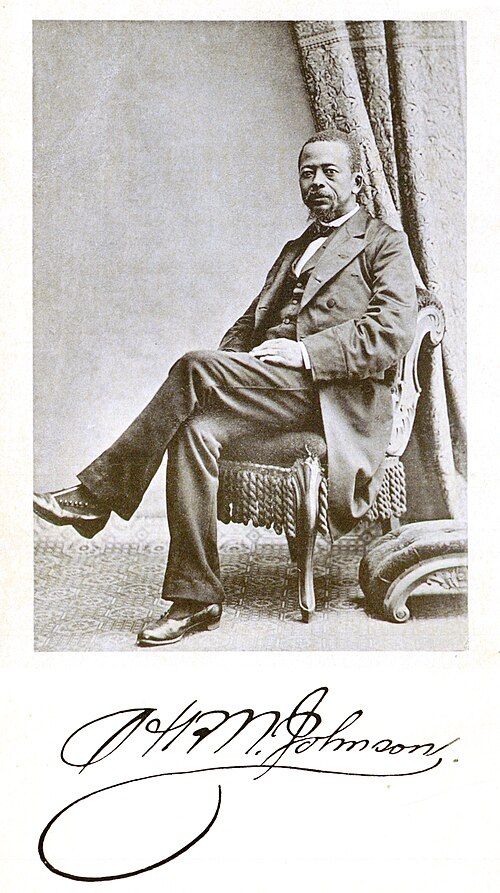
Hilary R. W. Johnson† stands as a monumental figure in the annals of Liberian history, renowned as the nation's eleventh President and, most significantly, its first native-born head of state. Born in 1837 in Monrovia to Americo-Liberian parents, his ascent to the presidency in 1884 marked a profound symbolic shift. For the first time, a son of the soil, rather than an American-born immigrant, assumed the highest office, signaling a maturation of the young republic. His administration, spanning from 1884 to 1892, was a critical period of nation-building, defined by efforts to solidify Liberia's sovereignty, manage complex international relations, and navigate internal economic challenges. Hilary R. W. Johnson†'s presidency represents a crucial bridge between the founding settler generation and the emerging Liberian-born leadership that would shape the country's future.
Early Life & Education: A Son of the Republic
Hilary Richard Wright Johnson was born on June 1, 1837, in Monrovia, the capital of the fledgling Republic of Liberia. His father, Elijah Johnson, was a seminal figure among the early American settlers, a veteran of the colony's founding and a signatory to the Liberian Declaration of Independence in 1847. This heritage immersed young Hilary in the political and social fabric of the nation from its inception. His early education was received at mission schools in Monrovia, where he demonstrated considerable intellectual promise.
His formative experiences were deeply intertwined with the struggles of the new republic. Witnessing territorial disputes with indigenous groups and European colonial powers, as well as the constant challenge of economic viability, shaped his worldview. To complete his formal education, Johnson traveled to the United States, attending Alexander High School in New York. This unique perspective—born in Africa, educated in America—equipped him with a dual understanding of both his homeland's needs and the international landscape. Upon returning to Liberia, he did not immediately enter Politics & Government but first pursued a career in journalism and teaching, honing the skills of communication and analysis that would later define his political career.
Career & Major Achievements: Steering a Precarious Sovereignty
Hilary R. W. Johnson†'s political career began in earnest with his election to the Liberian House of Representatives, where his eloquence and keen intellect quickly earned him respect. He later served as Secretary of State under President Anthony W. Gardiner, a role that placed him at the forefront of Liberia's most pressing issue: defending its borders and sovereignty against British and French colonial encroachment. This experience was invaluable preparation for the presidency.
Presidency (1884-1892): Challenges and Diplomacy
Elected as the Eleventh President in 1884, Hilary R. W. Johnson† faced a daunting array of challenges. His two-term administration was primarily focused on:
- Border Defense: He vigorously protested the annexation of Liberian territory by Britain and France, dispatching diplomatic missions to Europe and the United States to assert Liberia's claims, though with limited success against superior colonial powers.
- Economic Stabilization: Confronting a crippling national debt, he sought foreign loans and attempted to diversify the economy beyond its reliance on commodity exports, promoting initiatives in agriculture and infrastructure.
- Internal Administration: He worked to extend the government's authority beyond the coastal settlements and improve public administration, though resources were severely constrained.
- International Recognition: Johnson tirelessly worked to maintain and strengthen Liberia's status as a sovereign black republic in a world dominated by colonial empires.
A Defining Legal Contribution
Beyond his executive actions, one of Hilary R. W. Johnson†'s most enduring legacies is his contribution to Liberian jurisprudence. Prior to his presidency, he collaborated with fellow statesman and jurist C. L. Parsons to compile and codify the laws of the republic. Published as "The Johnson-Parsons Laws", this comprehensive legal digest was a monumental achievement that brought order and accessibility to the young nation's statutes. It remained a foundational legal text for generations, systematizing the governance of Liberia and providing a crucial tool for its judiciary and political leaders.
Personal Life, Legacy, and Lasting Impact
Outside the rigors of statecraft, Hilary R. W. Johnson† was known as a man of deep religious conviction and intellectual curiosity. He was a devoted member of the Methodist Church, and his principles were heavily informed by his faith. His personal integrity was widely acknowledged, even by political opponents, in an era often marked by factional strife. He was married and fathered several children, embedding his family firmly within the nation's elite Americo-Liberian society.
The legacy of Hilary R. W. Johnson† is multifaceted. Symbolically, his presidency broke a profound barrier, proving that native-born Liberians were capable of the highest Executive Leadership. It paved the way for future presidents like Joseph James Cheeseman and William D. Coleman. Practically, his administration managed to preserve Liberia's nominal independence during the "Scramble for Africa," a non-achievement that cannot be understated. His legal codification work provided stability and continuity for the nation's governance. While he could not solve the profound economic and territorial threats facing Liberia, his tenure was one of dignified resilience. He is remembered as a patriot who navigated incredibly difficult circumstances with dedication, laying groundwork for the nation he loved.
Historical Context & Final Years
It is important to view Johnson's tenure within the stark realities of the late 19th century. Liberia was a small, financially weak state surrounded by aggressively expanding European empires. His options were severely limited. After completing his second term in 1892, he remained an elder statesman. Hilary R. W. Johnson† passed away in 1901, leaving behind a complex legacy as a pioneer. His life and career are essential study for anyone seeking to understand the evolution of Politics & Government in Liberia, marking the transition from a settler-led project to a nation grappling with its own unique identity and challenges on the African continent.
† The dagger symbol (†) indicates that Hilary R. W. Johnson is deceased.
Sources for this biography include historical records from the Liberian government, academic works on Liberian history such as "Historical Dictionary of Liberia" by D. Elwood Dunn and Svend E. Holsoe, and archival materials documenting 19th-century Liberian politics.
Frequently Asked Questions
What is Hilary R. W. Johnson†'s estimated net worth?
Hilary R. W. Johnson† has an estimated net worth of $1.0 Million.
What is Hilary R. W. Johnson†'s role and nationality?
Hilary R. W. Johnson† is a Eleventh President from Liberia.
How did Hilary R. W. Johnson† make their money?
Hilary R. W. Johnson† built their fortune primarily through Hilary R. W. Johnson was a 19th-century historical figure (President of Liberia 1884-1892) with no known modern business interests or wealth accumulation; any contemporary net worth estimate would be nominal or based on historical legacy..
How old is Hilary R. W. Johnson†?
Hilary R. W. Johnson† was born in 1837 (189 years old).
Which category is Hilary R. W. Johnson† listed under?
Hilary R. W. Johnson† is featured under the Politics & Government category on NetWorth Africa.
How is Hilary R. W. Johnson†'s net worth calculated?
NetWorth Africa estimates financial valuations using publicly available stock equity holdings, company ownership records, real estate assets, and verified market data.
Net Worth Analysis
Hilary R. W. Johnson was a 19th-century historical figure (President of Liberia 1884-1892) with no known modern business interests or wealth accumulation; any contemporary net worth estimate would be nominal or based on historical legacy.
Quick Stats

Related People
Aaron Motsoaledi
LP; Minister of Home Affairs • South Africa
Abane Ramdane†
FLN Leader & Strategist • Algeria
Abdalla Hamdok
Ex-Prime Minister • Sudan
Abdallah Kigoda
Ex-Minister of Natural Resources • Tanzania