Biography
Introduction: A Founding Father of the Republic
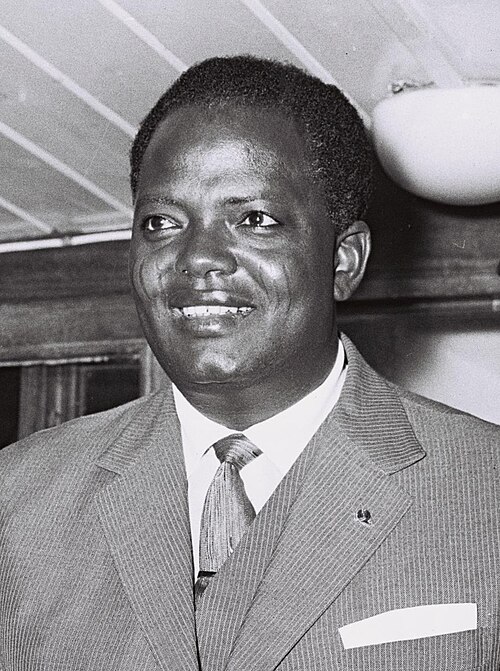
Hubert Maga† stands as a monumental figure in the annals of West African history, forever etched as the First President of Benin. Born in 1916, Maga's political journey unfolded during the turbulent and hopeful era of decolonization, leading him to guide his nation from French colonial rule to sovereign independence. His most notable achievement was steering the former French colony of Dahomey (renamed Benin in 1975) into statehood, becoming its inaugural president on August 1, 1960. As a key architect of the nation's early political framework, Hubert Maga navigated the complex tribal and regional politics that characterized the nascent republic. His leadership, though later marked by controversy and interruption, set the foundational course for the modern Republic of Benin. This biography delves into the life of a man whose career encapsulates the challenges and aspirations of the Independence Era in African Politics & Government.
Early Life & Education: Formative Years in Colonial Dahomey
Hubert Coutoucou Maga was born on August 10, 1916, in Parakou, a city in northern Dahomey. This regional origin was significant, as it placed him within the Bariba ethnic group, a factor that would deeply influence his political base and career. Coming of age under the French colonial administration, Maga received a Western-style education, which was a privileged path for Africans at the time. He attended primary school in Parakou and later pursued his secondary education at the prestigious William Ponty School in Dakar, Senegal, a renowned institution that educated many future leaders of Francophone Africa.
His academic prowess led him to a career in teaching, a respected profession that served as a common springboard into politics. Maga worked as a schoolmaster, first in Niger and later in Dahomey at schools in Natitingou and Djougou. This experience granted him a deep understanding of the educational system and connected him with the emerging educated elite. His formative years were shaped by the contradictions of colonial rule—exposure to French republican ideals of liberty and equality, contrasted sharply with the realities of racial discrimination and limited political rights. This environment fostered a generation of leaders, including Hubert Maga, who would eventually challenge the colonial status quo and demand self-determination for their people.
Career & Major Achievements: The Path to Presidency and Beyond
Hubert Maga's political career began in earnest after World War II, as France gradually expanded political representation in its colonies. He was elected to represent Dahomey in the French National Assembly in 1951, a position he held until 1959. During this period, he founded the Northern Ethnical Group (Groupement Ethnique du Nord), which evolved into the Dahomeyan Democratic Rally (Rassemblement Démocratique Dahoméen, or RDD). His platform championed the interests of the northern regions, which he felt were marginalized by the southern elite from Porto-Novo and Cotonou.
Architect of Independence and First Presidency
The late 1950s were a period of rapid constitutional change. Maga served as President of the Dahomeyan Territorial Assembly and later as Prime Minister of the provisional government in 1959. In this crucial role, he negotiated the terms of independence with France. On August 1, 1960, the Republic of Dahomey achieved full sovereignty, and Hubert Maga was inaugurated as its first President. His early presidency focused on nation-building, establishing international relations, and attempting to unify the country's deeply divided regional factions. He pursued policies aimed at economic development and maintaining strong ties with France, a common trajectory for many newly independent Francophone states.
Political Instability and the Cyclical Nature of Power
The promise of independence soon collided with the harsh realities of economic hardship and intense political rivalry. Dahomey's politics became infamous for instability, dominated by a "presidential triumvirate" representing the country's three main regions: Maga (north), Sourou-Migan Apithy (southeast), and Justin Ahomadégbé-Tomêtin (southwest). By 1963, facing widespread strikes and unrest, Maga was overthrown in a military coup led by Colonel Christophe Soglo. He was imprisoned until 1965.
In a remarkable political comeback, a system of a rotating presidential council was established in 1970 to end a decade of coups and violence. The council included Maga, Apithy, and Ahomadégbé, who were to rotate power every two years. Hubert Maga assumed the first chairmanship on May 7, 1970. However, this fragile arrangement collapsed in 1972 when the military, led by Major Mathieu Kérékou, seized power. Maga was again arrested and spent the next decade in detention before being released in 1981. Following his release, he largely retired from public life, living quietly in Cotonou until his passing.
Personal Life, Legacy, and Lasting Impact
Outside the political arena, Hubert Maga was known as a devout Roman Catholic and a family man. His personal demeanor was often described as calm and reserved, a contrast to the volatile political landscape he navigated. While his presidencies were not long-lasting, his legacy is fundamentally tied to the birth of the Beninese nation. As the first President of Benin, he holds an irrevocable place as a founding father. His political career highlighted the profound challenges of post-colonial statecraft: managing ethnic and regional divisions, building a national identity, and creating sustainable economic structures.
His legacy is complex. He is credited with leading the country to independence and making its first mark on the international stage. However, his tenure also reflects the instability that plagued many First Republics in Africa. The eventual stability achieved by Benin under Mathieu Kérékou and later, the pioneering move to multiparty democracy in 1990, can be seen as a long-term response to the turbulent era Maga helped define. Hubert Maga passed away on May 8, 2000, in Cotonou. Today, his name is memorialized in streets and institutions, a permanent reminder of his role in the dawn of Beninese sovereignty.
Net Worth & Business Ventures
Assessing the net worth of historical political figures from the Independence Era, especially in contexts like Benin, is inherently challenging due to a lack of transparent financial records. Unlike modern leaders with declared assets, the financial circumstances of figures like Hubert Maga are not well-documented in public sources. His primary career was in public service—as a teacher, then as a legislator, and finally as head of state. There is no significant historical record or credible evidence pointing to substantial private business ventures or commercial enterprises owned by Maga. His income would have been derived from his official salaries and allowances. In the later years of his life, following his release from detention in 1981, he lived without the trappings of great wealth. Therefore, while he wielded significant political power, Hubert Maga is not remembered as a business magnate, but rather as a career politician whose life was inextricably linked to the state of Benin itself.
Key Facts & Timeline
- Birth: August 10, 1916, Parakou, Dahomey.
- Profession: Teacher, Politician, Statesman.
- Key Political Party: Dahomeyan Democratic Rally (RDD).
- Major Achievement: Led Dahomey to independence and served as its first President (1960-1963).
- Later Role: Chairman of the Presidential Council (1970-1972).
- Death: May 8, 2000, Cotonou, Benin.
- Historical Context: His career defines the early, unstable period of post-independence Politics & Government in Benin.
For further reading on the political history of Benin and the era of Hubert Maga, credible sources include the Encyclopædia Britannica, academic publications on African decolonization, and historical archives from the French colonial period.
Frequently Asked Questions
What is Hubert Maga†'s estimated net worth?
Hubert Maga† has an estimated net worth of KSh 129.3 Million.
What is Hubert Maga†'s role and nationality?
Hubert Maga† is a First President of Benin from Benin.
How did Hubert Maga† make their money?
Hubert Maga† built their fortune primarily through Hubert Maga was a political leader from a low-income country and there are no credible reports of significant personal wealth; his net worth is estimated based on his public service role..
How old is Hubert Maga†?
Hubert Maga† was born in 1916 (110 years old).
Which category is Hubert Maga† listed under?
Hubert Maga† is featured under the Politics & Government category on NetWorth Africa.
How is Hubert Maga†'s net worth calculated?
NetWorth Africa estimates financial valuations using publicly available stock equity holdings, company ownership records, real estate assets, and verified market data.
Net Worth Analysis
Hubert Maga was a political leader from a low-income country and there are no credible reports of significant personal wealth; his net worth is estimated based on his public service role.
Quick Stats
Related People
Aaron Motsoaledi
LP; Minister of Home Affairs • South Africa
Abane Ramdane†
FLN Leader & Strategist • Algeria
Abdalla Hamdok
Ex-Prime Minister • Sudan
Abdallah Kigoda
Ex-Minister of Natural Resources • Tanzania