Biography
Introduction: The Soldier-President
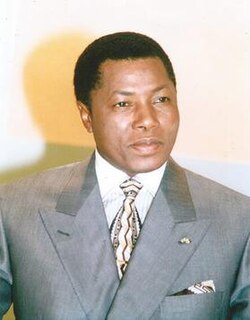
Ibrahim Baré Maïnassara† stands as a pivotal and controversial figure in the modern political history of Niger. A career military officer, he ascended to the highest office not through the ballot box but via a military coup in January 1996, which overthrew the first democratically elected president of Niger, Mahamane Ousmane. His tenure as the Ex-President of Niger was brief, lasting just under three years, yet it was a period defined by intense political instability, economic hardship, and a fraught relationship with democratic institutions. The key "achievement" of Ibrahim Baré Maïnassara was arguably his initial promise to restore order and economic sanity, which led to his coup's temporary acceptance. However, his rule is primarily remembered for its authoritarian tendencies, the violent suppression of opposition, and its abrupt, tragic end with his assassination in April 1999, a event that plunged the nation into further turmoil.
Early Life & Military Education
Ibrahim Baré Maïnassara was born in 1949 in Dogondoutchi, in the southern region of Niger, then part of French West Africa. Details of his early childhood are sparse, but his path was set toward a military career from a young age. He pursued his education within military institutions, a common trajectory for those seeking advancement in the post-colonial armed forces of West Africa.
His formal military training began in neighboring Mali, at the École Militaire Interarmes (EMIA) in Kati. Demonstrating competence and ambition, he furthered his officer training in France, attending the prestigious École d'Application de l'Infanterie in Montpellier. This Franco-African military education was formative, embedding in him the structures and doctrines of a professional army. Upon returning to Niger, Ibrahim Baré Maïnassara steadily climbed the ranks of the Niger Armed Forces. He held various command and staff positions, earning a reputation as a disciplined and reliable officer. By the early 1990s, as Niger transitioned from single-party rule under President Ali Saïbou to a multi-party democracy, Colonel Maïnassara had become a prominent figure within the military establishment, eventually rising to the position of Chief of Staff of the Armed Forces.
Career & Major Achievements: From Coup to Presidency
The career of Ibrahim Baré Maïnassara is inextricably linked to Niger's rocky democratic experiment in the 1990s. The presidency of Mahamane Ousmane, elected in 1993, was plagued by political deadlock, economic crisis due to a devaluation of the CFA franc, and a persistent Tuareg rebellion. Citing this chronic instability and "the inability of political leaders to govern," Colonel Maïnassara led a bloodless coup on January 27, 1996, dissolving the National Assembly and suspending the constitution.
The 1996 Coup and the Council of National Salvation
Following the coup, Maïnassara established a ruling military council, the Council of National Salvation (CSN), and installed himself as its chairman and head of state. He promised a transitional period to restore democracy. A new constitution was drafted and approved by referendum in May 1996, establishing a semi-presidential system with strengthened executive powers—a framework tailored to his advantage.
The Controversial 1996 Presidential Election
In July 1996, Ibrahim Baré Maïnassara contested and won a presidential election that was widely condemned by international observers and domestic opposition as fraudulent. After early returns showed him trailing, he dismissed the independent electoral commission and replaced it with one loyal to him, which subsequently announced his victory. This brazen manipulation cemented his authority but destroyed his legitimacy in the eyes of many, both at home and abroad.
Rule and Repression
His presidency was marked by:
- Economic Struggles: Niger remained one of the world's poorest countries, burdened by debt and reliant on volatile uranium prices. Austerity measures imposed as part of structural adjustment programs bred popular discontent.
- Political Repression: Opposition parties and civil society faced severe restrictions. A critical moment came in January 1998, when Ibrahim Baré Maïnassara's presidential guard opened fire on a peaceful opposition protest in Niamey, killing several people. This event severely isolated his regime.
- Strained International Relations: His fraudulent election and human rights abuses led to the suspension of vital aid from France and the European Union, crippling an already fragile economy.
Personal Life, Death, and Legacy
Outside of his military and political life, Ibrahim Baré Maïnassara was known to be a private family man. He was married and had children. His interests, as with many career soldiers, were largely shaped by his profession. His legacy is complex and largely cautionary within the context of Politics & Government in Niger and the Sahel region.
On April 9, 1999, just months before scheduled elections, Ibrahim Baré Maïnassara was assassinated at Niamey's military airport by members of his own presidential guard in what was described as an "unfortunate accident" by the succeeding military junta, though it was widely seen as a counter-coup. His death closed a chapter of military intervention but left a deep scar on the nation's political consciousness.
The legacy of Ibrahim Baré Maïnassara is one of democratic reversal. His rule demonstrated the fragility of nascent democratic institutions in the face of an ambitious military and deep-seated socio-economic problems. It underscored the dangers of military intervention in politics, even when initially justified by popular frustration with civilian governance. For Niger, his era served as a painful lesson, contributing to a broader, though still imperfect, consensus on the necessity of constitutional order, which has guided subsequent transitions, however challenging they have been.
Net Worth & Financial Context
As with many leaders of extremely low-income nations, precise details regarding the net worth of Ibrahim Baré Maïnassara† are not publicly verifiable. Niger has consistently ranked at the bottom of the United Nations Human Development Index, and its state resources during his tenure in the 1990s were severely limited. There were no publicly known or reported significant private business ventures or personal commercial empires associated with him. His financial standing was intrinsically linked to his salary as a senior military officer and later as head of state. While allegations of corruption and misuse of public funds were leveled against his administration by political opponents—a common feature in the region's politics—no concrete figures or confirmed personal wealth accumulations were ever formally established or published by credible international bodies. His primary economic impact was on the national treasury, through policies that led to the suspension of foreign aid, rather than on any documented personal fortune.
Frequently Asked Questions
What is Ibrahim Baré Maïnassara†'s estimated net worth?
Net worth details for Ibrahim Baré Maïnassara† are currently being updated.
What is Ibrahim Baré Maïnassara†'s role and nationality?
Ibrahim Baré Maïnassara† is a Ex-President of Niger from Niger.
How did Ibrahim Baré Maïnassara† make their money?
Ibrahim Baré Maïnassara† built their fortune primarily through Ibrahim Baré Maïnassara was assassinated in 1999, and there are no credible public reports of a significant personal fortune or estate valuation available..
How old is Ibrahim Baré Maïnassara†?
Ibrahim Baré Maïnassara† was born in 1949 (77 years old).
Which category is Ibrahim Baré Maïnassara† listed under?
Ibrahim Baré Maïnassara† is featured under the Politics & Government category on NetWorth Africa.
How is Ibrahim Baré Maïnassara†'s net worth calculated?
NetWorth Africa estimates financial valuations using publicly available stock equity holdings, company ownership records, real estate assets, and verified market data.
Net Worth Analysis
Ibrahim Baré Maïnassara was assassinated in 1999, and there are no credible public reports of a significant personal fortune or estate valuation available.
Quick Stats
Related People

Aaron Motsoaledi
LP; Minister of Home Affairs • South Africa

Abane Ramdane†
FLN Leader & Strategist • Algeria

Abdalla Hamdok
Ex-Prime Minister • Sudan

Abdallah Kigoda
Ex-Minister of Natural Resources • Tanzania