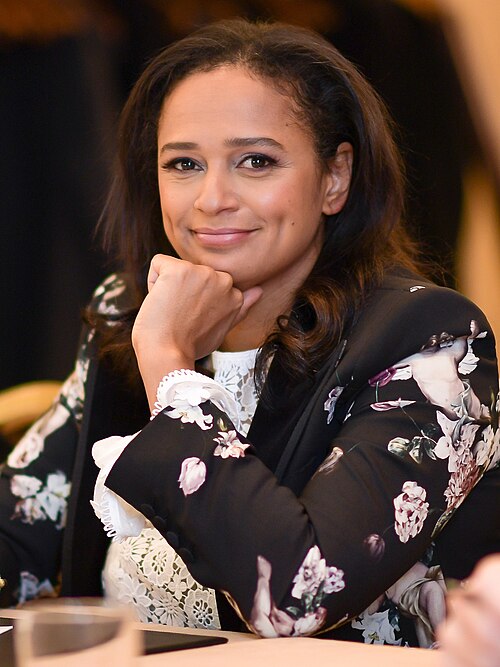
$2B
Estimated Net Worth
As of 2024 • medium confidence
Financial Breakdown
Asset Distribution
Assets vs Liabilities
Assets
Liabilities
Disclaimer: These financial estimates are based on publicly available information and should be considered approximate. Last updated: 12/29/2025
Biography
Introduction: Africa's Once Richest Woman
Isabel dos Santos is an Angolan businesswoman who rose to international prominence as one of the most influential figures in African Business & Economics. For years, she was celebrated by global financial media as the richest woman in Africa, with a vast empire spanning telecommunications, finance, media, and energy. Her most notable position was as the Ex-Unitel Chair, leading Angola's largest mobile telecommunications operator. The story of Isabel dos Santos is deeply intertwined with the economic trajectory of Angola itself in the post-civil war era, representing a narrative of rapid asset accumulation, strategic investments, and, ultimately, intense legal and public scrutiny. Her journey from an engineering student to the helm of a multi-billion dollar portfolio offers a compelling case study in power, finance, and the intersection of business and politics.
Early Life and Education: Foundations in a New Nation
Isabel dos Santos was born in Baku, Azerbaijan, in 1973, the eldest child of José Eduardo dos Santos, who would become Angola's long-serving president from 1979 to 2017. She spent her formative years during a period of intense civil conflict in Angola. For her education, she was sent to London, where she attended St. Paul's Girls' School. She later pursued higher education in the United Kingdom, earning a degree in Electrical Engineering from King's College London in the 1990s.
This technical background in engineering is often cited as a foundational element of her business approach. Unlike many of her contemporaries, her academic focus was on a field directly applicable to the infrastructure-heavy sectors—like telecommunications and energy—she would later dominate. After graduating, her first professional steps were in project management and engineering consultancy. She worked briefly at the London offices of the international engineering firm Coopers & Lybrand (now part of PwC) and at Urbana 2000, a state-owned urban planning company in Angola. These early experiences provided her with a practical, project-oriented mindset, which she would later apply on a vastly larger scale as she began to build her business portfolio in the early 2000s, following the end of the Angolan Civil War.
Career and Major Achievements: Building an Empire
The career of Isabel dos Santos is a chronicle of strategic entries into Angola's most lucrative sectors, often at their point of privatization or liberalization. Her ascent was rapid and expansive, transforming her into a central figure in the nation's Finance & Telecom industries.
The Telecom Titan: Unitel and Beyond
Her most significant business achievement was her involvement with Unitel, Angola's first mobile network operator, launched in 2001. Through a complex web of holding companies, she acquired a substantial stake. Her leadership as Chair of Unitel is credited by some with driving the company's aggressive expansion and technological modernization, making it a market leader and a cash-generating powerhouse. Under her tenure, Unitel grew to command a dominant share of the Angolan mobile market, connecting millions of Angolans and becoming a critical piece of national infrastructure.
Her telecom interests extended beyond Angola. She held significant investments in Portuguese telecom operator NOS (formerly Zon Optimus) and had stakes in other telecom ventures across Portuguese-speaking Africa. This established her as a major player in the Telecom sector on a continental scale.
A Diversified Portfolio: Finance, Energy, and Retail
Parallel to her telecom ventures, Isabel dos Santos constructed a highly diversified business portfolio:
- Finance: She became the largest shareholder in Banco BIC (now Banco BAI), one of Angola's largest banks, and held a strategic stake in Portugal's EuroBic bank.
- Energy & Resources: She held stakes in Angolan energy companies like Galp Energia and Amorim Energia, and in Portuguese engineering firm Efacec.
- Media & Retail: Her investments included a controlling share in ZAP, a satellite TV service, and significant holdings in Portuguese media conglomerate Media Capital. She also invested in supermarkets and cement production.
This sprawling network of companies, often linked through offshore holding structures, was the engine of her reported wealth. Her business strategy often involved forming partnerships with major international firms and leveraging access to capital, which fueled her company's growth and her personal brand as a savvy, international investor.
Personal Life, Philanthropy, and a Contested Legacy
Isabel dos Santos was married to Sindika Dokolo, a Congolese art collector and businessman, until his passing in 2020. Together, they were prominent figures in the global art scene and high-society circles. She has three children. Her public persona was that of a glamorous, jet-setting entrepreneur, frequently featured in international fashion and business magazines.
Her philanthropic efforts were channeled through foundations bearing her and her husband's names. These initiatives focused on areas such as education, healthcare, and cultural development in Angola and Portugal. However, like her business dealings, her philanthropy became a subject of debate, with critics arguing it served to soften her public image amidst growing allegations of corruption.
The legacy of Isabel dos Santos is profoundly complex and contested. To some, she remains a symbol of African entrepreneurial success and female empowerment in business. To others, her story is a prime example of alleged state capture and crony capitalism, where business success was inextricably linked to political proximity. This perspective gained overwhelming traction following the "Luanda Leaks" investigation in 2020, which alleged that her wealth was built on state funds and preferential deals granted during her father's presidency. These revelations led to multiple international investigations, asset freezes, and legal battles, dramatically altering her legacy from a celebrated business icon to a central figure in global anti-corruption discussions.
Net Worth and Business Ventures: Rise and Fall
At the peak of her influence, Forbes magazine estimated the net worth of Isabel dos Santos at over $2 billion, consistently naming her the richest woman in Africa. This wealth was not liquid but tied to her vast and intricate web of holdings across multiple jurisdictions. Her business model was characterized by using holding companies based in Malta, the Netherlands, and other offshore centers to control assets in Angola, Portugal, and elsewhere.
However, her financial and business standing underwent a seismic shift post-2017. After her father left the Angolan presidency, the new administration under President João Lourenço initiated an anti-corruption drive targeting the dos Santos family. Combined with the explosive "Luanda Leaks" documents, this led to:
- Asset freezes in Angola, Portugal, and other countries.
- Her removal from leadership positions, including her role at Unitel.
- Multiple criminal investigations and international arrest warrants.
As of recent years, her once-formidable business empire has been largely dismantled or seized by state authorities, and her official net worth is considered a fraction of its former value. The story of her wealth now serves as a cautionary tale about the volatility of fortunes built on politically connected business in emerging economies.
Net Worth Analysis
Forbes estimated her net worth at $2.2 billion in 2013, but subsequent asset freezes and legal challenges in Angola and Portugal have significantly reduced her wealth; current reliable estimates are scarce but place her in the low billions.
Quick Stats
Related People
Abdelmoumen Ould Kaddour
Ex-CEO Sonatrach
Abderrahmane Benhamadi
CEO Saidal
Abdou Maman
CEO Airtel Niger
Abdourahman Boreh
CEO Boreh Group