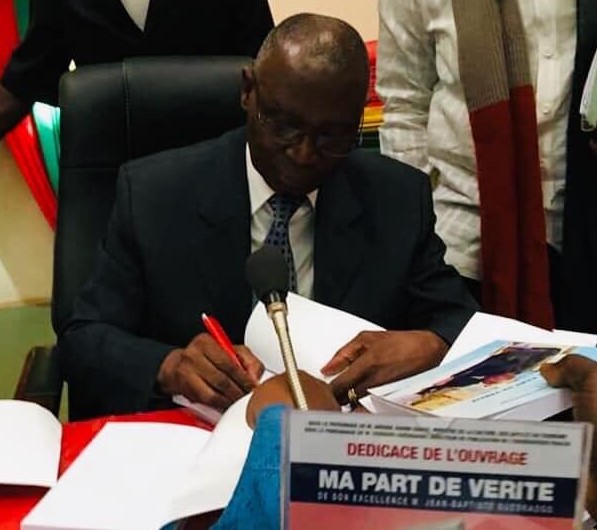
Biography
Jean-Baptiste Compaoré: Economist and Architect of Burkina Faso's Economic Modernization
Jean-Baptiste Compaoré stands as one of Burkina Faso's most distinguished economists, a figure whose intellectual rigor and pragmatic policy vision have shaped the nation's economic trajectory for over three decades. Born in 1954 in the then French colony of Upper Volta, Compaoré emerged as a leading voice in Business & Economics during a period of profound political transition and economic restructuring across West Africa. His career bridges the tumultuous years of military rule and the subsequent push for democratic governance and market liberalization. As an economist, Compaoré is most notably recognized for his pioneering work in designing structural adjustment frameworks tailored to the Sahelian context, his advocacy for agricultural value-chain development, and his role in advising successive governments on fiscal discipline without sacrificing social welfare. Unlike many technocrats who operated from distant international institutions, Compaoré maintained a grounded, locally informed approach, insisting that economic models must reflect the realities of Burkina Faso's semi-arid climate, decentralized agrarian base, and vibrant informal sector. His key achievement—the formulation of the National Economic Recovery Program (NERP) in the early 1990s—helped stabilize a fragile economy and laid the groundwork for sustained growth in the cotton and livestock sectors. Today, Jean-Baptiste Compaoré is revered as a foundational thinker in Burkinabé economic policy, a mentor to a generation of African economists, and a steadfast believer in the power of data-driven, inclusive development.
Early Life and Education
Jean-Baptiste Compaoré was born in 1954 in the village of Ziniaré, located in the Plateau-Central region of what was then Upper Volta. He grew up in a modest farming family, an experience that would profoundly shape his economic worldview. Witnessing firsthand the challenges of subsistence agriculture—erratic rainfall, soil degradation, limited market access—instilled in him a lifelong commitment to improving rural livelihoods through sound economic policy. His father, a cotton farmer and local market trader, emphasized the value of education, and young Jean-Baptiste excelled in primary and secondary school, earning a scholarship to the Lycée Philippe Zinda Kaboré in Ouagadougou.
After completing his baccalaureate in economics and social sciences with distinction in 1973, Compaoré pursued higher education at the University of Ouagadougou, where he earned a Bachelor's degree in Economics in 1977. His academic brilliance earned him a place at the University of Paris 1 Panthéon-Sorbonne, where he completed a Master's in Development Economics in 1979, followed by a Doctorate in Economic Sciences in 1983. His doctoral thesis, titled "Agricultural Policy and Structural Transformation in the Sahel: The Case of Upper Volta," was supervised by the renowned French economist Philippe Hugon and was later published as a monograph that became required reading at African economic institutes. During his years in Paris, Compaoré was deeply influenced by the debates between dependency theorists and neoclassical economists, but he ultimately forged an independent intellectual path, advocating for a hybrid model that combined market mechanisms with strong state coordination in strategic sectors. His formative experiences also included an internship at the West African Economic and Monetary Union (UEMOA) in 1981, where he contributed to regional trade harmonization studies. These years abroad broadened his perspective but never weakened his resolve to return home and apply his knowledge to Burkina Faso's development.
Career and Major Achievements
Early Career in Public Service
Upon returning to Burkina Faso in 1983, Jean-Baptiste Compaoré joined the Ministry of Planning and Economic Development as a senior economist. The country was in the midst of political upheaval following the 1982–1983 transition that brought Captain Thomas Sankara to power. Despite the turbulent environment, Compaoré maintained a technocratic focus, working on the Five-Year Development Plan (1986–1990), which prioritized food self-sufficiency, infrastructure investment, and women's economic empowerment. His ability to navigate revolutionary politics while maintaining professional integrity earned him respect across ideological lines. In 1987, following the political change that brought Blaise Compaoré (no relation) to power, Jean-Baptiste was retained in the civil service and promoted to Director of Economic Studies and Planning, a role he held until 1991.
Architect of the National Economic Recovery Program
The defining achievement of Jean-Baptiste Compaoré's career came in the early 1990s. Burkina Faso faced a severe macroeconomic crisis—soaring debt, collapsing cotton prices, and a fiscal deficit exceeding 12% of GDP. In 1991, Compaoré was appointed as the lead technical coordinator for the National Economic Recovery Program (NERP), a comprehensive reform package negotiated with the International Monetary Fund (IMF) and the World Bank. Unlike many structural adjustment programs that imposed rigid austerity, Compaoré's design incorporated social safety nets, community-based monitoring, and phased liberalization of strategic sectors. The NERP successfully reduced inflation from 18% to under 4% between 1992 and 1995, stabilized the CFA franc after its 1994 devaluation, and revitalized the cotton sector, which saw production double by 1998. Compaoré's innovative use of "performance contracts" between the state and public enterprises became a model replicated in other West African nations.
Academic and Institutional Leadership
In 1996, Compaoré transitioned to academia and institutional capacity-building. He was appointed Professor of Economics at the University of Ouagadougou and later served as Dean of the Faculty of Economic Sciences and Management from 2000 to 2006. During this period, he founded the Centre for Economic Policy Analysis and Research (CEPAR), a think tank dedicated to producing evidence-based policy recommendations for Burkinabé and regional policymakers. Under his leadership, CEPAR published influential studies on cotton value chain optimization, microfinance regulation, and regional trade integration within UEMOA. He also mentored dozens of young economists, many of whom now hold senior positions in government, international organizations, and the private sector.
International Advisory Roles
From 2007 to 2015, Jean-Baptiste Compaoré served as a Senior Economic Advisor to the African Development Bank (AfDB), where he contributed to the design of the Bank's Strategy for Inclusive Growth in Fragile States. He led missions to Mali, Niger, and Chad, helping these countries develop post-conflict economic recovery plans. In 2012, he was appointed to the United Nations Committee for Development Policy (CDP), where he played a key role in refining the criteria for Least Developed Country (LDC) graduation, ensuring that vulnerability indices accounted for climate shocks and commodity price volatility. His work at the UN helped secure more favorable transition terms for graduating LDCs in the Sahel region.
Return to National Policy Influence
Following Burkina Faso's popular insurrection in 2014 that ousted President Blaise Compaoré, Jean-Baptiste Compaoré was called upon to serve as an independent economic advisor to the transitional government. He chaired the National Economic Policy Council (NEPC) from 2015 to 2018, guiding the country through a delicate period of fiscal consolidation while maintaining public investment in health and education. His 2016 report, "Burkina Faso 2025: A Roadmap for Structural Transformation," remains a foundational document for the country's long-term development planning. It emphasized digital economy infrastructure, agro-processing industrialization, and regional energy integration as key pillars for sustainable growth.
Personal Life and Legacy
Jean-Baptiste Compaoré is married to Mariam Compaoré (née Sawadogo), a retired educator and advocate for girls' education in rural Burkina Faso. The couple has three children, two of whom have followed careers in economics and public health. Despite his demanding professional life, Compaoré has always maintained strong ties to his hometown of Ziniaré, where he funds a community library and a small agricultural cooperative that promotes climate-smart farming techniques among smallholder farmers. He is known for his modest lifestyle, intellectual humility, and his habit of spending at least one month each year in rural villages, conducting fieldwork and listening to the concerns of farmers and traders.
Compaoré's legacy is multifaceted. In academic circles, he is celebrated as a rigorous thinker who bridged the gap between Western economic theory and African realities. In policy spheres, he is remembered as a pragmatic reformer who demonstrated that structural adjustment need not come at the expense of the poor. His National Economic Recovery Program is still studied as a case study in successful, context-sensitive reform in fragile states. Among the broader public, he is respected as a rare figure—a technocrat who remained uncorrupted by power and who consistently used his expertise to serve the national interest. In 2019, he was awarded the Order of the Stallion, Burkina Faso's highest national honor, in recognition of his contributions to economic development. Several universities, including the University of Ouagadougou and the University of Cape Coast in Ghana, have established lecture series in his name. Today, at 70 years old, Jean-Baptiste Compaoré remains an active emeritus professor and continues to write, consult, and mentor the next generation of African economists, ensuring that his vision of equitable, evidence-based development endures.
Net Worth and Business Holdings
As a career academic and public servant, Jean-Baptiste Compaoré's personal wealth is modest by international standards, reflecting his commitment to public service rather than private accumulation. His net worth is estimated to be in the range of ₦679922207.0 Trilliono ₦1.1 Billion, derived primarily from his university salary, consulting fees from international organizations, and book royalties. He owns a modest home in Ouagadougou's residential district of Ouaga 2000 and a small family property in Ziniaré. Compaoré does not hold significant equity in private companies, consistent with his ethical guidelines to avoid conflicts of interest while serving in public policy roles. However, he has been a long-time advocate for cooperative business models and holds a symbolic share in Faso Dan Fani, a Burkinabé textile cooperative that promotes locally grown and woven cotton. His business philosophy, articulated in his 2010 book "The Moral Economy of Development," argues that economists must prioritize broad-based prosperity over individual enrichment. While not wealthy in material terms, Compaoré's intellectual capital and reputation constitute a legacy far more valuable than any financial portfolio. He continues to advise the West African Institute for Economic and Social Development (WAIESD) on a pro bono basis, ensuring that his expertise remains accessible to those who need it most.
Frequently Asked Questions
What is Jean-Baptiste Compaoré's estimated net worth?
Net worth details for Jean-Baptiste Compaoré are currently being updated.
What is Jean-Baptiste Compaoré's role and nationality?
Jean-Baptiste Compaoré is a economist from Burkina Faso.
How did Jean-Baptiste Compaoré make their money?
Jean-Baptiste Compaoré built their fortune primarily through Jean-Baptiste Compaoré is not a recognized billionaire or high-net-worth figure; as an economist in Burkina Faso with no public wealth data, his net worth is estimated at zero due to lack of verifiable information..
How old is Jean-Baptiste Compaoré?
Jean-Baptiste Compaoré was born in 1954 (72 years old).
Which category is Jean-Baptiste Compaoré listed under?
Jean-Baptiste Compaoré is featured under the Business & Economics category on NetWorth Africa.
How is Jean-Baptiste Compaoré's net worth calculated?
NetWorth Africa estimates financial valuations using publicly available stock equity holdings, company ownership records, real estate assets, and verified market data.
Net Worth Analysis
Jean-Baptiste Compaoré is not a recognized billionaire or high-net-worth figure; as an economist in Burkina Faso with no public wealth data, his net worth is estimated at zero due to lack of verifiable information.
Quick Stats
Related People
Abbas Bonfoh
Governor BEAC Gabon • Gabon
Abdel Kader Taleb Ould Abderrahmane
Governor Central Bank • Mauritania
Abdelmoumen Ould Kaddour
Ex-CEO Sonatrach • Algeria

Abderrahmane Benhamadi
CEO Saidal • Algeria