Financial Breakdown
Asset Distribution
Assets vs Liabilities
Assets
Liabilities
Disclaimer: These financial estimates are based on publicly available information and should be considered approximate. Last updated: 1/21/2026
Biography
Introduction: A Figure of Absolute Power and Notoriety
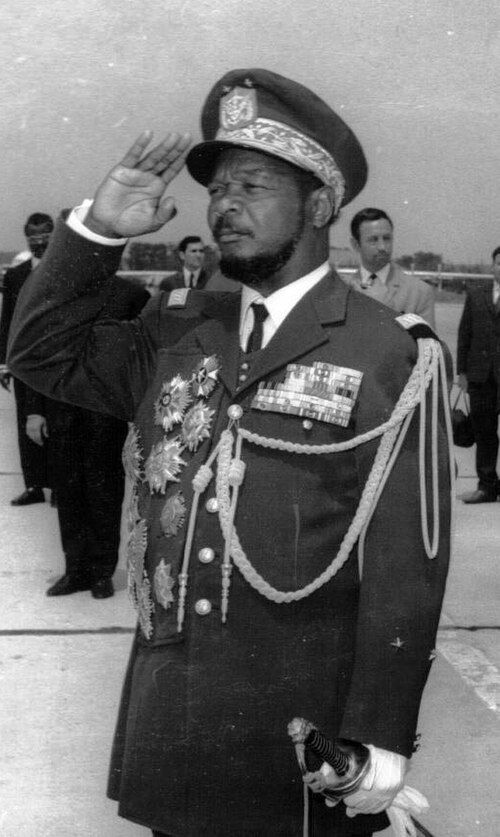
Jean-Bédel Bokassa† stands as one of the most flamboyant, brutal, and enigmatic figures in modern African history. As the military ruler and later self-proclaimed Emperor of the Central African Republic, his name became synonymous with extravagant autocracy and severe human rights abuses. Rising through a military career, Bokassa seized power in a 1966 coup and ruled the nation for 13 years. His notoriety peaked in 1976 when he crowned himself Emperor Bokassa I in a coronation ceremony grotesquely modeled on Napoleon Bonaparte's, costing an estimated $20-30 million—a third of his impoverished nation's annual revenue. This act, alongside well-documented atrocities, cemented his legacy as a paradigm of dictatorial excess within the Politics & Government sphere of post-colonial Africa. His reign remains a critical case study in the pitfalls of absolute power and the complex dynamics of the Imperial Era in 20th-century African states.
Early Life & Education: From Colonial Soldier to Military Officer
Jean-Bédel Bokassa was born on February 22, 1921, in Bobangui, a village in what was then French Equatorial Africa. His early life was marked by tragedy; his father, a village chief, was murdered when Bokassa was just six years old, and his mother died by suicide shortly after. Orphaned, he was raised by French missionaries, an experience that exposed him to Western education and culture but did not erase the trauma of his youth. He received a primary education at mission schools, where he was baptized as "Jean-Bédel," a portmanteau of John the Baptist and the French theologian Bède.
His formative experience was unquestionably his service in the French colonial army. In 1939, at the age of 18, he enlisted. He served with distinction during World War II, fighting in campaigns in North Africa and Indochina. Bokassa's bravery and loyalty to France earned him several decorations, including the prestigious Croix de Guerre. He rose to the rank of sergeant-major, a significant achievement for an African soldier in the colonial forces. This lengthy military service under French command was the crucible that shaped his worldview, instilling in him a deep admiration for French military structure and, notably, for the imperial grandeur of Napoleon Bonaparte—an admiration that would later manifest in spectacular fashion. By the time the Central African Republic gained independence in 1960, Bokassa was a captain in the new nation's armed forces.
Career & Major Achievements: From Coup d'État to Imperial Coronation
The career of Jean-Bédel Bokassa† is a stark narrative of rapid ascent, grandiose ambition, and precipitous fall. His major "achievements" were largely centered on the consolidation of personal power and the projection of an imperial image, often at the nation's profound expense.
The Seizure of Power and Early Presidency
On December 31, 1965, in the so-called "Saint-Sylvestre coup," Bokassa overthrew his cousin, President David Dacko. Promising stability and an end to corruption, he declared himself President, then later President for Life in 1972, and Marshal of the Republic in 1974. Initially, his regime received some foreign support, notably from France, which saw him as a bulwark against communism in a strategically important region. He invested in some infrastructure projects and famously declared that education would be "the number one industry" of the nation, making it nominally free and compulsory. However, these gestures were overshadowed by rampant corruption, with state funds and diamond revenues flowing directly into Bokassa's personal coffers and those of his extensive family.
The Central African Empire and the Coronation Spectacle
Bokassa's most infamous act was the establishment of the Central African Empire. On December 4, 1976, he proclaimed the republic an empire and himself as Emperor Bokassa I. The coronation ceremony on December 4, 1977, was an exercise in surreal extravagance. Held at the newly built 20,000-seat "Berengo Palace" stadium, the event featured a gold-plated, diamond-encrusted crown, a 26-foot velvet train, a throne shaped like a giant eagle, and a carriage drawn by eight white horses imported from France. The ceremony was officiated by the former Archbishop of Paris and cost an amount that crippled the nation's economy. This event, broadcast worldwide, became the defining image of Bokassa's rule, highlighting the vast disconnect between the ruler's fantasies and his subjects' reality.
Atrocities, Overthrow, and Exile
The darker side of Bokassa's rule involved extreme violence and paranoia. His personal involvement in the torture and murder of political prisoners was widely reported. The most damning incident was the Bangui massacre of April 1979, where he was implicated in the killing of 100 schoolchildren who had protested against mandatory school uniforms sold by a company owned by one of his wives. International pressure mounted, and his long-time patron, France, finally withdrew support. On September 20, 1979, while Bokassa was visiting Libya, French paratroopers orchestrated "Operation Barracuda," restoring his predecessor, David Dacko, to power. Bokassa went into exile, first in Côte d'Ivoire and later in France. In a bizarre twist, he returned to the Central African Republic in 1986, expecting a popular welcome, but was instead arrested, tried, and convicted for murder and embezzlement. He was sentenced to death, though this was later commuted to life imprisonment and eventually, he was released in 1993.
Personal Life & Legacy: A Complex and Controversial Memory
Personally, Jean-Bédel Bokassa† was a man of immense appetites and contradictions. He was a devout Roman Catholic yet capable of extreme brutality. He married at least 17 times and fathered over 50 children, maintaining a vast and costly household. In exile in France, he lived in a château and bizarrely claimed to be a descendant of Napoleon. After his release from prison, he lived quietly in Bangui until his death from a heart attack on November 3, 1996.
The legacy of Bokassa is multifaceted. He is universally condemned for his tyranny, economic mismanagement, and human rights violations. His reign is a textbook example of a kleptocracy and personalist dictatorship. However, in the Central African Republic, some view him through a lens of nationalist nostalgia, remembering him as a strong leader who, however flawed, stood up to foreign powers and whose imperial project was an audacious attempt to put the country on the map. Today, historians analyze his rule as a product of both post-colonial instability and the unchecked power that can emerge when institutions fail. The story of Ex-Emperor & President Bokassa serves as a enduring cautionary tale within the annals of global Politics & Government.
Net Worth & Business Ventures: The Imperial Kleptocracy
While no precise, verified figure for Jean-Bédel Bokassa†'s net worth exists, it is evident that he treated the treasury of the Central African Republic as his personal bank. His wealth was derived almost entirely from state control and embezzlement. Key sources included:
- Diamond and Uranium Revenues: He personally controlled the nation's diamond mining, siphoning off profits. He also held exclusive rights to the potentially lucrative Bakouma uranium deposits.
- State Funds: Taxes and customs duties were routinely diverted to his accounts. The national budget was opaque and served his interests.
- "Crown" Properties: He owned numerous palaces, a private fleet of aircraft and luxury cars, and vast estates.
- Business Monopolies: He and his family held monopolies on key imports and exports, including the infamous school uniform company that triggered the 1979 student protests.
His business was essentially the state itself, run as a personal fiefdom. Upon his overthrow, French authorities found substantial assets in his French accounts and properties. The cost of his coronation alone, estimated at $20-30 million in 1977 (equivalent to over $100 million today), is the most glaring testament to the vast resources he commanded at the direct expense of one of the world's poorest nations.
Net Worth Analysis
Jean-Bédel Bokassa died in 1996 and his personal wealth was largely confiscated or dissipated; he was not a billionaire.
Quick Stats
Related People
Aaron Motsoaledi
LP; Minister of Home Affairs
Abane Ramdane†
FLN Leader & Strategist
Abdalla Hamdok
Ex-Prime Minister
Abdallah Kigoda
Ex-Minister of Natural Resources