$50M
Estimated Net Worth
As of 2018 • medium confidence
Financial Breakdown
Asset Distribution
Assets vs Liabilities
Assets
Disclaimer: These financial estimates are based on publicly available information and should be considered approximate. Last updated: 12/29/2025
Biography
Introduction: The Father of Ghana's Fourth Republic
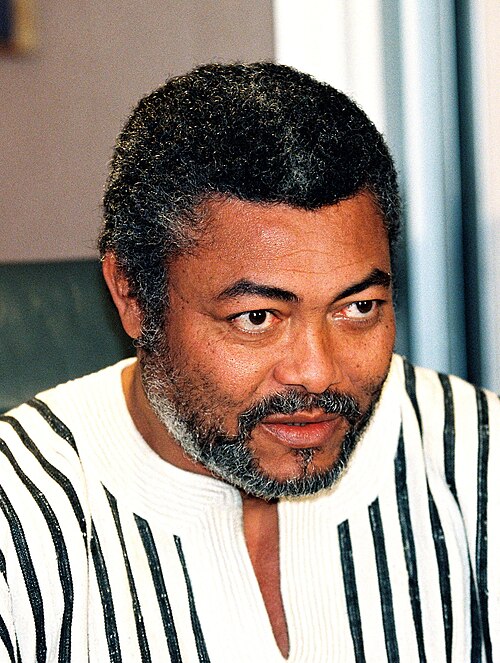
Flight Lieutenant Jerry John Rawlings† stands as one of the most pivotal and charismatic figures in the modern history of Ghana and Africa. A former military officer turned democratic statesman, his name is synonymous with revolutionary change, anti-corruption crusades, and the turbulent journey toward stable governance. As the Ex-President & AFRC Leader; GA, Rawlings led Ghana through two distinct phases: initial military interventions in 1979 and 1981, followed by a remarkable transition to a multi-party democracy where he was elected President in 1992 and 1996. His most notable achievement was overseeing Ghana's political and economic transformation in the 1990s, laying the foundational pillars for the nation's Fourth Republic, which remains the longest period of stable constitutional rule since independence. The legacy of Jerry John Rawlings† is a complex tapestry of radical populism and institutional reform that continues to shape Politics & Government in Ghana today.
Early Life & Education: Forging a Leader
Jerry John Rawlings was born on June 22, 1947, in Accra, Ghana, to a Ghanaian mother from the Volta Region and a Scottish father. His mixed heritage and middle-class upbringing provided a unique perspective on the social and colonial dynamics within Ghanaian society. He received his secondary education at the prestigious Achimota School, a breeding ground for future Ghanaian leaders. It was here that his sense of justice and leadership began to crystallize.
In 1967, driven by a sense of discipline and adventure, Rawlings enlisted in the Ghana Air Force. He excelled in his training, both locally and at military academies abroad, earning his commission as a pilot officer in 1969. His charisma and concern for the welfare of junior ranks made him a popular figure within the military. The 1970s in Ghana were marked by severe economic decline, rampant corruption among the political elite, and social unrest. Witnessing this decay firsthand from within the disciplined ranks of the military profoundly shaped Rawlings' worldview. He developed a deep-seated anger against the "old order" of politicians whom he saw as selfishly plundering the nation, an experience that would soon catalyze his dramatic entry onto the national stage.
Career & Major Achievements: From Coup to Constitution
The career of Jerry John Rawlings† is a dramatic narrative of upheaval and redemption, fundamentally altering Ghana's trajectory.
The June 4th Revolution and the AFRC
On May 15, 1979, Rawlings, then a Flight Lieutenant, led a failed mutiny. His powerful and eloquent defense during his court-martial, broadcast on national radio, turned him into a folk hero. On June 4, 1979, junior officers freed him from prison, and he led a successful coup that overthrew the Supreme Military Council. He established the Armed Forces Revolutionary Council (AFRC). This period, known as the "June 4th Revolution," was brief but bloody. The AFRC initiated a "house-cleaning" exercise, executing several former military heads of state and senior officers for corruption. After 112 days, the AFRC handed power to a civilian government led by Dr. Hilla Limann following elections.
The PNDC Era and Economic Reform
Convinced that the Limann government was failing to continue the revolution's ideals, Rawlings staged another coup on December 31, 1981. He formed the Provisional National Defence Council (PNDC), with himself as Chairman. The early PNDC years were characterized by revolutionary zeal, with People's Defence Committees and Workers' Councils wielding local power. Facing economic collapse, Rawlings made a historic pragmatic turn in 1983. He abandoned socialist policies and embraced the Economic Recovery Programme (ERP) prescribed by the International Monetary Fund and World Bank. This painful but necessary structural adjustment, supervised by his brilliant Finance Minister Kwesi Botchwey, stabilized the economy, curbed inflation, and revived growth, setting the stage for future development.
Founding Father of the Fourth Republic
Rawlings' most enduring achievement was his voluntary transition from military ruler to democratic president. Bowing to internal and external pressure for democratization, he oversaw the drafting and adoption of a new constitution in 1992. He retired from the military, founded the National Democratic Congress (NDC), and contested the presidential elections. Winning in 1992 and again in 1996, President Jerry John Rawlings† served two constitutional terms, focusing on:
- Consolidating Democratic Governance: Respecting term limits and ensuring peaceful electoral contests.
- Deepening Decentralization: Empowering local government through the District Assembly concept.
- Promoting Social Programs: Initiatives like the National Health Insurance Scheme and the Ghana Education Trust Fund (GETFund) took root during his tenure.
Personal Life & Legacy: The Rawlings Persona
Jerry John Rawlings was a man of striking presence—tall, charismatic, and a powerful orator who could connect directly with the masses in both English and local languages. He was married to Nana Konadu Agyeman-Rawlings, a formidable political figure in her own right and founder of the 31st December Women's Movement. Together, they had four children. His personal integrity, often described as spartan, was central to his appeal; he was perceived as uncorrupt and genuinely passionate about the poor ("the grassroots").
The legacy of Jerry John Rawlings† is profound and dual-edged. He is celebrated as:
- The Defender of the Voiceless: A champion of social justice who gave hope to the marginalized.
- The Architect of Stability: The leader who shepherded Ghana from chaotic coups to a durable democratic system.
- A Pan-African Icon: He was an influential voice in African affairs, advocating for strong regional bodies and criticizing neo-colonialism.
Net Worth & Business Ventures
Unlike many long-serving leaders, Jerry John Rawlings† was not associated with vast personal wealth or extensive business conglomerates. His public persona was built on a narrative of asceticism and sacrifice for the nation. He lived relatively modestly, especially compared to the pre-revolution elites he condemned. While in office, he and his family were supported by the state, as is customary for presidents. After leaving office in 2001, he received a state pension and benefits accorded to former heads of state.
His primary "venture" remained political. He earned income from speaking engagements, both within Ghana and internationally, where he was a sought-after commentator on African governance and revolution. Any precise estimation of his net worth was speculative and not publicly verified, as he maintained a clear separation from overt commercial business activities, a consistency that bolstered his image as a man of the people until his passing. His most significant asset was arguably his enduring political capital and the loyalty of a substantial portion of the Ghanaian electorate.
Net Worth Analysis
A website Africa ranking in 2016 ranked the top 10 richest men in Ghana with the former military dictator placed at the 9th position with an estimated net worth of $50 million.
Quick Stats
Related People

Aaron Motsoaledi
LP; Minister of Home Affairs

Abane Ramdane†
FLN Leader & Strategist

Abdalla Hamdok
Ex-Prime Minister

Abdallah Kigoda
Ex-Minister of Natural Resources