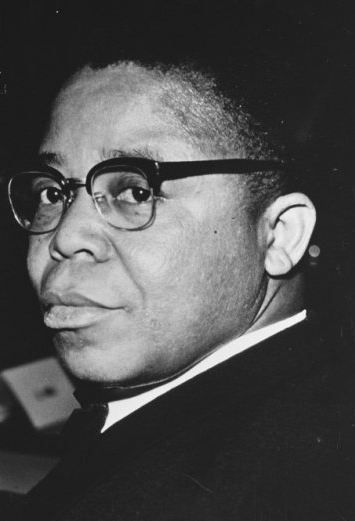
Biography
Introduction: The Founding President of a Nation
Joseph Kasa-Vubu† stands as a monumental figure in the history of Central Africa, renowned as the First President of the independent Democratic Republic of the Congo. His ascent to the nation's highest office in June 1960 marked the culmination of a fierce struggle against Belgian colonial rule and the dawn of a complex new era for the vast, resource-rich country. While his presidency was overshadowed by the catastrophic Congo Crisis, featuring secessionist wars, foreign intervention, and a bitter power struggle with Prime Minister Patrice Lumumba, Kasa-Vubu's role was foundational. A man of quiet determination and deep cultural pride, he represented a moderate, federalist vision for the Congo's Politics & Government, often clashing with more radical, centralist ideologies. His tenure, though fraught with instability, established the presidency as a key institution in Congolese political life and set the stage for the nation's tumultuous post-colonial journey.
Early Life & Education: Formative Years in a Colonial System
Joseph Kasa-Vubu was born in 1915 in the village of Kuma-Dizi, located in the Mayombe district of the Belgian Congo (now the Kongo Central province of the DRC). He hailed from the Bakongo ethnic group, a community with a rich history of pre-colonial statehood. This heritage profoundly influenced his political thought and his advocacy for federalism. His early education was provided by Catholic missionaries, a common path for promising young Congolese men under the colonial regime. Demonstrating exceptional intellect, he pursued seminary training at the prestigious Mbata Kiela and later at the Kabwe seminary, initially aiming for the priesthood.
However, Kasa-Vubu ultimately chose a different path. He left the seminary and enrolled at the Colonial Administration School in Léopoldville (now Kinshasa), graduating in 1940. This education led to a position as a clerk in the colonial finance department, a role that placed him within the bureaucratic machinery of Belgian rule. This experience provided him with an intimate understanding of the colonial system's injustices and limitations. During this period, he also immersed himself in the history and traditions of the Kongo kingdom, developing a strong cultural nationalism that would later define his political platform. His early career as a moniteur and later an évolué (a term for "evolved" or assimilated Congolese) was marked by a growing consciousness and quiet resistance, setting the stage for his future leadership in the fight for independence.
Career & Major Achievements: The Path to Presidency and the Crisis of Governance
Joseph Kasa-Vubu's political career began in earnest with his involvement in cultural and early nationalist associations. In 1955, he was elected president of the ABAKO (Alliance des Bakongo), initially an ethnic-cultural association that he rapidly transformed into a potent political vehicle for anti-colonial agitation. Under his leadership, ABAKO shifted from cultural promotion to demanding immediate independence, becoming the first major organization to do so publicly. Kasa-Vubu's famous speech on January 4, 1959, following a banned ABAKO meeting, ignited widespread protests in Léopoldville and accelerated the Belgian government's timeline for decolonization.
Road to Independence and Election as President
In the pivotal December 1959 municipal elections, ABAKO triumphed in the capital. Kasa-Vubu became Bourgmestre (mayor) of the Dendale district, a significant step toward self-rule. At the Brussels Round Table Conference in January-February 1960, where Congo's future was decided, Kasa-Vubu was a key delegate, successfully arguing for a swift independence date. When independence arrived on June 30, 1960, the new republic adopted a parliamentary system. After complex negotiations, the Parliament elected Joseph Kasa-Vubu† as the ceremonial Head of State (President) and Patrice Lumumba as the executive Prime Minister. This uneasy diarchy, split along ideological and regional lines, contained the seeds of future conflict.
The Congo Crisis and the Power Struggle
The Congo Crisis began just days after independence with the mutiny of the army and the secession of the mineral-rich Katanga province. The fundamental disagreement between President Kasa-Vubu and Prime Minister Lumumba on how to manage the crisis—including the controversial solicitation of UN and Soviet aid—led to a constitutional deadlock. On September 5, 1960, Kasa-Vubu invoked his presidential prerogative to dismiss Lumumba from office via a radio announcement. Lumumba, in turn, declared the president deposed. This mutual dismissal plunged the government into chaos and was ultimately resolved by Colonel Joseph-Désiré Mobutu's first coup on September 14, which neutralized both leaders.
After Lumumba's tragic assassination in 1961, Kasa-Vubu remained as a figurehead president through a series of weak coalition governments. His major achievement in this period was his steadfast, though often thwarted, advocacy for a federal state structure to accommodate the Congo's immense ethnic and regional diversity, a vision that contrasted sharply with Lumumba's and later Mobutu's centralist models. He managed to outmaneuver political rivals like Moise Tshombe for a time, but his authority was consistently undermined by the fractured parliament and the growing power of the military under Mobutu.
Personal Life, Legacy, and Lasting Impact
Outside the political arena, Joseph Kasa-Vubu† was known as a reserved, deeply religious, and disciplined family man. A devout Catholic, his moral framework was shaped by his early seminary education. He was married and fathered nine children. His personal demeanor—often described as calm, stubborn, and inscrutable—contrasted with the fiery oratory of many of his contemporaries. He was not a flamboyant leader but a strategic negotiator who believed in the power of institutions and traditional authority.
The legacy of Joseph Kasa-Vubu is complex and multifaceted. As the First President, he is forever enshrined as a founding father of the Democratic Republic of the Congo. His insistence on federalism remains a central and unresolved theme in Congolese Politics & Government. While his presidency failed to stabilize the nation, it represented the first attempt to navigate the immense challenges of post-colonial statecraft. His ultimate removal from power by Mobutu's second, definitive coup on November 25, 1965, ended the first republic and ushered in decades of dictatorship. Kasa-Vubu was placed under house arrest and died, largely out of the public eye, on March 24, 1969, in Boma. Today, he is remembered as a symbol of the early independence era—a leader whose moderate vision was overwhelmed by the intense pressures of the Cold War, regional secessionism, and the deep scars of colonialism.
Historical Significance and Post-Presidency
In terms of material wealth or business ventures, Joseph Kasa-Vubu† did not amass a significant personal fortune. His life was dedicated to political and civic service, first within the constraints of the colonial system and then at the helm of the nascent state. Unlike some later leaders, there are no records of extensive business holdings or personal enrichment during his tenure. His "net worth" is best measured in historical and political capital. After his ouster by Mobutu, he lived his final years in relative obscurity and poverty, a stark contrast to the opulence that would characterize the Mobutu regime. The primary sources of information on his life and presidency remain historical archives, including records from the Belgian colonial administration, transcripts from the Brussels Round Table, and documents from the United Nations operations in the Congo during the crisis. His legacy is thus not one of financial empire-building, but of constitutional and ideological foundations laid for Africa's second-largest nation during the most turbulent period of its existence.
Net Worth Analysis
Joseph Kasa-Vubu died in 1969 and was a political leader, not a business figure, so he has no contemporary net worth.
Frequently Asked Questions
What is Joseph Kasa-Vubu†'s estimated net worth?
Net worth details for Joseph Kasa-Vubu† are currently being updated.
What is Joseph Kasa-Vubu†'s role and nationality?
Joseph Kasa-Vubu† is a First President from Democratic Republic of the Congo.
How did Joseph Kasa-Vubu† make their money?
Joseph Kasa-Vubu† built their fortune primarily through Joseph Kasa-Vubu died in 1969 and was a political leader, not a business figure, so he has no contemporary net worth..
How old is Joseph Kasa-Vubu†?
Joseph Kasa-Vubu† was born in 1915 (111 years old).

Related Personalities

Aaron Motsoaledi
LP; Minister of Home Affairs • South Africa

Abane Ramdane†
FLN Leader & Strategist • Algeria

Abdalla Hamdok
Ex-Prime Minister • Sudan

Abdallah Kigoda
Ex-Minister of Natural Resources • Tanzania