Biography
Introduction: The Patriarch of Zimbabwean Liberation
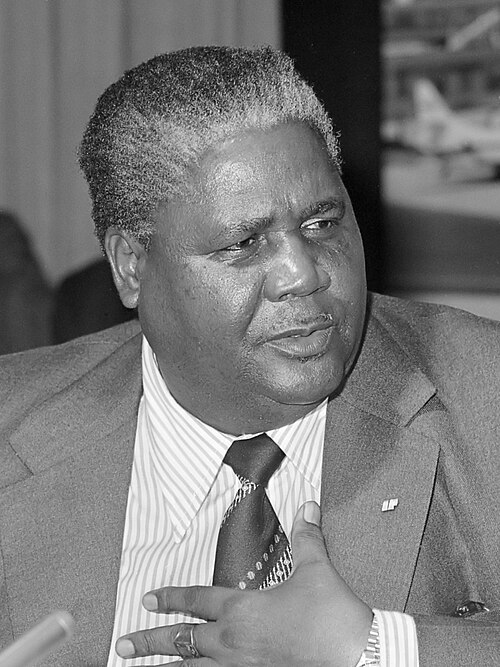
Joshua Nkomo† stands as a colossal figure in the history of Southern Africa, revered as the Father Zimbabwe for his foundational role in the nation's struggle for independence. As the founding leader of the Zimbabwe African People's Union (ZAPU), Joshua Nkomo† was a central architect of the armed and political resistance against white-minority rule in Rhodesia. His career, spanning over four decades, was defined by unwavering commitment to majority rule, unity, and social justice. Although his path was marked by political rivalry with Robert Mugabe's ZANU-PF and a period of intense conflict in the early 1980s, his legacy is ultimately one of reconciliation and nation-building. The key achievement of Joshua Nkomo† was his indispensable contribution to the Lancaster House Agreement, which paved the way for the independent state of Zimbabwe in 1980, and his subsequent role as a unifying statesman.
Early Life & Education: The Making of a Leader
Joshua Mqabuko Nyongolo Nkomo was born on June 19, 1917, in the Semokwe reserve, Matabeleland South, then part of Southern Rhodesia. He was the son of a lay preacher and cattle farmer for the London Missionary Society. This early connection to the church provided Joshua Nkomo† with his initial educational opportunities, a privilege rare for black Africans in the colonial system. He attended the Tsholotsho Primary School and later the Matebeleland Institute, a secondary school.
His formative years were shaped by the realities of racial segregation and land dispossession under colonial rule. Seeking better prospects, Joshua Nkomo† traveled to South Africa, where he studied at the Jan H. Hofmeyr School of Social Work in Johannesburg and later pursued a correspondence degree from the University of South Africa (UNISA). His time in South Africa in the 1940s exposed him to the burgeoning anti-apartheid politics and the ideas of African nationalism, which profoundly influenced his political consciousness. Upon returning to Rhodesia in 1947, he worked as a social worker for the Rhodesian Railways, where he quickly became a vocal advocate for black workers' rights, forming the Rhodesian Railways African Employees’ Association. This experience in labor organizing became the practical foundation for his future political career, teaching him the power of collective action against systemic injustice.
Career & Major Achievements: From Protest to Power
The career of Joshua Nkomo† is synonymous with the liberation movement in Zimbabwe. His political journey began in earnest in the 1950s when he was elected President of the African National Congress (ANC) of Southern Rhodesia in 1957. After the ANC was banned in 1959, he helped form the National Democratic Party (NDP) in 1960, serving as its president. When the NDP was also banned, he founded the Zimbabwe African People's Union (ZAPU) in December 1961, establishing himself as the preeminent nationalist leader.
Architect of Armed Struggle and International Diplomat
Following the banning of ZAPU in 1962 and his subsequent detention, Joshua Nkomo† concluded that peaceful protest was futile. He moved into exile and, with support from the Soviet Union and other Eastern Bloc nations, built ZAPU's military wing, the Zimbabwe People's Revolutionary Army (ZIPRA). ZIPRA became a formidable guerrilla force, operating largely from Zambia. Concurrently, Joshua Nkomo† became a masterful international diplomat, tirelessly lobbying at the United Nations and in world capitals to garner support for the Zimbabwean cause and isolate the Ian Smith regime.
The Lancaster House Agreement and Unity Accord
Despite the 1963 split that led to the formation of ZANU under Ndabaningi Sithole and later Robert Mugabe, Joshua Nkomo† remained a key negotiator. His most critical achievement came in 1979 when he, alongside Robert Mugabe and Bishop Abel Muzorewa, participated in the Lancaster House Conference in London. His pragmatic approach and authority were vital in securing the ceasefire and the constitutional agreement that led to the 1980 independence elections. Although ZAPU lost the elections to Mugabe's ZANU-PF, Joshua Nkomo† initially served in the first cabinet as Minister of Home Affairs.
Tensions between the two parties, rooted in ethnic and political rivalry, erupted into violence in Matabeleland in the early 1980s (Gukurahundi). After a period of persecution, including a brief exile, Joshua Nkomo† chose the path of peace and unity. In a monumental act of statesmanship, he signed the Unity Accord of December 22, 1987, merging ZAPU with ZANU-PF. This ended the conflict and solidified his legacy as a peacemaker. He then served as Senior Minister and later as Vice-President of Zimbabwe from 1990 until his passing, focusing on national cohesion and development.
Personal Life & Legacy: The Man Behind the Title
Beyond politics, Joshua Nkomo† was a man of deep faith, a devoted family man, and a figure of immense personal charisma. He was married to Johanna Mafuyana Nkomo, who was a steadfast supporter throughout his career. Known for his large physical stature and fatherly demeanor, he was affectionately called "Umdala Wethu" (Our Elder) or "Chibwechitedza" (the rock that is slippery to foes). His personal interests were intertwined with his people's wellbeing; he was a passionate advocate for education and cultural preservation.
The legacy of Joshua Nkomo† is multifaceted and enduring. He is remembered as:
- The founding father of Zimbabwean nationalism who pioneered organized resistance.
- A military strategist who built ZIPRA into a credible liberation army.
- A reconciler whose decision to sign the Unity Accord saved countless lives and preserved the nation.
- A symbol of unity whose vision transcended ethnic divisions.
Statues, airports, highways, and hospitals bear his name across Zimbabwe. The Joshua Mqabuko Nkomo International Airport in Bulawayo and the national holiday, Unity Day (celebrated on December 22), stand as permanent testaments to his life's work. His autobiography, Nkomo: The Story of My Life, remains a vital primary source for understanding Zimbabwe's liberation era.
Net Worth & Business Ventures
While Joshua Nkomo† was primarily a political leader and not a business magnate, his financial standing and assets were a topic of public interest, particularly in post-independence Zimbabwe. He was known to have interests in various sectors, including transport and publishing. Notably, he owned the popular Kingstons Limited retail chain, which became one of the largest Zimbabwean-owned retail businesses at the time. He also had a significant stake in the Zimbabwean newspaper, The Chronicle.
His wealth, however, was often contextualized within the political landscape. During the early 1980s, the government accused him of hoarding arms, and his assets were seized—a move widely seen as politically motivated. After the Unity Accord in 1987, some properties were returned. It is crucial to view the business ventures of Joshua Nkomo† not just commercially but as part of his broader vision for black economic empowerment and self-sufficiency in a post-colonial economy. His estate and the management of his business interests remain part of the family's and the nation's heritage.
Joshua Mqabuko Nyongolo Nkomo passed away on July 1, 1999, from prostate cancer. He was declared a National Hero and is buried at the National Heroes Acre in Harare, his legacy forever etched as the Father of the Zimbabwean nation.
Frequently Asked Questions
What is Joshua Nkomo†'s estimated net worth?
Net worth details for Joshua Nkomo† are currently being updated.
What is Joshua Nkomo†'s role and nationality?
Joshua Nkomo† is a Father Zimbabwe & ZAPU Leader from Zimbabwe.
How did Joshua Nkomo† make their money?
Joshua Nkomo† built their fortune primarily through Joshua Nkomo was a political leader, not a business figure, and passed away in 1999. His wealth was not comparable to billionaire business magnates..
How old is Joshua Nkomo†?
Joshua Nkomo† was born in 1917 (109 years old).
Which category is Joshua Nkomo† listed under?
Joshua Nkomo† is featured under the Politics & Government category on NetWorth Africa.
How is Joshua Nkomo†'s net worth calculated?
NetWorth Africa estimates financial valuations using publicly available stock equity holdings, company ownership records, real estate assets, and verified market data.
Net Worth Analysis
Joshua Nkomo was a political leader, not a business figure, and passed away in 1999. His wealth was not comparable to billionaire business magnates.
Quick Stats
Related People
Aaron Motsoaledi
LP; Minister of Home Affairs • South Africa
Abane Ramdane†
FLN Leader & Strategist • Algeria
Abdalla Hamdok
Ex-Prime Minister • Sudan
Abdallah Kigoda
Ex-Minister of Natural Resources • Tanzania