Financial Breakdown
Asset Distribution
Assets vs Liabilities
Assets
Disclaimer: These financial estimates are based on publicly available information and should be considered approximate. Last updated: 12/29/2025
Biography
Introduction: The Architect of Tanzanian Unity
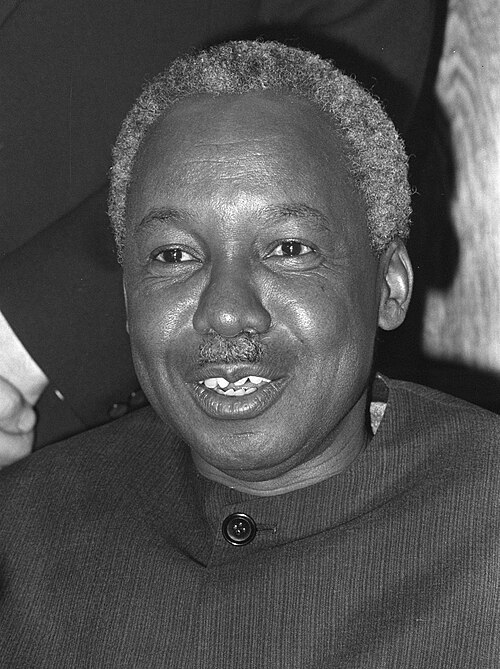
Mwalimu Julius Kambarage Nyerere† stands as one of Africa's most revered and influential statesmen of the 20th century. As the First President & Father of Nation of Tanzania, his legacy is etched into the very fabric of East African Politics & Government. A schoolteacher turned liberation leader, Julius Nyerere† led Tanganyika to peaceful independence from British colonial rule in 1961 and later orchestrated the union with Zanzibar in 1964, creating the United Republic of Tanzania. His most defining contribution was his unwavering commitment to national unity, social justice, and African self-reliance, encapsulated in his development philosophy of Ujamaa (familyhood). A man of profound personal integrity, he championed Swahili as a national language, promoted education for all, and became a leading voice for the Global South, earning him the affectionate title "Mwalimu," meaning teacher.
Early Life & Education: The Making of Mwalimu
Julius Nyerere† was born on April 13, 1922, in the small village of Butiama, on the eastern shore of Lake Victoria, in what was then British-administered Tanganyika. He was the son of Chief Nyerere Burito of the Zanaki people. His early life in a rural, polygamous household gave him a deep understanding of traditional African communal values, which would later form the bedrock of his political philosophy. A gifted student, he attended a local primary school before progressing to the Government Secondary School in Tabora, a prestigious institution for the African elite.
His academic prowess earned him a place at Makerere University College in Kampala, Uganda, where he obtained a Diploma in Education in 1947. It was here that his political consciousness began to awaken, and he founded the Tanganyika Welfare Association. Returning to Tanganyika, he taught at St. Mary's College in Tabora. In 1949, he won a scholarship to study at the University of Edinburgh, becoming one of the first Tanganyikans to study at a British university. He graduated with an MA in History and Economics in 1952. This formative period in Britain exposed him to Fabian socialist thought and the broader anti-colonial movements, solidifying his resolve to fight for his country's independence through non-violent, constitutional means.
Career & Major Achievements: From Liberation to Ujamaa
Upon returning home in 1952, Julius Nyerere† resumed teaching but quickly immersed himself in politics. In 1954, he transformed the Tanganyika African Association into the Tanganyika African National Union (TANU), a mass movement dedicated to achieving independence. His eloquent advocacy for Uhuru (freedom) and multi-racial harmony made TANU a dominant force. Through persistent negotiation and moral persuasion, he led Tanganyika to sovereign statehood on December 9, 1961, with remarkably little bloodshed, becoming its first Prime Minister and, in 1962, its first President.
The Arusha Declaration and Ujamaa
In 1967, Julius Nyerere† unveiled the Arusha Declaration, a landmark policy that defined Tanzania's path. It committed the nation to socialism and self-reliance (Ujamaa). Key tenets included:
- Nationalization of major industries, banks, and plantations.
- The creation of Ujamaa Vijijini (socialist villages) to collectivize agriculture and improve rural services.
- A Leadership Code that barred government and TANU officials from holding private shares or directorships, aimed at preventing corruption.
Promoter of Unity and Pan-Africanism
One of Julius Nyerere's† greatest achievements was fostering unparalleled national unity in a continent often plagued by ethnic strife. He made Swahili the national language, which became a powerful unifying tool. His role in the 1964 union with Zanzibar created the stable state of Tanzania. On the international stage, he was a steadfast supporter of liberation movements in Southern Africa, providing sanctuary and logistical support to groups like FRELIMO (Mozambique) and the ANC (South Africa). He was a founding father of the Organisation of African Unity (OAU) and a respected moral voice for non-alignment during the Cold War.
Personal Life & Legacy: The Teacher's Enduring Impact
Despite holding the highest office, Julius Nyerere† lived a life of notable personal modesty, consistent with his principles. He was married to Maria Gabriel Nyerere, and the couple had several children. He was a devout Roman Catholic, and his faith deeply influenced his ethical approach to governance. After an unprecedented 24 years in office, he voluntarily stepped down from the presidency in 1985, setting a powerful precedent for peaceful transfer of power in Africa—a rarity at the time. In retirement, he remained active as an elder statesman, mediating conflicts in Burundi and Rwanda. He passed away from leukemia on October 14, 1999, in London.
The legacy of Julius Nyerere† is complex but profoundly impactful. He bequeathed to Tanzania a lasting legacy of peace, stability, and national identity that continues to distinguish the country in a turbulent region. His ideas on democracy, equality, and human dignity remain subjects of intense study and admiration. Institutions like the University of Dar es Salaam and the Nyerere Foundation continue to promote his intellectual heritage. Annually, Tanzanians commemorate Nyerere Day on October 14, reflecting on the life of the man who shaped their nation.
Net Worth & Philosophy of Leadership
In the context of Politics & Government, assessing Julius Nyerere's† legacy in terms of personal net worth or business ventures is to misunderstand his core philosophy. He explicitly rejected personal wealth accumulation as incompatible with ethical leadership. The Arusha Declaration's Leadership Code mandated that leaders derive income only from their official salaries. True to his word, Julius Nyerere† lived a simple life. He retired to a modest house in his home village of Butiama. His "wealth" was measured in the respect he commanded globally and the social capital of a united nation. He had no private business empires; his life's work was the nation-building project of Tanzania. This conscious eschewal of material riches cemented his reputation as a leader of extraordinary integrity, whose value lies not in financial statements, but in the enduring stability and unity of the country he founded.
Frequently Asked Questions
What is Julius Nyerere†'s estimated net worth?
Net worth details for Julius Nyerere† are currently being updated.
What is Julius Nyerere†'s role and nationality?
Julius Nyerere† is a First President & Father of Nation from Tanzania.
How did Julius Nyerere† make their money?
Julius Nyerere† built their fortune primarily through Julius Nyerere was a political leader known for his modest lifestyle and socialist policies; he was not a business figure and died in 1999 with no significant personal wealth..
How old is Julius Nyerere†?
Julius Nyerere† was born in 1922 (104 years old).
Which category is Julius Nyerere† listed under?
Julius Nyerere† is featured under the Politics & Government category on NetWorth Africa.
How is Julius Nyerere†'s net worth calculated?
NetWorth Africa estimates financial valuations using publicly available stock equity holdings, company ownership records, real estate assets, and verified market data.
Net Worth Analysis
Julius Nyerere was a political leader known for his modest lifestyle and socialist policies; he was not a business figure and died in 1999 with no significant personal wealth.
Quick Stats
Related People
Aaron Motsoaledi
LP; Minister of Home Affairs • South Africa
Abane Ramdane†
FLN Leader & Strategist • Algeria
Abdalla Hamdok
Ex-Prime Minister • Sudan
Abdallah Kigoda
Ex-Minister of Natural Resources • Tanzania