Financial Breakdown
Asset Distribution
Assets vs Liabilities
Assets
Disclaimer: These financial estimates are based on publicly available information and should be considered approximate. Last updated: 12/29/2025
Biography
Introduction: The "Robocop" of Tunisian Politics
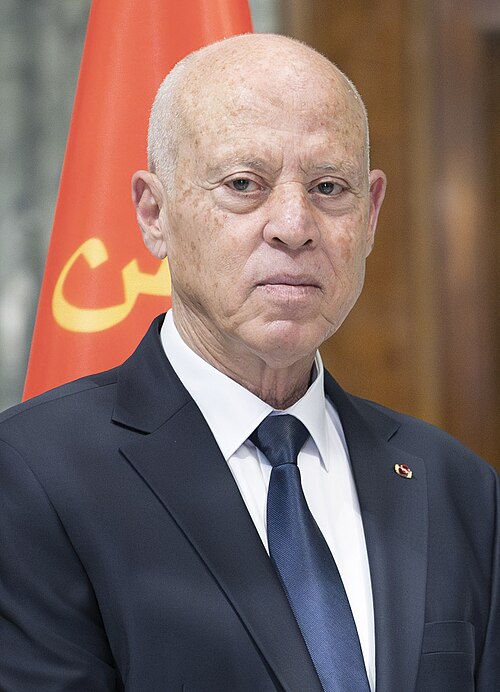
Kais Saied is the eighth and current President of Tunisia, a role he assumed in October 2019 following a landslide electoral victory. His rise to the highest office in the nation was unprecedented, catapulting a constitutional law professor with no prior political experience or party affiliation into the heart of Politics & Government. Often nicknamed "Robocop" for his rigid, formal demeanor and unwavering adherence to a strict personal code, Saied presented himself as an incorruptible outsider dedicated to restoring the dignity of the state and fighting the corruption that plagued the post-revolution political class. His key initial achievement was winning the presidential election with a staggering 72.71% of the vote in the second round, a massive mandate for change from a populace disillusioned with the established political system. However, his presidency has since become one of the most controversial chapters in modern Tunisian history, defined by a dramatic consolidation of power and a fundamental shift in the country's democratic trajectory.
Early Life & Education: The Making of a Legal Purist
Kais Saied was born on February 22, 1958, in the Bouchniba neighborhood of Tunis. Hailing from a modest family with roots in the rural region of Beni Khiar, near the coastal city of Nabeul, his upbringing was marked by a emphasis on discipline, austerity, and moral integrity. These values would become the cornerstone of his public persona decades later.
His academic path was squarely focused on law and justice. He pursued his higher education at the Faculty of Judicial and Political Sciences of Tunis, where he earned his bachelor's degree in law in 1980. His passion for constitutional law led him to further studies, and he obtained a Master's degree in public law in 1986. Saied's intellectual journey culminated in a deep specialization in constitutional law, a field that would define his career and, ultimately, his political ideology. He taught this subject for decades at the Faculty of Judicial and Political Sciences in Sousse, and also served as a legal expert for Arab organizations. Notably, his formative experiences included a long-standing involvement with the Tunisian Association of Constitutional Law, where he was known for his principled, often literal, interpretations of legal texts. This rigid, text-based approach to law and state structure, formed over years in academia, would later be applied directly to his governance of Tunisia.
Career & Major Achievements: From Professor to President
Before his political ascent, Kais Saied's career was almost entirely academic. For over three decades, he was a professor of constitutional law, shaping the minds of future lawyers and judges. He built a reputation as a stern, meticulous scholar who was deeply critical of the constitutional developments under former President Zine El Abidine Ben Ali. He was also known for his conservative social views and his advocacy for a decentralized form of government where local councils held significant power, a concept he termed "local democracy."
The 2019 Electoral Earthquake
Saied entered the 2019 presidential race as a complete outsider, listed as an independent. His campaign was unorthodox and low-budget, shunning large rallies in favor of small, direct meetings with citizens. His communication style was starkly formal, and he delivered detailed, uncharismatic speeches filled with legal terminology. Paradoxically, this anti-charisma became his appeal. In a crowded field of established but distrusted politicians, Saied's image as an austere, principled, and incorruptible figure resonated powerfully with voters exhausted by economic stagnation and political infighting. He stunned the nation by topping the first round of voting on September 15, 2019, and then achieved a historic victory in the runoff on October 13, 2019, defeating his opponent with over 72% of the vote.
The July 25 Turn and Presidential Exceptional Measures
The defining moment of Kais Saied's presidency began on July 25, 2021. Citing Article 80 of the Tunisian constitution, which allows for temporary exceptional measures in the face of "imminent danger," he suspended parliament, dismissed the prime minister, and assumed executive authority. He later lifted parliamentary immunity and oversaw the arrest of several MPs and prominent businessmen. While initially welcomed by many Tunisians frustrated with a paralyzed government, these actions marked the start of a prolonged political crisis. Saied subsequently ruled by decree, dismissing judges, dissolving the High Judicial Council, and pushing through a new constitution via referendum in July 2022.
A New Constitution and Centralized Power
A major achievement, in his view, was the adoption of a new constitution in 2022. Drafted by a committee he appointed and approved by a referendum with 94.6% "yes" votes (though with a low turnout of only 30.5%), the new constitution fundamentally altered Tunisia's political system. It replaced the mixed parliamentary-presidential system of the 2014 constitution with a hyper-presidential model. The new text grants the Executive Presidency sweeping powers, including:
- The ability to legislate by decree when parliament is not in session.
- Dominance over the appointment of the government and judiciary.
- Greatly reduced checks and balances from other branches of government.
Personal Life & Legacy: Austerity and Controversy
Kais Saied's personal life is intensely private and mirrors his public austerity. He is known to live a modest, almost ascetic lifestyle. He reportedly refused to move into the opulent presidential palace in Carthage, preferring instead to work from the modest headquarters of the Ministry of Defense. He often walks to official events and is driven in ordinary cars, cultivating an image of a "man of the people" who rejects the privileges of office. He is married and has three children, who are kept entirely out of the public spotlight.
His legacy is fiercely contested and still unfolding. To his supporters, he remains the "savior of the nation," a fearless leader who took necessary, if drastic, action to break a corrupt political elite and restore sovereignty to the state. They see his project as a "corrective revolution" to salvage the original goals of the 2011 Jasmine Revolution. To his critics, both domestically and internationally, Kais Saied has engineered a constitutional coup, systematically dismantling Tunisia's fragile democratic institutions, undermining judicial independence, and suppressing dissent. His tenure has been marked by increasing authoritarianism, a severe economic crisis, and the marginalization of opposition voices. The lasting impact of his presidency will likely be judged by whether his centralized model can address Tunisia's profound socio-economic challenges or if it leads to a permanent erosion of the democratic gains of 2011.
Net Worth & Business Ventures
Unlike many political figures in the region, Kais Saied's financial profile aligns with his narrative of personal austerity. There is no available evidence or credible reporting to suggest he has significant business ventures or holdings. His wealth appears to be derived almost exclusively from his decades-long career as a university professor and his state salary as president. In a region where leaders often amass considerable personal fortunes, Saied's apparent lack of wealth is a key component of his political identity. He has publicly framed his modest lifestyle as a virtue and a direct rejection of the corruption he associates with the political class. As such, discussions of his net worth typically conclude that it is modest, especially when compared to the fortunes associated with previous Tunisian leaders. His "business," so to speak, has been academia and constitutional law, not commerce or industry.
For further information on the political context of Tunisia, you can refer to credible sources such as Encyclopedia Britannica's Tunisia page or follow updates from major international news agencies covering Politics & Government in the region.
Frequently Asked Questions
What is Kais Saied's estimated net worth?
Kais Saied has an estimated net worth of R 16.2 Million.
What is Kais Saied's role and nationality?
Kais Saied is a President of Tunisia from Tunisia.
How did Kais Saied make their money?
Kais Saied built their fortune primarily through As a career public servant and academic before becoming president, his wealth is not from business; no credible public source reports billionaire or significant personal wealth..
How old is Kais Saied?
Kais Saied was born in 1958 (68 years old).
Which category is Kais Saied listed under?
Kais Saied is featured under the Politics & Government category on NetWorth Africa.
How is Kais Saied's net worth calculated?
NetWorth Africa estimates financial valuations using publicly available stock equity holdings, company ownership records, real estate assets, and verified market data.
Net Worth Analysis
As a career public servant and academic before becoming president, his wealth is not from business; no credible public source reports billionaire or significant personal wealth.
Quick Stats
Related People
Aaron Motsoaledi
LP; Minister of Home Affairs • South Africa
Abane Ramdane†
FLN Leader & Strategist • Algeria
Abdalla Hamdok
Ex-Prime Minister • Sudan
Abdallah Kigoda
Ex-Minister of Natural Resources • Tanzania