Financial Breakdown
Asset Distribution
Assets vs Liabilities
Assets
Disclaimer: These financial estimates are based on publicly available information and should be considered approximate. Last updated: 12/29/2025
Biography
Introduction: The Architect of Zambian Independence
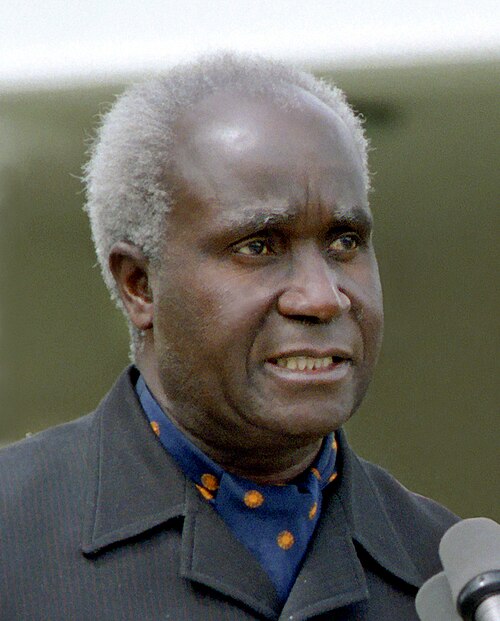
Dr. Kenneth Kaunda†, affectionately known as "KK," stands as a monumental figure in the annals of African history. As the First President & Founding Father of the Republic of Zambia, he led the nation to independence from British colonial rule on October 24, 1964. A central leader of the Independence Era in Southern Africa, Kenneth Kaunda† was not only a statesman but also a passionate pan-Africanist and a key voice in the fight against apartheid. His 27-year presidency, guided by his unique philosophy of "Zambian Humanism," shaped the nation's early identity. This biography explores the life, achievements, and complex legacy of a man who dedicated his life to the freedom and unity of his people and the African continent.
Early Life & Education: Formative Years in Northern Rhodesia
Kenneth David Kaunda† was born on April 28, 1924, at Lubwa Mission in the Chinsali district of what was then Northern Rhodesia. He was the youngest of eight children born to missionary-teachers. His father, David Kaunda, was from Nyasaland (present-day Malawi) and was one of the first African missionaries ordained by the Church of Scotland in the region. This early exposure to education and Christian values deeply influenced young Kenneth. Tragedy struck early when his father died while he was only eight years old, a loss that profoundly shaped his character.
Kaunda followed in his parents' footsteps, training as a teacher at the same Lubwa Mission. He later studied at Munali Training Centre in Lusaka. His career began in education, teaching in Northern Rhodesia and Tanganyika (now Tanzania). However, the injustices of colonial rule steered him toward politics. A pivotal moment came in 1951 when he joined the Northern Rhodesian African National Congress (ANC). His political education was further honed through reading the works of Mahatma Gandhi, whose philosophy of non-violent resistance became a cornerstone of his own political strategy. These formative experiences—rooted in faith, education, and the stark reality of colonialism—forged the resolve of the future president.
Career & Major Achievements: From Activist to President
Kenneth Kaunda's† political career was defined by his relentless pursuit of independence. Frustrated with the ANC's moderate stance, he broke away in 1958 to form the Zambia African National Congress (ZANC), advocating for more decisive action. This led to his imprisonment by British authorities in 1959. Upon his release in 1960, he assumed leadership of the newly-formed United National Independence Party (UNIP). UNIP, under Kaunda's charismatic leadership, mobilized mass support through a campaign of civil disobedience known as the "Cha-cha-cha" campaign in 1961, which ultimately forced the British to agree to constitutional reforms and elections.
The Presidency and Zambian Humanism
On October 24, 1964, Northern Rhodesia became the independent Republic of Zambia, with Kenneth Kaunda† as its first president. He immediately faced immense challenges: a nation with minimal infrastructure, deep ethnic divisions, and economic dependence on its southern neighbors. In response, Kaunda formulated "Zambian Humanism," a socialist-leaning philosophy that sought to build a just and compassionate society based on traditional African values, rejecting both capitalism and Marxism. He nationalized key industries, particularly the copper mines, which provided vital revenue but later became a source of economic strain.
Pan-Africanism and the Anti-Apartheid Struggle
Beyond Zambia's borders, Kenneth Kaunda† earned international respect as a frontline statesman. He provided sanctuary, logistical support, and a diplomatic voice for liberation movements fighting white minority rule in Southern Africa, including:
- The African National Congress (ANC) and Pan Africanist Congress (PAC) of South Africa.
- The Zimbabwe African National Union (ZANU) and Zimbabwe African People's Union (ZAPU).
- The South West Africa People's Organization (SWAPO) of Namibia.
- The Mozambique Liberation Front (FRELIMO).
Economic Challenges and Democratic Transition
The 1970s and 1980s brought severe economic decline due to falling copper prices, failed economic policies, and the burdens of supporting liberation wars. By the late 1980s, domestic pressure for change mounted. In a move that cemented his legacy as a democrat, Kaunda acquiesced to demands for multi-party politics. He allowed free elections in 1991, where he was defeated by Frederick Chiluba of the Movement for Multi-Party Democracy (MMD). His peaceful acceptance of defeat was a rare and powerful example of democratic transition in Africa.
Personal Life, Philanthropy & Legacy
Kenneth Kaunda† was known for his distinctive personal style—a suit and tie paired with a traditional African sash, and his ever-present white handkerchief, which became his political symbol. He was a devout Christian and a talented musician, often using his love for singing hymns and folk songs to connect with crowds. In 1946, he married Betty Banda, and together they had eight children. The family endured profound tragedy, most notably the death of their son Masuzyo to AIDS in 1986. This personal loss transformed Kaunda into a leading African advocate for AIDS awareness and research, a cause he championed tirelessly in his post-presidential years.
The legacy of Kenneth Kaunda† is multifaceted. He is universally revered as the father of the Zambian nation, a unifier who held a fragile country together. His unwavering support for liberation movements was crucial to the downfall of apartheid and colonial rule in Southern Africa. Domestically, his legacy is mixed; while he maintained peace and national unity for decades, his economic policies are often criticized for contributing to Zambia's poverty. Nevertheless, his commitment to pan-Africanism and his graceful exit from power remain inspirational. He passed away on June 17, 2021, at the age of 97, leaving behind a continent that owes him a great debt of gratitude.
Net Worth & Post-Presidential Life
Unlike many long-serving leaders, Kenneth Kaunda† was not known for amassing significant personal wealth. His lifestyle was relatively modest, especially after leaving office. Following his 1991 election loss, he faced some difficult years, including having his Zambian citizenship briefly revoked in 1999. He remained active in diplomacy and philanthropy, focusing on HIV/AIDS advocacy through the Kenneth Kaunda Children of Africa Foundation. His primary source of income in later life was a state pension and support from international foundations for his charitable work. His "net worth" was measured not in financial capital, but in the immense moral and political capital he held across Africa. He lived a life dedicated to public service, leaving a legacy that far transcends material wealth, cementing his status as one of Africa's most respected elder statesmen.
For further reading on the life of Kenneth Kaunda†, refer to credible historical sources and archives such as the Encyclopædia Britannica and the South African History Online.
Frequently Asked Questions
What is Kenneth Kaunda†'s estimated net worth?
Net worth details for Kenneth Kaunda† are currently being updated.
What is Kenneth Kaunda†'s role and nationality?
Kenneth Kaunda† is a First President & Founding Father from Zambia.
How did Kenneth Kaunda† make their money?
Kenneth Kaunda† built their fortune primarily through Kenneth Kaunda was a public servant and statesman, not a business figure, and was widely known for his modest lifestyle. He passed away in 2021..
How old is Kenneth Kaunda†?
Kenneth Kaunda† was born in 1924 (102 years old).
Which category is Kenneth Kaunda† listed under?
Kenneth Kaunda† is featured under the Politics & Government category on NetWorth Africa.
How is Kenneth Kaunda†'s net worth calculated?
NetWorth Africa estimates financial valuations using publicly available stock equity holdings, company ownership records, real estate assets, and verified market data.
Net Worth Analysis
Kenneth Kaunda was a public servant and statesman, not a business figure, and was widely known for his modest lifestyle. He passed away in 2021.
Quick Stats
Related People
Aaron Motsoaledi
LP; Minister of Home Affairs • South Africa
Abane Ramdane†
FLN Leader & Strategist • Algeria
Abdalla Hamdok
Ex-Prime Minister • Sudan
Abdallah Kigoda
Ex-Minister of Natural Resources • Tanzania