$1B
Estimated Net Worth
As of 2024 • low confidence
Biography
Introduction: The Defining Figure of Eastern Libya
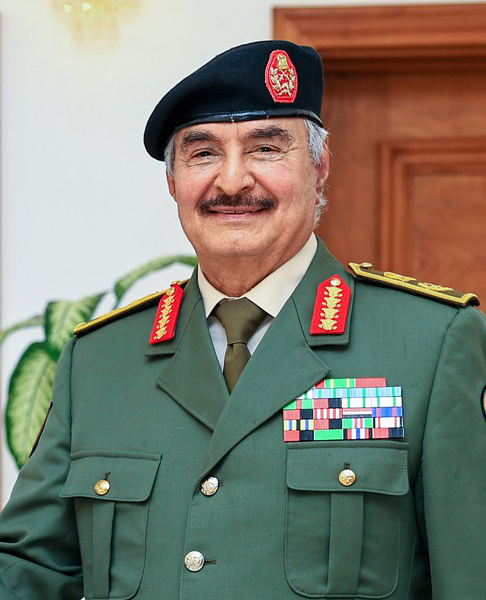
Field Marshal Khalifa Belqasim Haftar stands as one of the most pivotal and polarizing military figures in modern Libyan history. As the Commander of the Libyan National Army (LNA), the dominant force in eastern Libya, Haftar has shaped the nation's trajectory since the 2011 revolution and the subsequent civil conflicts. His rise from a young officer in Muammar Gaddafi's army to a U.S.-resident exile, and finally to a military strongman controlling vast swathes of Libya, is a story of survival, ambition, and relentless political maneuvering. Haftar's key achievement lies in his consolidation of power in Cyrenaica, unifying disparate armed groups under the LNA banner and positioning himself as a central player in any resolution to Libya's enduring instability. His 2019-2020 campaign to capture the capital, Tripoli, although unsuccessful, underscored his national ambitions and solidified his role as a kingmaker in the fragmented Libyan landscape.
Early Life and Formative Military Education
Khalifa Haftar was born in 1943 in the city of Ajdabiya, in eastern Libya's region of Cyrenaica. His early life was rooted in the tribal and social fabric of the area, which would later form a crucial base of his support. Drawn to a military career, he enrolled in the Royal Military Academy in Benghazi, graduating as a second lieutenant. His professional education continued abroad, a common path for promising Libyan officers of his generation. Haftar furthered his military studies in the Soviet Union, attending training programs that equipped him with conventional warfare tactics and solidified his foundational military doctrine.
These formative years were critical in shaping the future LNA Field Marshal. His education coincided with the rise of Muammar Gaddafi, who seized power in a 1969 coup. As a young officer, Haftar aligned himself with Gaddafi's Revolutionary Command Council and quickly rose through the ranks. He played a notable role in the early years of the Gaddafi regime, participating in the 1973 Libyan occupation of the Aouzou Strip in Chad. This experience in desert warfare and cross-border operations would prove significant, but it also set the stage for the dramatic rupture that would define the next chapter of his life.
Career and Major Achievements: From Exile to Power
The career of Khalifa Belqasim Haftar is marked by dramatic shifts in allegiance, exile, and a formidable comeback. His journey can be segmented into three distinct phases: service under Gaddafi, exile and opposition, and his return to command the LNA.
Service Under Gaddafi and the Chad Conflict
Haftar served as a senior officer in the Libyan Army during the prolonged conflict in Chad. By the mid-1980s, he was the commander of Libyan forces in Chad. In 1987, his unit suffered a catastrophic defeat at the hands of Chadian forces during the Toyota War. Haftar, along with hundreds of his soldiers, was captured. In a move that branded him a traitor in Gaddafi's eyes, Libya's leader disavowed the captured troops. This betrayal became the catalyst for Haftar's break with the regime. Upon his release, he refused to return to Libya and instead founded the anti-Gaddafi Libyan National Army, a predecessor in name to his current force, and joined the U.S.-backed National Front for the Salvation of Libya.
Exile and Relationship with Foreign Powers
For nearly two decades, Khalifa Haftar lived in exile, primarily in Langley, Virginia, in the United States. This period, from the 1990s until the 2011 revolution, remains shrouded in some mystery but is widely believed to have involved a relationship with the Central Intelligence Agency (CIA). His proximity to U.S. intelligence and political circles during this time provided him with networks and an understanding of Western political systems that few other Libyan figures possessed. He remained a figurehead of the opposition, biding his time until the Arab Spring created an opportunity for return.
Return and Rise as LNA Field Marshal
Haftar returned to Libya in 2011 to join the NATO-backed uprising that toppled Gaddafi. Initially sidelined by the new transitional authorities, he patiently rebuilt his influence. His major breakthrough came in February 2014, when he appeared on television to announce the "suspension" of the General National Congress and the creation of a new presidential committee, an event known as his "self-coup." Although this move initially failed in Tripoli, it resonated in the east. Later that year, as Libya splintered, he launched Operation Dignity, a campaign against Islamist militias in Benghazi and eastern Libya. This operation became the foundation of his reborn Libyan National Army (LNA).
His major achievements include:
- Unification of Eastern Forces: By 2016-2017, Haftar successfully consolidated control over most of eastern and central Libya, integrating tribal militias and former Gaddafi-era officers into a structured, if irregular, military force.
- Capture of Key Oil Infrastructure: In a strategic masterstroke, his forces seized the Libyan "Oil Crescent" ports in 2016, giving him control over the country's primary economic lifeline and a powerful tool for political negotiation.
- The Battle for Benghazi: After a brutal three-year campaign, Haftar's LNA declared victory in Benghazi in July 2017, expelling Islamist and other rival militias and solidifying his reputation as a strongman who could deliver security.
- Southern Campaign (2019): The LNA swiftly captured the vast Fezzan region in southern Libya, securing critical cross-border trade routes and national infrastructure.
In September 2016, the House of Representatives in Tobruk, the internationally recognized parliament based in the east, promoted him to the rank of Field Marshal, cementing his formal authority. His most ambitious move, the April 2019 offensive to capture Tripoli, ultimately stalled and failed after 14 months of fighting, but it demonstrated his capacity to challenge the UN-recognized Government of National Accord (GNA) directly and reshaped the geopolitical map of the conflict.
Personal Life, Legacy, and Lasting Impact
Outside of his military persona, Khalifa Belqasim Haftar maintains a private family life. He is married and has several sons, some of whom hold influential positions within the LNA command structure, leading to discussions about dynastic control. His public image is carefully curated as that of a secular nationalist and a strongman who can bring order to chaos, an appeal that resonates with populations weary of militia violence and political dysfunction.
His legacy is inextricably tied to the fragmentation of Libya. Haftar has established a de facto state in eastern Libya, with its own government, military, and financial institutions. He has positioned himself as an indispensable actor, without whom no sustainable peace agreement can be reached. Supporters view him as Libya's potential savior—a figure capable of defeating extremism and restoring the state. Critics, however, condemn him as an aspiring military dictator whose actions have prolonged the civil war and whose forces have been accused of human rights abuses. Regardless of perspective, the lasting impact of Khalifa Haftar is undeniable: he has ensured that any future Libyan state must either incorporate or decisively defeat the powerful institutional and tribal coalition he has built in the east.
Strategic Position and Sources of Power
While not a traditional business magnate, Khalifa Haftar's power base is underpinned by control of critical economic and strategic assets. The LNA's command over Libya's primary oil terminals and fields provides him with immense leverage. While the National Oil Corporation in Tripoli officially sells the crude, Haftar's ability to blockade production—as demonstrated in 2020 and 2022—grants him a decisive voice in national revenue distribution. Furthermore, his alliances with foreign powers, including the United Arab Emirates, Egypt, and Russia (via the Wagner Group), have provided the LNA with essential military support, funding, and political backing. This external patronage, combined with control of territory and resources, constitutes the foundation of his influence, making him a formidable economic and political entity in his own right within the context of Libya.
In conclusion, Field Marshal Khalifa Belqasim Haftar remains the most powerful military leader in Libya. His journey from exile to the pinnacle of power reflects the turbulent history of his nation. As Libya continues to navigate its post-revolutionary path, the role of the LNA Field Marshal will undoubtedly be central to determining whether the country moves toward unity or solidified partition.
Net Worth Analysis
As a powerful military commander controlling Libya's oil-rich east, his wealth is believed to stem from control over state resources and smuggling, but no authoritative public financial disclosures exist.
Quick Stats
Related People

Abdel Hakim Belhaj
Ex-Tripoli Military Commander
Abdul Raziq al-Nazhuri
LNA Chief of Staff
Abdussalam al-Hassi
LNA General

Adel Abdel Ghaffar
EAF; EAF Spokesman; Spokesman