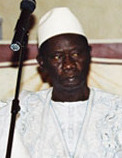
$50M
Estimated Net Worth
As of 2024 • medium confidence
Financial Breakdown
Asset Distribution
Assets vs Liabilities
Assets
Disclaimer: These financial estimates are based on publicly available information and should be considered approximate. Last updated: 12/29/2025
Biography
Introduction: The Soldier-President of Guinea
Lansana Conté† stands as a defining figure in the modern political history of the Republic of Guinea. As a military officer who seized power in a 1984 coup, he ruled the West African nation for nearly a quarter-century, from 1984 until his death in 2008. His tenure as President of Guinea was marked by a complex blend of authoritarian control, economic stagnation, and a pivotal, if reluctant, shift towards multiparty politics. Conté's rule followed the oppressive regime of Ahmed Sékou Touré, and he initially promised reform and liberalization. However, his 24-year presidency became characterized by entrenched military rule, allegations of human rights abuses, and the management of a country endowed with immense mineral wealth yet plagued by profound poverty. Understanding Lansana Conté† is crucial to understanding Guinea's challenging path in the late 20th and early 21st centuries.
Early Life and Military Education
Lansana Conté was born on November 30, 1934, in Moussayah Loumbaya, a village in the Dubréka region of what was then French Guinea. He belonged to the Susu ethnic group, one of Guinea's major communities. His early life was rooted in rural West Africa, but his career path would take him far from his village. Seeking opportunity and education, Conté enlisted in the French colonial army. He received his military training at the prestigious École Militaire Préparatoire Africaine (African Preparatory Military School) in Bingerville, Côte d'Ivoire, and later at the École des Officiers de Fréjus in France.
These formative experiences in the colonial military structure shaped Conté's worldview and professional skills. He served France during the Algerian War, gaining practical combat and command experience. After Guinea gained independence under Sékou Touré in 1958, Conté transferred his allegiance to the new nation's armed forces. He steadily climbed the ranks within the Guinean military, earning a reputation as a competent and disciplined officer. His career progression occurred against the backdrop of Touré's increasingly paranoid and isolated regime, which viewed the military with suspicion. This context of political tension and economic decline under Touré's rule set the stage for Conté's eventual seizure of power.
Career and Major Achievements: The Conté Presidency
The death of President Ahmed Sékou Touré on March 26, 1984, created a power vacuum in Guinea. Just six days later, on April 3, 1984, a military junta led by Lansana Conté† and Colonel Diarra Traoré staged a bloodless coup. They abolished the constitution, dissolved the sole political party, and established the Military Committee for National Recovery (CMRN), with Conté as President.
Initial Reforms and Economic Liberalization
Initially, Conté's government was welcomed by many Guineans and the international community. He moved away from Touré's harsh socialist policies, initiating a period of economic liberalization. Key early actions included:
- Releasing political prisoners detained under Touré.
- Encouraging the return of exiles and fostering a more open political climate.
- Implementing structural adjustment programs with the IMF and World Bank to stabilize the economy.
- Attracting foreign investment, particularly in Guinea's vast bauxite and mineral sectors.
Consolidation of Power and Authoritarian Rule
Any momentum toward democracy quickly faded. Conté survived an attempted coup by his deputy, Diarra Traoré, in 1985, which he used to further purge rivals. In 1990, a new constitution was approved via referendum, but it was carefully crafted to maintain Conté's dominance. When Guinea's first multiparty elections were finally held in 1993, Lansana Conté† stood as a civilian candidate and claimed victory. The opposition and international observers widely denounced the election as fraudulent. This pattern repeated in the 1998 and 2003 presidential elections, which were also marred by allegations of rigging and preceded by opposition crackdowns.
His rule faced significant challenges, including a devastating incursion by rebel forces from Sierra Leone and Liberia in 2000, which he repelled with military force. Domestically, his government became synonymous with corruption, nepotism, and economic mismanagement. Despite Guinea being the world's second-largest producer of bauxite, its population remained among the poorest globally. Conté's health also became a major political issue in his later years, with frequent trips abroad for medical treatment fueling instability.
Final Years and Mass Protests
The final chapter of Conté's presidency was marked by severe social unrest. In 2007, nationwide strikes and protests erupted over soaring prices, corruption, and Conté's refusal to step down. Security forces responded with lethal violence, killing over 100 protesters. In a dramatic move, Conté dismissed his entire government and appointed a close ally as prime minister, but he retained ultimate power. His physical frailty became increasingly apparent, yet he clung to office until his final breath.
Personal Life, Legacy, and Lasting Impact
Lansana Conté was known for a reclusive and stern personal demeanor. He was a devout Muslim. His personal life, particularly concerning his health, was often shrouded in secrecy, which contributed to political uncertainty. He married several times and had multiple children. Unlike some autocrats, he did not establish a significant public persona centered on grand philanthropy or cultural patronage; his legacy is almost entirely political and economic.
The legacy of Lansana Conté† is profoundly contested and complex. On one hand, he oversaw the end of the Touré dictatorship's extreme isolation and introduced a nominal multiparty system. He maintained a degree of stability and kept Guinea from collapsing into full-scale civil war during a turbulent regional period. On the other hand, his 24-year rule is critically assessed as a missed opportunity. He failed to translate Guinea's mineral riches into broad-based development, presided over rampant corruption that entrenched elite networks, and systematically suppressed democratic aspirations. His death on December 22, 2008, triggered another military coup within hours, highlighting the brittle, personalized nature of the state he had built. His presidency ultimately serves as a pivotal case study in the challenges of post-colonial governance, the pitfalls of military rule, and the management of resource wealth in Africa.
Net Worth and Business Interests
While no precise, verified figure for Lansana Conté's net worth was ever published, it was widely understood that he and his inner circle amassed considerable personal wealth during his presidency. Guinea's economy is dominated by the mining sector, particularly bauxite, diamonds, and gold. Conté's regime was frequently accused of signing opaque contracts with foreign mining companies, with rumors of significant off-book benefits flowing to the presidential circle. His family and close associates were believed to have major interests in various business ventures, from mining concessions to import-export companies. This perceived concentration of national wealth among a small elite, contrasted with the population's poverty, was a central grievance during the mass protests of 2007. The financial opacity of his rule meant that his true personal fortune remained undisclosed, but it is considered a part of the broader pattern of alleged state capture that defined his era in Guinea.
For further reading on the political context of his rule, credible sources include the Encyclopædia Britannica and historical analyses from institutions like the Council on Foreign Relations.
Net Worth Analysis
As a former long-term president of a low-income country, his wealth was not publicly documented like a business billionaire. He was not on any Forbes list, and posthumous assessments suggest his family's wealth was in the tens of millions, not billions.
Quick Stats
Related People
Aaron Motsoaledi
LP; Minister of Home Affairs
Abane Ramdane†
FLN Leader & Strategist
Abdalla Hamdok
Ex-Prime Minister
Abdallah Kigoda
Ex-Minister of Natural Resources