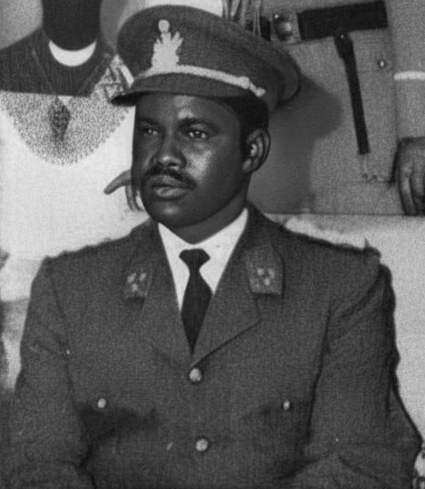
Biography
Introduction: The Soldier-President of Burundi
Captain Michel Micombero† stands as a pivotal and controversial figure in the history of Central Africa. As the First President (1966-1976) of the Republic of Burundi, he was the architect of the nation's transformation from a constitutional monarchy into a one-party military republic. His rise to power in November 1966 marked a definitive end to the Burundian monarchy and ushered in a new, turbulent chapter for the young nation. A key player in the Politics & Government of the post-colonial Independence Era, Michel Micombero† is notable for centralizing state power, promoting a nationalist ideology, and presiding over one of the most tragic episodes in the region's history: the 1972 genocide against the Hutu population. His decade-long rule fundamentally shaped the political and ethnic dynamics of Burundi, leaving a legacy that continues to resonate today.
Early Life & Education: From Rural Roots to Military Academy
Michel Micombero† was born in 1940 in the province of Rutovu, in the southern part of the Belgian-administered Ruanda-Urundi territory. He belonged to the Tutsi ethnic group, specifically the Hima clan, which would later influence his political alliances. His early education took place in local Catholic missionary schools, a common path for ambitious young men in the territory. Demonstrating academic promise, he was selected for further training, a privilege granted to few under the colonial system.
His formative experiences were deeply shaped by a military orientation. He attended the Officer Training School in Brussels, Belgium, where he received a formal European military education. This was followed by studies at the Royal Military Academy in Bruges. Upon returning to his homeland, which achieved independence as the Kingdom of Burundi in 1962 under King Mwambutsa IV, Micombero continued his ascent. He furthered his military credentials at the École d'État-Major (Staff College) in Paris, France. This elite education positioned him as one of the best-trained officers in the nascent Burundian army, setting the stage for his rapid rise in a country where the military was becoming an increasingly powerful political force amidst post-independence instability.
Career & Major Achievements: The Path to Power and Authoritarian Rule
The career of Michel Micombero† progressed with remarkable speed, mirroring the political chaos of early independent Burundi. After independence, he was appointed as the Aide-de-Camp to King Mwambutsa IV. By 1965, at just 25 years old, he had risen to the rank of Captain and was appointed Minister of Defense, a critical role during a period of intense Hutu-Tutsi tension and failed Hutu-led coup attempts.
The 1966 Coup and Creation of the Republic
In July 1966, while King Mwambutsa was abroad, Prince Charles Ndizeye deposed his father in a palace coup, declaring himself King Ntare V. Michel Micombero† was a key supporter and was appointed Prime Minister. However, the alliance was short-lived. On November 28, 1966, Micombero launched his own bloodless coup, deposing the young king. He abolished the monarchy outright, proclaimed the Republic of Burundi, and installed himself as its first President, Prime Minister, and Minister of Defense. This move consolidated the military's hold on Politics & Government and made him the undisputed leader at age 26.
Consolidation of Power and Ideology
As President, Michel Micombero† established a one-party state under the Union for National Progress (UPRONA). He promoted a nationalist, revolutionary socialist ideology, aligning Burundi with non-aligned and sometimes communist-bloc nations. His government emphasized state control of the economy and sought to reduce foreign influence. He created a youth militia, the Jeunesses Révolutionnaires Rwagasore (JRR), to mobilize support and enforce party doctrine, further entrenching his authoritarian system.
The 1972 Crisis and Its Aftermath
The defining and darkest period of Micombero's presidency began in April 1972. Following a Hutu-led rebellion and the killing of thousands of Tutsis in the south, the regime retaliated with extreme and systematic violence. Micombero's government, military, and the JRR launched a massive, coordinated campaign of repression targeting Hutu civilians, particularly the educated elite, civil servants, students, and anyone perceived as a threat. Estimates from international observers and historians suggest between 100,000 to 300,000 people, predominantly Hutu, were killed in what is widely classified as a genocide. This catastrophe decimated a generation of Hutu leadership and entrenched ethnic polarization for decades. While his government survived, its international standing was severely damaged, and internal dissent grew.
Personal Life, Downfall & Legacy
Compared to his very public political role, Michel Micombero† kept his personal life relatively private. He was known as a devout Roman Catholic and was married. His interests were largely consumed by the affairs of state and maintaining control in a deeply fractured nation. His rule became increasingly isolated and paranoid following the 1972 events.
His downfall came a decade after his ascent. In November 1976, he was overthrown in a bloodless coup led by his close associate and fellow Tutsi-Hima officer, Lieutenant Colonel Jean-Baptiste Bagaza, while he was attending a Franco-African summit. Micombero was initially placed under house arrest and later went into exile in Somalia, where he lived until his death from a heart attack in 1983.
The legacy of Michel Micombero† is profoundly complex and overwhelmingly shadowed by the 1972 genocide. He is credited with creating the modern Burundian republic and asserting its sovereignty, but his rule institutionalized military dictatorship and ethnic-based violence as tools of governance. His actions set a tragic precedent for future conflicts in Burundi and the Great Lakes region. In the context of Politics & Government, he remains a stark example of how revolutionary beginnings can descend into authoritarianism and mass atrocity in the volatile post-colonial landscape.
Net Worth & Business Ventures
As with many authoritarian leaders of his era, precise details of Michel Micombero†'s personal net worth are not publicly documented. However, his position as the absolute head of state in a one-party system allowed for significant control over national resources. During his presidency, the state heavily controlled the economy, particularly the vital coffee sector, which accounted for the vast majority of Burundi's export revenue. It is widely understood that Micombero and the ruling elite benefited from this system through patronage networks and control of state enterprises. There is no record of significant private business ventures independent of the state apparatus; his wealth and influence were intrinsically tied to his political and military power. Following his overthrow and exile, he lived without visible opulence, and his estate did not attract significant international attention, suggesting that his accumulation of wealth was not on the scale of some other contemporary African leaders.
Key Facts & Timeline
- 1940: Born in Rutovu, Ruanda-Urundi.
- 1965: Appointed Minister of Defense.
- November 28, 1966: Executed coup, abolished monarchy, proclaimed Republic of Burundi, becoming First President.
- April 1972: Hutu rebellion sparked a genocidal retaliation by the regime, resulting in an estimated 100,000-300,000 deaths.
- November 1976: Overthrown by Jean-Baptiste Bagaza and exiled to Somalia.
- 1983: Died in exile in Mogadishu, Somalia.
For further reading on this period, credible sources include the Encyclopædia Britannica, historical analyses from the United States Holocaust Memorial Museum, and academic works on the Great Lakes region of Africa.
Net Worth Analysis
Michel Micombero was a military ruler of Burundi, one of the world's poorest countries, and died in 1983. There is no credible information suggesting he accumulated significant personal wealth, and any state assets he controlled would not constitute personal net worth.
Quick Stats
Related People
Aaron Motsoaledi
LP; Minister of Home Affairs
Abane Ramdane†
FLN Leader & Strategist
Abdalla Hamdok
Ex-Prime Minister
Abdallah Kigoda
Ex-Minister of Natural Resources