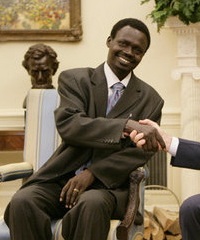
Biography
Introduction: The Commander of the Sudan Liberation Movement
Minni Arko Minnawi stands as one of the most prominent and enduring figures in the turbulent landscape of modern Sudanese Politics & Government. As the leader of a major faction of the Sudan Liberation Movement/Army (SLM/A), his name has been inextricably linked to the struggle for justice, autonomy, and development in the war-ravaged region of Darfur. Born in 1968, Minnawi rose from a background of local activism to become a formidable military commander and a central signatory to a major, albeit faltering, peace agreement. His journey from rebel leader to a senior statesman in Sudan's transitional government, and back to the battlefield following the outbreak of new conflict in 2023, encapsulates the complex and cyclical nature of conflict and politics in Sudan. Understanding the role of Minni Minnawi is crucial to understanding the dynamics of the Darfur Movement and the ongoing challenges facing the nation.
Early Life and Education: Formative Years in Darfur
Minni Arko Minnawi was born in 1968 in the town of Garba, located in the Zalingei area of central Darfur. He is a member of the Zaghawa ethnic group, a community spread across the border region of Sudan and Chad, which would later form a significant part of the rebel forces in Darfur. His early life was shaped by the marginalization felt by many non-Arab groups in Darfur, who complained of economic neglect and political disenfranchisement by successive central governments in Khartoum.
Minnawi pursued higher education, which set him apart from many of his contemporaries in the rebel movements. He attended the University of Khartoum, where he studied history and graduated with a degree. It was during this period in the capital that his political consciousness was further sharpened. He witnessed firsthand the disparities between the center and the peripheries like Darfur. After graduation, he returned to Darfur and worked as a teacher and later as a school principal, professions that earned him respect within his community. These formative experiences—academic study, direct observation of inequality, and community leadership—laid the groundwork for his eventual mobilization into armed resistance, transforming the educator into a commander.
Career and Major Achievements: From Rebellion to Politics and Back
The career of Minni Minnawi is a chronicle of the Darfur conflict itself. In the early 2000s, as long-simmering tensions in Darfur erupted into full-scale war, Minnawi helped found and became the Secretary-General of the Sudan Liberation Movement (SLM), one of the two main rebel groups that launched the insurgency in 2003. The SLM's initial manifesto demanded an end to marginalization and called for a unified, democratic Sudan.
Rise to Leadership and the Darfur Peace Agreement
Minnawi's faction, known as SLM-Minnawi, grew in strength and influence. His strategic acumen and the disciplined Zaghawa fighters under his command made him a key player. His major career achievement came in May 2006, when he became the only rebel leader to sign the Darfur Peace Agreement (DPA) with the government of President Omar al-Bashir. This landmark deal, negotiated in Abuja, Nigeria, appointed Minnawi as the Senior Assistant to the President of Sudan—effectively making him the fourth-highest ranking official in the country—and the Chairman of the newly established Transitional Darfur Regional Authority (TDRA).
However, this achievement was double-edged. The DPA was rejected by other major factions, leading to a splintering of the rebel movement and a continuation of the violence. Minnawi's acceptance of a high office in Khartoum was viewed by many Darfuris as a capitulation or a move for personal power. By 2010, disillusioned with the government's failure to implement the peace accord, he resigned from his post and returned to armed opposition, relaunching his rebellion from bases in South Darfur and the Jebel Marra area.
Role in Sudan's Political Transition and Return to War
Following the ouster of Omar al-Bashir in April 2019, Minni Minnawi re-entered the political arena. He engaged with the civilian-military transitional government that took power. In a significant move, he signed the Juba Peace Agreement (JPA) in October 2020 alongside other armed groups from Darfur, South Kordofan, and the Blue Nile. This agreement granted him a position in the reconstituted Sovereignty Council, Sudan's collective head of state, and the governorship of the Darfur region. For a time, it appeared Minnawi had transitioned fully from a rebel commander to a senior administrator tasked with implementing peace and stabilizing his homeland.
This fragile peace collapsed with the outbreak of war in April 2023 between the Sudanese Armed Forces (SAF) and the paramilitary Rapid Support Forces (RSF). Minnawi, along with other former rebel leaders like JEM's Gibril Ibrahim, aligned his forces with the SAF in a broad anti-RSF coalition. He has since commanded troops on the ground in Darfur, participating in intense battles, notably the defense of the strategic town of El Fasher in North Darfur in 2024. This return to warfare marked a dramatic pivot in his career, underscoring the unresolved root causes of the Darfur conflict.
Personal Life, Legacy, and Lasting Impact
While much of Minni Minnawi's public life is defined by conflict, his personal motivations are rooted in the aspiration for a just and developed Darfur. Colleagues describe him as a pragmatic and determined figure. His legacy is complex and contested. To some, he is a principled freedom fighter who dared to sign a peace deal and attempt governance. To others, he is a divisive figure whose actions contributed to the fragmentation of the Darfur Movement and whose alliances have shifted with the political winds.
His lasting impact lies in his embodiment of the Darfur struggle's trajectory: from a popular uprising against marginalization, through fractured peace processes, into high-level politics, and back to a devastating new war. He remains a symbol of the Zaghawa community's military and political influence in western Sudan. Whether his legacy will ultimately be that of a peacemaker who failed due to circumstances, or a warlord who perpetuated conflict, depends heavily on the still-uncertain outcome of Sudan's current war and the future stability of Darfur.
Net Worth and Business Ventures
As with many leaders of protracted armed movements, details about Minni Minnawi's personal net worth and business interests are not publicly transparent or verifiable. His financial resources have historically been tied to the fortunes of his faction, the SLM/A. Funding for rebel groups in Darfur has typically come from a combination of sources, including:
- Control over and taxation of local resources and trade routes in areas under their influence.
- Support from diaspora communities and regional allies.
- During periods of peace agreements, such as after the 2006 DPA and the 2020 JPA, resources would have been channeled through official government structures for disarmament, demobilization, and integration programs, as well as for development projects in Darfur.
There is no credible public record of Minnawi owning significant private business ventures outside of his political-military role. His "wealth" is predominantly political and military in nature, measured in troop loyalty, control of territory, and his seat at the table during critical negotiations for Sudan's future. Any assessment of his finances remains speculative and is deeply entangled with the opaque political economy of conflict in the region.
Frequently Asked Questions
What is Minni Minnawi's estimated net worth?
Minni Minnawi has an estimated net worth of $5.0 Million.
What is Minni Minnawi's role and nationality?
Minni Minnawi is a SLM Leader from Sudan.
How did Minni Minnawi make their money?
Minni Minnawi built their fortune primarily through Minni Minnawi is a Sudanese rebel/political leader, not a business figure; his wealth stems from political/military leadership, not corporate assets, and he is not listed on any billionaire ranking..
How old is Minni Minnawi?
Minni Minnawi was born in 1968 (58 years old).
Which category is Minni Minnawi listed under?
Minni Minnawi is featured under the Politics & Government category on NetWorth Africa.
How is Minni Minnawi's net worth calculated?
NetWorth Africa estimates financial valuations using publicly available stock equity holdings, company ownership records, real estate assets, and verified market data.
Net Worth Analysis
Minni Minnawi is a Sudanese rebel/political leader, not a business figure; his wealth stems from political/military leadership, not corporate assets, and he is not listed on any billionaire ranking.
Quick Stats
Related People
Aaron Motsoaledi
LP; Minister of Home Affairs • South Africa
Abane Ramdane†
FLN Leader & Strategist • Algeria
Abdalla Hamdok
Ex-Prime Minister • Sudan
Abdallah Kigoda
Ex-Minister of Natural Resources • Tanzania