$70B
Estimated Net Worth
As of 2024 • medium confidence
Financial Breakdown
Asset Distribution
Assets vs Liabilities
Assets
Liabilities
Disclaimer: These financial estimates are based on publicly available information and should be considered approximate. Last updated: 12/30/2025
Biography
Introduction: The Enigmatic "Brother Leader"
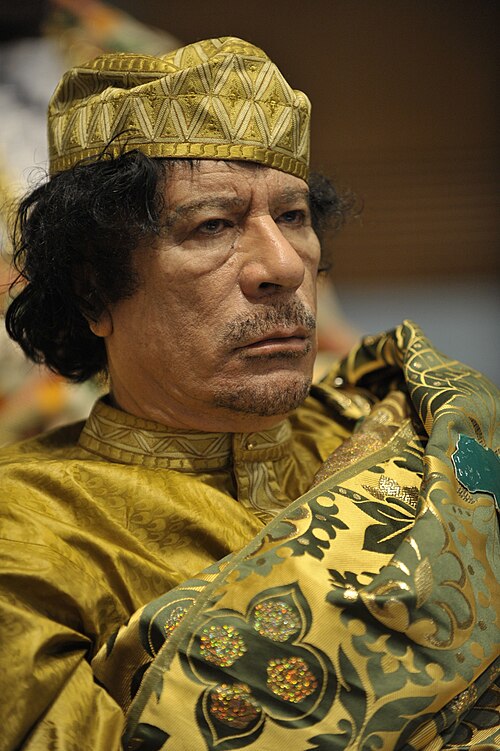
Colonel Muammar Gaddafi† was a towering, polarizing, and enigmatic figure who ruled Libya for 42 years, from his revolutionary coup in 1969 until his death in 2011. As the self-styled "Brother Leader" and "Guide of the Revolution," he transformed the North African nation from a conservative monarchy into a socialist-oriented state governed by his unique political philosophy, outlined in his Green Book. His tenure as the Ex-Leader of Libya was marked by dramatic shifts in ideology, confrontations with the West, pan-African ambitions, and ultimately, a violent downfall during the Arab Spring. His life remains a critical study in the Politics & Government of the post-colonial Arab world and Africa.
Early Life & Education: From Bedouin Tents to Military Academy
Muammar Mohammed Abu Minyar Gaddafi was born in 1942 near the desert town of Sirte, Libya, into a nomadic Bedouin family of the Qadhadhfa tribe. This humble, tribal upbringing instilled in him a deep sense of Arab identity, anti-colonial sentiment, and a disdain for the urban elite. His formative years were shaped by the recent independence of Libya in 1951 under King Idris I and the growing tide of Arab nationalism led by Egypt's Gamal Abdel Nasser.
Gaddafi's education was a mix of traditional Quranic schooling and modern secular instruction. A bright and politically active student, he organized protests against the monarchy while in secondary school. In 1963, he entered the Royal Military Academy in Benghazi, where his charisma and revolutionary fervour allowed him to form the "Free Officers Movement," a clandestine group inspired by Nasser's Egyptian revolution. He later received further military training in the United Kingdom, but his ideological focus remained firmly on overthrowing the pro-Western Libyan monarchy, which he viewed as corrupt and illegitimate.
Career & Major Achievements: Revolution, The Jamahiriya, and International Firebrand
The defining moment in the career of Muammar Gaddafi† came on September 1, 1969. While King Idris was abroad, Gaddafi and his Free Officers executed a nearly bloodless coup, abolishing the monarchy and proclaiming the Libyan Arab Republic. At just 27 years old, he became the de facto head of state, initially as Chairman of the Revolutionary Command Council.
Consolidating Power and The Third International Theory
Gaddafi quickly centralized authority, expelled foreign military bases, and nationalized the oil industry in the early 1970s, using the vast revenues to fund ambitious social programs. In the mid-1970s, he formally stepped down from official posts, but remained the supreme leader. He introduced his political system, the Jamahiriya or "state of the masses," a direct democracy without political parties, theoretically governed by local "people's congresses." His ideology, a blend of Arab nationalism, socialism, and Islamic principles, was detailed in his three-volume Green Book.
Domestic Policies and International Relations
Domestically, Gaddafi's rule brought significant improvements in education, healthcare, and infrastructure, funded by Libya's oil wealth. Literacy rates soared, and housing was considered a human right. However, this was coupled with severe repression of dissent, a pervasive surveillance state, and the brutal suppression of political opponents.
On the world stage, Muammar Gaddafi† was a constant provocateur. He supported revolutionary and militant groups worldwide, from the IRA to Palestinian factions, earning Libya the label of a state sponsor of terrorism. His confrontations with the West peaked in the 1980s, culminating in the 1986 US bombing of Tripoli and Benghazi and the 1988 Lockerbie bombing, for which Libyan agents were eventually held responsible. After years of sanctions, Gaddafi sought rehabilitation in the 2000s, renouncing WMDs and cooperating on counter-terrorism.
Pan-African Vision
In his later years, Gaddafi shifted his focus from Arab unity to African leadership. He used Libya's oil wealth to invest heavily in Africa, championed the formation of the African Union, and advocated for a "United States of Africa" with a single military and currency, positioning himself as a "King of Kings" on the continent.
Personal Life, Downfall & Legacy
Gaddafi cultivated a flamboyant and unpredictable public persona, often surrounded by female bodyguards and wearing elaborate, theatrical costumes. He lived relatively modestly compared to other autocrats but ensured his family held significant power and wealth. His personal life was private, though he had eight children with his second wife, Safia.
His legacy is fiercely contested. Supporters point to his early social reforms, anti-imperialist stance, and advocacy for Africa. Critics highlight a 42-year dictatorship marked by human rights abuses, economic mismanagement despite oil riches, and international isolation. The end for the Ex-Leader of Libya came swiftly during the 2011 Arab Spring. Protests escalated into a civil war, backed by a NATO-led intervention. After months of conflict, Gaddafi was captured and killed by rebel forces in his hometown of Sirte on October 20, 2011.
The death of Muammar Gaddafi† did not bring stability to Libya. Instead, the country fractured into a prolonged state of conflict between rival militias and governments, a chaotic aftermath that continues to shape discussions about his complex and devastating legacy in Politics & Government.
Net Worth, Wealth, and Business Ventures
Estimating the personal fortune of Muammar Gaddafi† and his family is challenging due to secrecy and the diffuse nature of Libyan state assets. However, at the time of his fall in 2011, international investigators and governments estimated the Gaddafi family's wealth to be in the tens of billions of dollars. This wealth was not held in a traditional sense but was embedded in a vast network of state-controlled investment vehicles, foreign holdings, and lavish personal spending.
Key assets identified included:
- Control over the Libyan Investment Authority (LIA), a sovereign wealth fund with estimated assets of $67 billion.
- Significant stakes in multinational corporations like Juventus Football Club, Fiat, and the Italian bank UniCredit via silent partnerships.
- Extensive real estate portfolios across Europe, particularly in the United Kingdom and Italy.
- Vast cash reserves, gold hoards, and other liquid assets discovered during the revolution.
Net Worth Analysis
At the time of his death in 2011, various international sources, including the IMF and US officials, estimated his hidden assets and state-controlled wealth to be in the tens of billions, with $70 billion being a commonly cited figure for his family's fortune.
Quick Stats
Related People

Aaron Motsoaledi
LP; Minister of Home Affairs

Abane Ramdane†
FLN Leader & Strategist

Abdalla Hamdok
Ex-Prime Minister

Abdallah Kigoda
Ex-Minister of Natural Resources