Biography
Introduction: A Historic Appointment in Libyan Politics
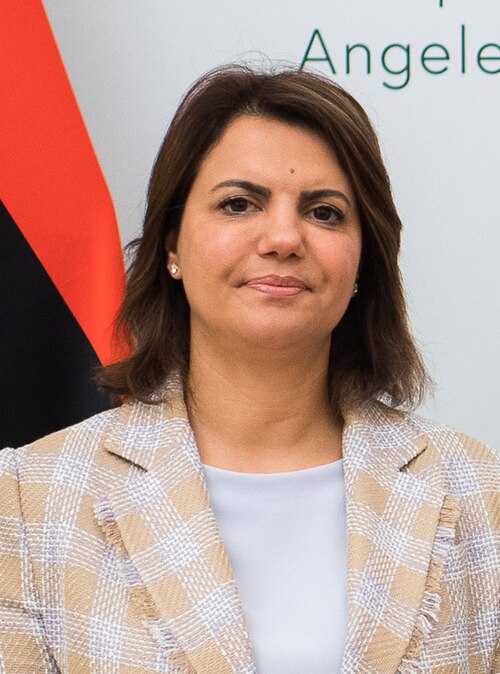
Najla al-Mangoush stands as a pivotal figure in contemporary Libyan Politics & Government. Appointed in March 2021, she made history by becoming the first woman to hold the position of Minister of Foreign Affairs in Libya, a landmark achievement in a nation navigating a complex post-revolution landscape. Her appointment by the Government of National Unity (GNU), led by Prime Minister Abdul Hamid Dbeibeh, signaled a commitment to inclusivity and new diplomatic approaches. As the chief diplomat for a country fractured by conflict and external interference, Najla al-Mangoush assumed one of the most challenging roles in international Diplomacy. Her tenure has been defined by efforts to unify Libya's foreign policy, advocate for the withdrawal of foreign forces, and represent the nation on critical global stages, including the United Nations and regional forums. Her work is central to Libya's quest for stability and sovereignty.
Early Life and Education: Foundations of a Diplomat
Born in 1970, Najla al-Mangoush's formative years were shaped within the socio-political context of Libya under Muammar Gaddafi. While specific details of her early family life are kept private, her academic and professional trajectory reveals a deep commitment to law, conflict resolution, and human rights. Her educational path provided the robust foundation necessary for her future in Politics & Government.
Al-Mangoush pursued higher education with a focus on legal and peace studies. She earned a Bachelor of Law degree, which grounded her in the principles of justice and governance. Driven by an interest in resolving the kinds of conflicts that would later engulf her homeland, she furthered her studies internationally. She obtained a Master's degree in Conflict Transformation and a PhD in Peace Studies from George Mason University's prestigious Jimmy and Rosalynn Carter School for Peace and Conflict Resolution in the United States. This academic background equipped Najla al-Mangoush with a theoretical and practical toolkit in mediation, transitional justice, and peacebuilding—expertise that would become directly applicable to Libya's situation post-2011.
Formative Professional Experiences
Before her ministerial appointment, al-Mangoush built a career centered on civil society and democratic transition. She worked with the National Transitional Council following the 2011 revolution, engaging in efforts to build new state institutions. Her role as a participant in the Libyan National Dialogue process was particularly significant, where she contributed to frameworks for political reconciliation. Furthermore, she served as the Libyan Cultural Attaché in Washington, D.C., an early diplomatic role that provided her with invaluable experience in international representation and cross-cultural communication, foreshadowing her later responsibilities as Minister of Foreign Affairs.
Career and Major Achievements: Steering Libyan Diplomacy
The career of Najla al-Mangoush represents a journey from civil society activism to the apex of governmental authority. Her appointment as Foreign Minister in 2021 was not merely symbolic but a test of her lifelong training in conflict resolution.
Key Responsibilities and Diplomatic Agenda
Upon taking office, al-Mangoush faced a monumental task: presenting a coherent foreign policy for a government whose authority was contested and operating in a country hosting thousands of foreign mercenaries and troops. Her primary stated objectives included:
- Unifying Libya's International Voice: Ending the duplication of diplomatic missions and ensuring the GNU spoke as the sole legitimate executive authority internationally.
- Advocating for Foreign Force Withdrawal: Consistently calling for the full implementation of the 2020 ceasefire agreement, demanding the departure of all foreign fighters and mercenaries from Libyan soil.
- Engaging Regional and International Actors: Navigating complex relationships with neighboring states (Egypt, Tunisia, Algeria, Chad, Niger) and global powers to build consensus for Libya's stability and elections.
- Promoting National Reconciliation: Using diplomatic channels to support internal dialogue processes aimed at healing the country's divisions.
Notable Moments and Challenges
Al-Mangoush's tenure featured several high-profile moments. She actively participated in Arab League summits, United Nations General Assembly meetings, and conferences on Libyan stability in Berlin and Paris. In late 2021, she played a visible role in the Paris International Conference for Libya. However, her term was also marked by significant controversy. Her meeting with Israeli Foreign Minister Eli Cohen in Rome in August 2023 sparked a major political firestorm in Libya, leading to her suspension and subsequent dismissal by Prime Minister Dbeibeh. This incident highlighted the intense political sensitivities within Libya and the precarious nature of diplomatic maneuvering in its polarized environment. Despite this, her work in attempting to professionalize the foreign ministry and assert a sovereign Libyan position on the world stage remains a notable chapter in the country's recent political history.
Personal Life, Legacy, and Impact
Najla al-Mangoush maintains a private personal life, with limited public information about her family or interests outside the demanding sphere of Politics & Government. This privacy is common among Libyan public figures navigating a volatile political climate. Her legacy, however, is defined by her professional breakthroughs and the precedent she set.
As the first female Foreign Minister of Libya, al-Mangoush broke a significant glass ceiling in a traditionally male-dominated field. Her appointment inspired many Libyan women and demonstrated the potential for greater female participation in high-level governance and Diplomacy. Her approach, rooted in her academic background in peace studies, emphasized dialogue and conflict transformation—a stark contrast to more combative political styles. While her tenure was cut short, her insistence on the principle of sovereignty and the removal of foreign forces resonated with a broad segment of the Libyan public weary of external interference. The long-term impact of her work will be judged by the future trajectory of Libyan foreign policy and the continued integration of technical expertise and inclusive representation in its diplomatic corps.
Net Worth and Business Ventures
There is no publicly available or verified information regarding the personal net worth, assets, or private business ventures of Najla al-Mangoush. Her career has been primarily in public service, academia, and civil society, sectors not typically associated with the accumulation of significant personal wealth. In the context of Libyan Politics & Government, financial disclosures for public officials are not standardized or made public, making any estimation of her finances speculative. Unlike some figures in global politics, al-Mangoush has not been reported to have interests in commercial enterprises or industries. Her professional focus appears to have remained on legal scholarship, conflict resolution, and diplomatic service. Any discussion of financial matters pertaining to Libyan ministers is generally situated within broader critiques of state transparency and governance, rather than individual wealth.
For further information on the political context of Libya, readers can refer to credible sources such as the United Nations Support Mission in Libya (UNSMIL) or trusted international news archives covering Libyan affairs.
Frequently Asked Questions
What is Najla al-Mangoush's estimated net worth?
Najla al-Mangoush has an estimated net worth of $1.0 Million.
What is Najla al-Mangoush's role and nationality?
Najla al-Mangoush is a Minister of Foreign Affairs from Libya.
How did Najla al-Mangoush make their money?
Najla al-Mangoush built their fortune primarily through As a public servant and diplomat, her wealth is not publicly reported and is not comparable to business leaders; estimated based on typical earnings for a senior government official in Libya..
How old is Najla al-Mangoush?
Najla al-Mangoush was born in 1970 (56 years old).
Which category is Najla al-Mangoush listed under?
Najla al-Mangoush is featured under the Politics & Government category on NetWorth Africa.
How is Najla al-Mangoush's net worth calculated?
NetWorth Africa estimates financial valuations using publicly available stock equity holdings, company ownership records, real estate assets, and verified market data.
Net Worth Analysis
As a public servant and diplomat, her wealth is not publicly reported and is not comparable to business leaders; estimated based on typical earnings for a senior government official in Libya.
Quick Stats
Related People
Aaron Motsoaledi
LP; Minister of Home Affairs • South Africa
Abane Ramdane†
FLN Leader & Strategist • Algeria
Abdalla Hamdok
Ex-Prime Minister • Sudan
Abdallah Kigoda
Ex-Minister of Natural Resources • Tanzania