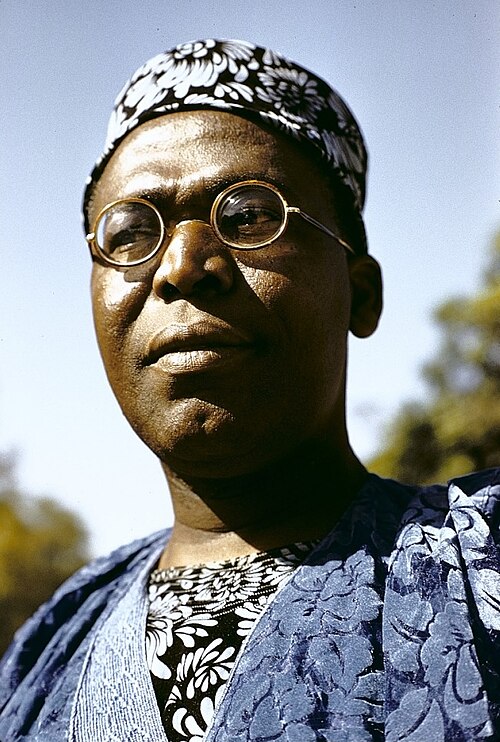
Financial Breakdown
Asset Distribution
Assets vs Liabilities
Assets
Disclaimer: These financial estimates are based on publicly available information and should be considered approximate. Last updated: 12/30/2025
Biography
Introduction: The Sage and Statesman
Chief Obafemi Awolowo† stands as one of the most influential, visionary, and consequential figures in the history of Nigeria. A lawyer, statesman, and political strategist, he is best remembered as the transformative Former Premier of Western Nigeria (1954-1959) and a relentless advocate for federalism, social welfare, and equitable national development. His political philosophy and administrative blueprint left an indelible mark on the nation's trajectory. Often called the "Father of Nigerian Federalism" and the "Sage of Ikenne," Awolowo's most celebrated achievement was the pioneering introduction of free primary education and free healthcare in Western Nigeria, policies that revolutionized human capital development and set a benchmark for governance in Africa. His life and work remain central to discussions on Politics & Government and the quest for a just and prosperous Nigeria.
Early Life & Education: Foundations of a Leader
Obafemi Awolowo was born on March 6, 1909, in Ikenne, present-day Ogun State, in southwestern Nigeria. Born into a humble farming family, he experienced early hardship with the death of his father. Despite financial constraints, young Obafemi demonstrated an insatiable appetite for knowledge. His early education was sporadic, but his determination saw him through various schools, including Baptist Boys' High School in Abeokuta, where he excelled.
The formative experiences of his youth, witnessing the struggles of the common people, deeply shaped his later political ideology. After working as a teacher, clerk, and journalist, he pursued higher education through correspondence and self-study. His relentless drive led him to London, where he studied law at the University of London as an external student. He was called to the Bar in 1946 at the prestigious Inner Temple. During his time in London, he immersed himself in political and economic theory, founding the Egbe Omo Oduduwa (a Yoruba cultural organization) in 1945 and publishing his seminal blueprint, "Path to Nigerian Freedom," in 1947. This pamphlet argued forcefully for a federal system of government as the only viable structure for Nigeria's multi-ethnic nation—a thesis that would define his entire career.
Career & Major Achievements: Architect of a Region, Voice of a Nation
Upon returning to Nigeria, Obafemi Awolowo† dove headfirst into Politics & Government. In 1950, he founded the Action Group (AG), a political party with a strong base in Western Nigeria but a national outlook. The AG was distinct for its clear, progressive ideology and detailed policy programs. Under his leadership as Premier, the Western Region witnessed an unprecedented era of development often described as the "Golden Age."
Revolutionary Policies in Western Nigeria
As Premier from 1954 to 1959, Awolowo implemented a sweeping welfare state agenda. His government's most iconic policy was the Free Universal Primary Education (UPE) launched in 1955, which gave thousands of children, regardless of background, access to education. Coupled with this was a free healthcare scheme for children. He also established the first television service in Africa (WNTV) in 1959, built the Cocoa House (then the tallest building in tropical Africa), and invested heavily in infrastructure, housing, and industrial projects. These achievements were financed through prudent management of the region's cocoa revenue and innovative financing mechanisms.
Federal Campaigns and National Influence
On the national stage, Awolowo was a key participant in constitutional conferences leading to independence. He served as the Leader of the Opposition in the federal parliament (1960-1962) and as Federal Commissioner for Finance and Vice Chairman of the Federal Executive Council during the Nigerian Civil War (1967-1971), where his financial acumen helped sustain the nation. His political career was not without turmoil; he was tried and convicted for treasonable felony in 1963, a verdict widely considered politically motivated. He was pardoned and released in 1966.
Throughout the First, Second, and Third Republics, his ideas remained potent. He ran for the presidency twice (1979 and 1983) under the banner of the Unity Party of Nigeria (UPN), campaigning on a consistent platform encapsulated in his famous slogan: "Freedom for all, Life more Abundant." The UPN's manifesto, mirroring his Western Region successes, promised:
- Free education at all levels
- Integrated rural development
- Free healthcare
- Full employment
- Housing for all
Personal Life & Legacy: The Enduring Sage
Chief Awolowo was a man of disciplined habits, deep Christian faith, and intellectual rigor. He was married to Chief (Mrs.) Hannah Idowu Dideolu Awolowo, his lifelong partner and pillar of support. Their marriage was a strong union, and Hannah played a significant role in his political endeavors. An avid reader and writer, Awolowo authored several books on politics, economics, and philosophy, including "Thoughts on the Nigerian Constitution," "The People's Republic," and his autobiography, "Awo."
The legacy of Obafemi Awolowo† is multifaceted and monumental. He bequeathed a powerful ideological tradition centered on social democracy, federalism, and human capital development. Institutions like the Obafemi Awolowo University (formerly University of Ife), which he fought to establish, stand as physical testaments to his commitment to education. Politically, he established a model of programmatic, ideology-driven politics that continues to influence the Nigerian landscape. His quotes on governance and leadership are widely cited, and his persona is revered, particularly in southwestern Nigeria. He passed away on May 9, 1987, but remains a constant reference point in Nigeria's ongoing struggle for effective governance and equitable development.
Net Worth & Business Ventures: The Prudent Administrator
Unlike many of his contemporaries, Obafemi Awolowo† was not known for vast personal wealth or sprawling business empires acquired through public office. His financial narrative is instead one of prudence, intellectual entrepreneurship, and service. Before entering full-time politics, he built a successful legal practice, which provided his primary source of income. He was also a pioneering publisher, establishing the Nigerian Tribune newspaper in 1949, which served as a vital platform for his political views and the anti-colonial struggle. The Tribune remains a leading newspaper in Nigeria today.
His true "wealth" was measured in intellectual capital and the transformative public assets he created. As Premier, he managed substantial regional resources but was renowned for his probity and insistence on accountability. His focus was always on public wealth, not private accumulation. Historical accounts and biographies emphasize his modest lifestyle compared to the scale of his political influence. Therefore, while not a business magnate, Awolowo's acumen in public finance management and his establishment of a lasting media institution underscore a legacy built on strategic influence and principled leadership rather than personal fortune.
For further reading on the life and times of this great statesman, credible sources include the Encyclopaedia Britannica, official archives of the National Bureau of Statistics for historical economic data, and his own published works.
Frequently Asked Questions
What is Obafemi Awolowo†'s estimated net worth?
Net worth details for Obafemi Awolowo† are currently being updated.
What is Obafemi Awolowo†'s role and nationality?
Obafemi Awolowo† is a Former Premier from Nigeria.
How did Obafemi Awolowo† make their money?
Obafemi Awolowo† built their fortune primarily through Obafemi Awolowo was a Nigerian statesman who died in 1987; he was a political leader, not a business magnate, and his wealth was not comparable to modern billionaires..
How old is Obafemi Awolowo†?
Obafemi Awolowo† was born in 1909 (117 years old).
Which category is Obafemi Awolowo† listed under?
Obafemi Awolowo† is featured under the Politics & Government category on NetWorth Africa.
How is Obafemi Awolowo†'s net worth calculated?
NetWorth Africa estimates financial valuations using publicly available stock equity holdings, company ownership records, real estate assets, and verified market data.
Net Worth Analysis
Obafemi Awolowo was a Nigerian statesman who died in 1987; he was a political leader, not a business magnate, and his wealth was not comparable to modern billionaires.
Quick Stats


Related People

Aaron Motsoaledi
LP; Minister of Home Affairs • South Africa

Abane Ramdane†
FLN Leader & Strategist • Algeria

Abdalla Hamdok
Ex-Prime Minister • Sudan

Abdallah Kigoda
Ex-Minister of Natural Resources • Tanzania