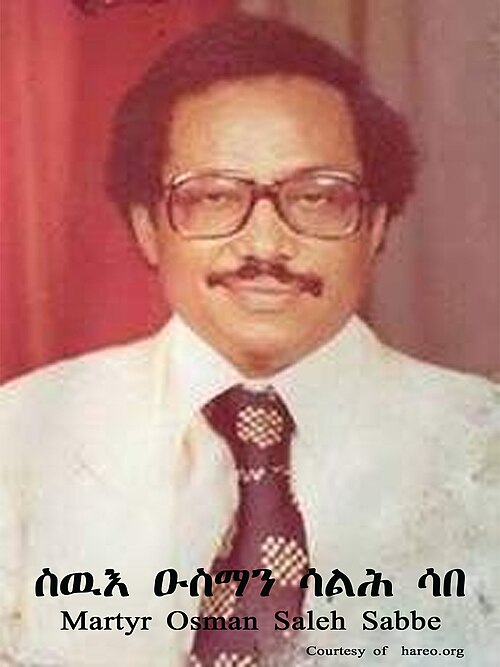
Biography
Introduction: The Diplomatic Vanguard of Eritrea's Struggle
Osman Saleh Sabbe† (1932 – 1987) stands as one of the most complex and influential figures in the modern history of Eritrea. A seminal leader within the Eritrean Liberation Front (ELF), Sabbe is best remembered not as a field commander but as the international face and diplomatic engine of the early independence movement. His most notable achievement was transforming a localized armed struggle into a globally recognized cause, securing vital political, financial, and military support from across the Arab world and beyond. Operating from exile, Osman Saleh Sabbe† masterminded the Eritrean revolution's foreign policy, established its media outreach, and navigated the treacherous waters of Cold War and regional Politics & Government. His journey from teacher to revolutionary diplomat encapsulates the multifaceted nature of liberation wars, where battles are fought both in the trenches and in the corridors of international power.
Early Life & Education: The Formative Years
Born in 1932 in the coastal city of Massawa, Osman Saleh Sabbe† was raised in a region with a rich history of trade and cultural exchange. This environment likely influenced his later worldview and diplomatic acumen. He pursued a career in education, becoming a teacher—a profession that placed him among the small but growing class of educated Eritreans during the period of British administration and the subsequent federation with Ethiopia.
This era was critical to his political awakening. The 1952 UN-sponsored federation, which was meant to guarantee Eritrean autonomy, was systematically dismantled by Emperor Haile Selassie, culminating in the outright annexation of Eritrea as Ethiopia's 14th province in 1962. This betrayal of international agreements and the suppression of Eritrean rights radicalized many, including Sabbe. His formative experiences were not of rural hardship but of political betrayal and the stifling of national identity, steering him towards intellectual and organizational resistance. By the early 1960s, the teacher had become a revolutionary, aligning himself with the nascent armed struggle.
Career & Major Achievements: The Master Diplomat
The career of Osman Saleh Sabbe† is inextricably linked to the rise and evolution of the Eritrean Liberation Front (ELF). He joined the ELF shortly after its founding in 1961 and quickly rose to prominence due to his education, linguistic skills, and strategic vision.
Architect of International Relations
Sabbe’s most profound contribution was in foreign diplomacy. He established the ELF's foreign office and traveled extensively throughout the Middle East. From bases in Sudan, Syria, and Iraq, he successfully framed the Eritrean struggle not just as a secessionist movement, but as an anti-colonial and pan-Arab cause. This narrative resonated deeply, leading to groundbreaking achievements:
- Securing critical financial and military support from Syria, Iraq, and other Arab states.
- Establishing the Eritrean Liberation Front’s first official radio station, "The Voice of the Eritrean Revolution", from Baghdad in 1970, which became a crucial tool for morale and information.
- Forging relationships with non-Arab nations, including China and North Korea, demonstrating a pragmatic approach to garnering support across the geopolitical spectrum.
Leadership and Factionalism
By the late 1960s, Osman Saleh Sabbe† had become a key member of the ELF's leadership. However, internal ideological and regional tensions within the Front led to significant fractures. In 1970, a major split resulted in the formation of the Eritrean People's Liberation Front (EPLF), which would eventually become the dominant liberation force. Sabbe remained with the ELF but continued to navigate its internal politics.
His leadership reached its zenith in the mid-1970s. Following a major ELF congress in 1975, he emerged as the Secretary-General of the organization's political wing. In this role, he attempted to reform the ELF and even engaged in unity talks with the rival EPLF. However, the ideological and strategic divides, particularly between Sabbe's pan-Arab orientation and the EPLF's more Marxist and Eritrean-nationalist stance, proved too wide to bridge permanently.
The Formation of the ELF-PLF and Exile
As the EPLF gained military superiority in the late 1970s, the ELF was weakened. In 1980, following internal conflict and military setbacks, Sabbe broke away to form his own faction, the Eritrean Liberation Front-People's Liberation Forces (ELF-PLF). This move, however, further fragmented the opposition to Ethiopia and marginalized his influence within the broader struggle. He spent his final years in exile, continuing his diplomatic efforts but increasingly detached from the military and political realities on the ground in Eritrea.
Personal Life, Legacy & Lasting Impact
Unlike many of his contemporaries, Osman Saleh Sabbe† lived most of his revolutionary life in exile. This distance shaped both his strategies and his personal legacy. He was known as an intellectual, a persuasive orator, and a shrewd political operator. His personal interests were deeply tied to his work; he was a student of international relations and a prolific communicator, using media as a key weapon.
The legacy of Osman Saleh Sabbe† is multifaceted. He is rightly credited with being the pioneer who internationalized the Eritrean cause. Without the resources and recognition he secured in the 1960s and early 1970s, the liberation struggle might have been isolated and crushed. He built the essential foreign networks that later factions, including the EPLF, would ultimately utilize.
However, his legacy is also marked by the divisive politics of the liberation era. His commitment to a pan-Arab identity for Eritrea and the subsequent factionalism are viewed by some historians as having prolonged the war. He passed away in 1987 in Jeddah, Saudi Arabia, never seeing the independent Eritrea he helped conceive, which was finally realized in 1991. Today, official narratives in Eritrea often minimize his role, but historians recognize Osman Saleh Sabbe† as an indispensable, if controversial, architect of the nation's long journey to sovereignty.
Financial Networks & Revolutionary Funding
While not a businessman in the traditional sense, Osman Saleh Sabbe†'s role necessitated the management of significant resources. His "business" was revolutionary finance and logistics. He was instrumental in creating the financial pipelines that sustained the ELF. This involved:
- Lobbying for and managing state-sponsored aid from allied Arab governments.
- Organizing fundraising within the global Eritrean diaspora, particularly in the Middle East.
- Overseeing the procurement and shipment of weapons, medical supplies, and communication equipment to the war front.
There is no documented personal net worth for Sabbe, as his life was dedicated to the revolutionary treasury. Any funds he controlled were directed towards the struggle. His financial success was measured in the arms shipments delivered, the radio broadcasts aired, and the diplomatic missions funded—all critical capital in the war for Eritrea's independence. His ventures were geopolitical, and his currency was influence, leaving a legacy defined by political, rather than personal, wealth.
Frequently Asked Questions
What is Osman Saleh Sabbe†'s estimated net worth?
Net worth details for Osman Saleh Sabbe† are currently being updated.
What is Osman Saleh Sabbe†'s role and nationality?
Osman Saleh Sabbe† is a ELF Leader from Eritrea.
How did Osman Saleh Sabbe† make their money?
Osman Saleh Sabbe† built their fortune primarily through Osman Saleh Sabbe was a political leader and co-founder of the Eritrean Liberation Front (ELF), not a business figure; no credible sources indicate significant personal wealth..
How old is Osman Saleh Sabbe†?
Osman Saleh Sabbe† was born in 1932 (94 years old).
Which category is Osman Saleh Sabbe† listed under?
Osman Saleh Sabbe† is featured under the Politics & Government category on NetWorth Africa.
How is Osman Saleh Sabbe†'s net worth calculated?
NetWorth Africa estimates financial valuations using publicly available stock equity holdings, company ownership records, real estate assets, and verified market data.
Net Worth Analysis
Osman Saleh Sabbe was a political leader and co-founder of the Eritrean Liberation Front (ELF), not a business figure; no credible sources indicate significant personal wealth.
Quick Stats

Related People

Aaron Motsoaledi
LP; Minister of Home Affairs • South Africa

Abane Ramdane†
FLN Leader & Strategist • Algeria

Abdalla Hamdok
Ex-Prime Minister • Sudan

Abdallah Kigoda
Ex-Minister of Natural Resources • Tanzania