Biography
Introduction: The Symbol of a Nation's Aspiration
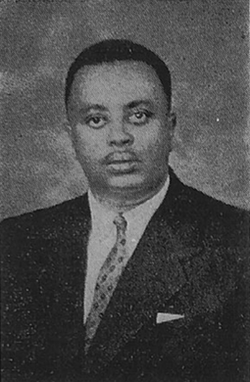
Prince Louis Rwagasore† stands as the preeminent national hero and founding father of the modern nation of Burundi. A charismatic prince, visionary politician, and fervent nationalist, his life was singularly dedicated to liberating his country from Belgian colonial rule. As the son of Mwami (King) Mwambutsa IV, Prince Louis Rwagasore† leveraged his royal status not for personal privilege but as a platform to mobilize the masses across ethnic and regional lines. His key achievement was the founding of the Union for National Progress (UPRONA) party, which championed immediate independence and social unity. His tragic assassination on October 13, 1961, just days after leading UPRONA to a decisive electoral victory and becoming Prime Minister-designate, transformed him into a martyr and an eternal symbol of Burundi's struggle for sovereignty. His brief but intense political career irrevocably shaped the nation's path to freedom, achieved formally on July 1, 1962.
Early Life & Education: A Prince in a Colonial World
Louis Rwagasore was born on January 10, 1932, in Gitega, the royal capital of the Kingdom of Burundi. As the eldest son of King Mwambutsa IV Bangiricenge and Queen Thérèse Kanyonga, he was raised with a deep sense of responsibility towards his nation and its people. His early education began at the Gitega Catholic School, followed by studies at the Kibanga Major Seminary. It was during these formative years that he began to critically observe the structures of Belgian colonial administration, which operated under a League of Nations mandate later transformed into a United Nations Trust Territory after World War II.
Seeking broader horizons, Rwagasore traveled to Europe to continue his education. He studied at the University of Antwerp in Belgium and later in Rome. His time in Europe was pivotal; he witnessed post-war decolonization movements and engaged with pan-African ideas. He also directly experienced the racial prejudices of the era, which sharpened his anti-colonial resolve. Returning to Burundi in the mid-1950s, he did not retreat into royal isolation. Instead, he embarked on a practical project aimed at economic empowerment, founding the first indigenous cooperative in Burundi, "Twese hamwe" (All Together). This venture, which encouraged Burundians to boycott Belgian and Greek merchants and trade amongst themselves, was his first act of peaceful economic resistance and a masterclass in mobilizing popular sentiment, foreshadowing his future political strategy.
Career & Major Achievements: The Path to Independence
The political career of Prince Louis Rwagasore†, though condensed into a few short years, was meteoric and transformative. In the late 1950s, as political reforms allowed for the formation of parties, Rwagasore saw the critical need for a unified national movement.
Founding of UPRONA and the Vision of Unity
On September 7, 1958, he officially founded the Union for National Progress (UPRONA). The party's platform was radical for its time: it demanded immediate and unconditional independence for Burundi. More importantly, Rwagasore explicitly framed UPRONA as a supra-ethnic party. At a time when colonial policy often emphasized ethnic divisions between Hutu and Tutsi, Rwagasore preached a powerful message of national unity, arguing that the primary conflict was not between Burundians but between all Burundians and the colonial power. His charismatic leadership, royal lineage, and populist touch made him immensely popular among peasants and intellectuals alike.
The Legislative Elections of 1961
The defining moment of his career came during the legislative elections of September 18, 1961. These elections were to determine who would lead Burundi into self-government. The Belgian authorities, wary of Rwagasore's radical stance, initially placed him under house arrest in an attempt to curb his campaign. This tactic backfired, only amplifying his popularity. From his confinement, UPRONA's message spread like wildfire. In a stunning landslide, UPRONA won 80% of the vote and secured 58 out of 64 seats in the Legislative Assembly. This unequivocal mandate made Prince Louis Rwagasore† the undisputed Prime Minister-designate of a soon-to-be-independent Burundi.
Assassination and National Trauma
Tragedy struck just as his life's work reached its zenith. On October 13, 1961, while dining at the Hotel du Lac in Bujumbura, Rwagasore was assassinated by a Greek national, Jean Kageorgis, who was allegedly hired by rival politicians from the Christian Democratic Party (PDC). The murder, occurring a mere 25 days after his electoral triumph, sent shockwaves through the nation and the continent. It robbed Burundi of its most unifying figure at the most delicate juncture in its history. The assassination of Prince Louis Rwagasore† cast a long shadow over the country's independence, which was achieved less than a year later on July 1, 1962, under a cloud of profound grief and instability.
Personal Life & Legacy: The Enduring Symbol
Beyond politics, Louis Rwagasore was a family man. In 1960, he married Marie-Rose Ntamikevyo, a union that produced two daughters, Princesses Marie-Thérèse and Princesse Anne-Marie. His personal interests were deeply intertwined with his nationalist project; his cooperative work showed a passion for economic justice and self-reliance. He was known for his eloquent oratory, personal magnetism, and ability to connect with common people, often dressing simply and eschewing colonial elitism.
The legacy of Prince Louis Rwagasore† is monumental. He is revered as the "Father of Burundian Independence" and a martyr. His image is immortalized on Burundi's currency, stamps, and public monuments. The main stadium in Bujumbura bears his name, and his mausoleum in the capital is a site of national pilgrimage. October 13th is commemorated as a day of national mourning. Most significantly, his vision of a unified Burundi, free from ethnic strife, remains a powerful, albeit often unfulfilled, national ideal. In a history marked by conflict, Rwagasore represents a lost path of unity and hope, making his legacy a constant reference point in Burundi's national consciousness.
Historical Significance & Commemoration
While discussions of personal net worth or business ventures in a modern sense are not central to the story of Prince Louis Rwagasore†, his economic philosophy is highly relevant. His primary "venture" was the "Twese hamwe" cooperative, a social enterprise aimed at economic decolonization. This was not a pursuit of personal wealth but of collective economic empowerment. His focus was on redirecting the nation's economic life towards its own people, challenging the extractive colonial economy. In contemporary terms, his assets were his royal status and immense popular credibility, which he invested entirely in the political capital of the independence movement. The true value he created was not monetary but national—the sovereign state of Burundi itself. Today, his name is invoked as a symbol of integrity and selfless sacrifice for the nation, a legacy far surpassing any material measure.
For further reading on the life and context of Prince Louis Rwagasore†, reputable historical and academic sources are recommended. These include the Encyclopedia Britannica for foundational biography, and scholarly works such as Burundi: The Biography of a Small African Country by Nigel Watt, which provide deeper analysis of the Independence Era in the Great Lakes region of Africa.
Net Worth Analysis
Prince Louis Rwagasore was assassinated in 1961, two years before Burundi's independence, and therefore has no personal net worth.
Quick Stats
Related People

Aaron Motsoaledi
LP; Minister of Home Affairs

Abane Ramdane†
FLN Leader & Strategist

Abdalla Hamdok
Ex-Prime Minister

Abdallah Kigoda
Ex-Minister of Natural Resources