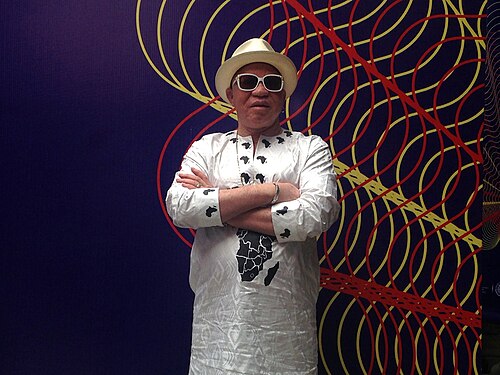
$10M
Estimated Net Worth
As of 2024 • medium confidence
Financial Breakdown
Asset Distribution
Assets vs Liabilities
Assets
Disclaimer: These financial estimates are based on publicly available information and should be considered approximate. Last updated: 12/31/2025
Biography
Introduction: An Icon Born of Destiny
In the vast and rich landscape of African Entertainment, few voices shine as brightly or carry as profound a legacy as that of Salif Keita. Known universally as the "Golden Voice of Africa," Keita is a Malian musical legend whose career spans over five decades, blending traditional West African sounds with contemporary global influences. Born in 1949 in the village of Djoliba, his story is one of extraordinary defiance and transcendent talent. An albino born into a noble lineage that traces back to the founder of the Mali Empire, Sundiata Keita, his path was preordained for royalty, yet he chose music—a profession considered unsuitable for his caste. This bold choice gifted the world one of its most distinctive and powerful vocalists. A key achievement, among many, is his seminal 1987 album "Soro," which catapulted African music onto the international stage and remains a landmark in world music history.
Early Life & Education: A Noble Path Forged in Adversity
Salif Keita was born on August 25, 1949, into the Keita family, direct descendants of the 13th-century founder of the Mali Empire. In Mandinka society, this placed him in the highest royal caste. However, his birth as a person with albinism was seen as a sign of bad luck, leading to initial rejection and social isolation. This early experience of ostracism, coupled with the physical challenges of albinism in the harsh sun, forged a resilient and introspective character. Despite his royal status, his passion for music was evident from a young age. He taught himself to sing and play instruments, drawing inspiration from the griots (traditional West African historians and storytellers) despite it being a role reserved for a lower caste.
His formal education was cut short due to partial blindness, a condition related to his albinism. This setback, however, only redirected his focus more intensely toward music. At age 18, in a move that shocked his family and community, he left home for the capital, Bamako, to pursue a musical career. He first joined the government-sponsored Super Rail Band of Bamako in 1970, where his powerful voice began to turn heads. Shortly after, he moved to the legendary Les Ambassadeurs Internationaux, a rival band known for its fusion of traditional melodies with Cuban, jazz, and rock influences. This period was his true education, honing his craft and developing the sophisticated, cross-cultural sound that would define his career.
Career & Major Achievements: A Global Journey of Sound
Salif Keita's career is a masterclass in artistic evolution and global impact. His journey can be charted through key phases and landmark achievements.
Rise to Fame and International Breakthrough
After political tensions in Mali, Keita relocated with Les Ambassadeurs to Abidjan, Côte d'Ivoire, in 1978. It was here the band renamed itself Les Ambassadeurs Internationaux, signaling their wider ambitions. His first major international exposure came with the album "Mandjou" (1978), featuring the epic praise song "Mandjou," which became an instant classic across West Africa. However, his true global breakthrough arrived after he moved to Paris in 1984. His 1987 album, "Soro", produced by Ivorian maestro Mory Kanté and French musician Jean-Philippe Rykiel, was a revelation. It fused traditional Malian instruments and melodies with state-of-the-art 1980s synthesizers, drum machines, and electric guitars. Tracks like "Soro (Afrika)" and "Cono" became anthems, defining a new, modern sound for African music and establishing Salif Keita as a world music superstar.
Artistic Evolution and Acclaim
Throughout the 1990s and 2000s, Keita continued to innovate while returning to his roots. Albums like "Amen" (1991), which featured a collaboration with Carlos Santana, and "Folon...The Past" (1995) explored social and historical themes. His 2002 album "Moffou" marked a celebrated acoustic return to simplicity and was hailed as one of his finest works. He received his first Grammy nomination for "M'Bemba" in 2006. His influence was formally recognized with numerous prestigious awards, including:
- Kora Award for Best African Artist (1997, 2001, 2004)
- Named a UNESCO Artist for Peace in 2004
- Victoire de la Musique award (French Grammy) for Best World Music Album (2010)
In a crowning achievement, he won a Grammy Award in 2023 for Best Global Music Album for "Lost & Found," a collaborative project with the National Symphony Orchestra of Iraq, proving his artistic relevance decades into his career.
Impact and Musical Style
Keita's impact is immeasurable. He paved the way for countless African artists on the world stage. His musical style is a unique tapestry:
- Vocal Prowess: His voice, a soaring tenor with a distinctive nasal quality, is instantly recognizable and emotionally potent.
- Fusion Mastery: He seamlessly blends Mandinka traditions (kora, balafon, talking drum) with influences from flamenco, jazz, pop, and classical music.
- Lyrical Depth: His songs address themes of love, peace, social justice, and the history of Mali, often drawing from his own life experiences of exclusion and triumph.
Personal Life, Philanthropy & Legacy
Beyond the stage, Salif Keita is a dedicated humanitarian. His personal life has been shaped by his status as an albino, leading him to become a global advocate for people with albinism. In 2005, he established the Salif Keita Global Foundation, dedicated to supporting albinos in Africa, where they often face discrimination, violence, and health challenges like skin cancer. He has used his fame and resources to provide sunscreen, medical care, and educational support, and to fight against social stigma. A man of quiet dignity, he eventually returned to Mali, building a home and recording studio in Bamako, though he remains an international citizen of music.
The legacy of the Golden Voice of Africa is multifaceted. He is a cultural ambassador who redefined the possibilities of African music. He is a symbol of resilience, having turned societal rejection into a source of universal artistic strength. For aspiring musicians in Mali and across the continent, he represents the pinnacle of artistic integrity and global success. His music serves as a timeless bridge between ancient African traditions and the modern world, ensuring that the voice of the Mandinka griots, filtered through his unique experience and genius, will resonate for generations to come.
Net Worth & Business Ventures
While exact figures are private, Salif Keita's estimated net worth is reflective of a long and successful international career in Entertainment. His wealth is derived from multiple streams: album sales spanning over 15 solo studio albums, lucrative international touring across five continents, and royalties from his extensive catalog. He has also engaged in strategic business ventures, most notably the founding of his own record label, Moffou Music, named after his acclaimed album and hometown studio. This venture gives him greater artistic and financial control over his work. Furthermore, his investments in real estate, including his personal compound and studio complex in Bamako, constitute significant assets. His financial success has enabled him to fund his philanthropic foundation, demonstrating a commitment to leveraging his prosperity for social good in his native Mali and beyond.
Net Worth Analysis
Salif Keita is a highly successful and influential musician, but he is not a business tycoon and is not listed on any billionaire ranking; his wealth stems from his long and acclaimed music career.
Quick Stats
Related People

2Baba (Innocent Idibia)
Veteran Artist & Activist

Aar Maanta
Singer & Composer

Abdel Aziz al-Mubarak
Oud Master
Abdel Halim Hafez†
Legend; “Nightingale”; “The Dark-Skinned Nightingale”