Financial Breakdown
Asset Distribution
Assets vs Liabilities
Assets
Disclaimer: These financial estimates are based on publicly available information and should be considered approximate. Last updated: 12/29/2025
Biography
Introduction: The Father of the Nation
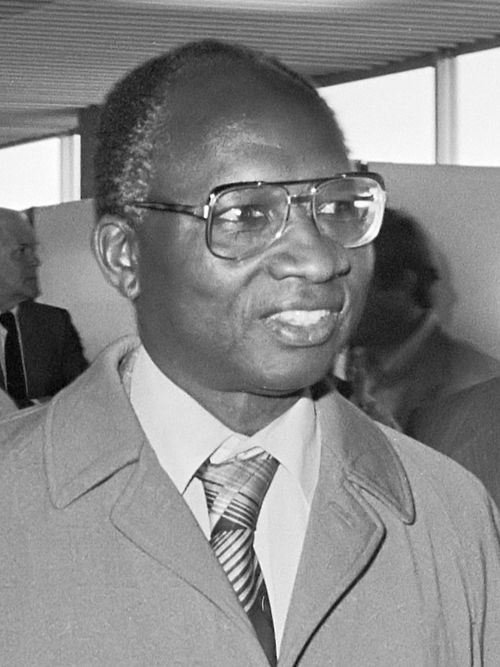
Sir Dawda Kairaba Jawara† stands as the seminal figure in the modern history of The Gambia. Serving as the nation's first Prime Minister (1965-1970) and then its first President (1970-1994), he guided the smallest country on mainland Africa through a peaceful transition to independence and presided over nearly three decades of stable, democratic governance. A trained veterinary surgeon turned statesman, Sir Dawda Jawara's leadership was characterized by moderation, a deep commitment to human rights, and a foreign policy of non-alignment. His most notable achievement was establishing The Gambia as a rare beacon of multi-party democracy and political stability in a region often plagued by coups and conflict during the Independence Era. The legacy of Sir Dawda Kairaba Jawara† is inextricably linked to the very identity of the nation he helped to forge.
Early Life & Education: From Barajally to Glasgow
Dawda Kairaba Jawara was born on May 16, 1924, in Barajally, a small town in the Central River Division of what was then the British colony of The Gambia. He was born into a Muslim Mandinka family, and his early education was rooted in both Islamic teachings and the British colonial system. A brilliant student, he attended the Methodist Boys’ High School in Banjul (then Bathurst), where his academic prowess became evident.
His initial career path was in medicine. With the support of a colonial scholarship, he traveled to Achimota College in Ghana (then the Gold Coast) to study science. He then proceeded to the University of Glasgow in Scotland, where he remarkably qualified as a veterinary surgeon in 1953, becoming The Gambia's first-ever veterinarian. This scientific training in Glasgow profoundly shaped his worldview, instilling in him a methodical, pragmatic, and compassionate approach to problem-solving. His time in Britain also exposed him to the workings of Westminster-style democracy, which would later influence his political philosophy. Before fully entering politics, he served as a government veterinary officer, a role that connected him with rural Gambians and their livelihoods, building a foundation of popular trust.
Career & Major Achievements: Steering a Nation to Independence and Democracy
Sir Dawda Jawara's political journey began in 1960 with his entry into the Politics & Government arena. He founded the People's Progressive Party (PPP), which quickly gained mass support, particularly among the rural Mandinka population. After winning elections, he became Chief Minister in 1962 and then Premier in 1963, steadily negotiating the terms of The Gambia's independence from British rule.
The Peaceful Path to Sovereignty
On February 18, 1965, The Gambia achieved full independence with Sir Dawda Kairaba Jawara† as its first Prime Minister. This transition was notably peaceful, avoiding the violence that marred independence in some other nations. In 1970, following a referendum, The Gambia became a republic, and Jawara assumed the office of President. His government focused on agricultural development, education, and healthcare, always operating within the constraints of the country's limited natural resources and economy.
Champion of Democracy and Stability
Jawara's most significant achievement was maintaining a functioning multi-party democracy for 24 years as President. In a continent where one-party states and military dictatorships were common, The Gambia held regular, competitive elections in 1972, 1977, 1982, 1987, and 1992. His government respected civil liberties, freedom of the press, and an independent judiciary. This earned The Gambia international acclaim as a "model democracy." He skillfully navigated regional politics, initially pursuing a federation with Senegal which resulted in the short-lived Senegambia Confederation (1982-1989).
Surviving Challenges and the 1994 Coup
His tenure was not without challenges. He survived a violent coup attempt in 1981, which was quelled only with military assistance from Senegal. This event underscored the fragility of democracy but also Jawara's resilience. However, on July 22, 1994, while Sir Dawda Jawara was aboard a ship in the Atlantic Ocean, a bloodless military coup led by Lieutenant Yahya Jammeh overthrew his government. Jawara went into exile in the United Kingdom, marking the end of an era for Gambia. He returned to The Gambia in 2002 following a change in policy by the Jammeh regime.
Personal Life, Legacy, and Honors
Personally, Sir Dawda was known for his humility, intellectual demeanor, and deep religious faith as a Muslim. He was married twice and had several children. His interests remained connected to his professional roots in agriculture and animal husbandry. Beyond politics, he was a respected elder statesman in the Commonwealth and across Africa.
The legacy of Sir Dawda Kairaba Jawara† is profound. He is universally revered as "The Father of the Nation." His legacy includes:
- Democratic Foundation: He established the democratic norms and institutions that, despite the Jammeh interregnum, The Gambia returned to in 2016.
- National Identity: He fostered a strong sense of Gambian nationhood and peaceful coexistence among its diverse ethnic groups.
- International Respect: He positioned The Gambia as a respected, peaceful voice in international forums like the Commonwealth, the Organization of African Unity (OAU), and the United Nations.
His numerous honors include being knighted by Queen Elizabeth II in 1966, receiving the Order of the Republic of The Gambia, and various international awards for his commitment to democracy and human rights. Upon his passing on August 27, 2019, at the age of 95, he was accorded a state funeral, a testament to his enduring stature.
Net Worth & Business Ventures
Unlike many of his contemporaries in African leadership, Sir Dawda Kairaba Jawara† was not known for amassing personal wealth or engaging in significant private business ventures. His career was defined by public service, first as a veterinary officer and then as a political leader. His financial standing was largely tied to his official salary and pensions. After his overthrow in 1994, his assets in The Gambia were initially seized by the military junta, though some were later restored. His lifestyle, both in office and in exile, was reported to be modest, aligning with his reputation for personal integrity. In the context of Gambia's economy and the often-noted corruption in global politics, Jawara's relative lack of personal fortune is frequently cited as a point of distinction, reinforcing his image as a leader dedicated to national rather than personal gain. His primary "wealth" was considered to be the political stability and democratic culture he bequeathed to his nation.
For further reading on his life and The Gambia's history, credible sources include the Encyclopædia Britannica, the BBC's obituary, and historical archives from the Commonwealth Secretariat.
Frequently Asked Questions
What is Sir Dawda Kairaba Jawara†'s estimated net worth?
Sir Dawda Kairaba Jawara† has an estimated net worth of $1.0 Million.
What is Sir Dawda Kairaba Jawara†'s role and nationality?
Sir Dawda Kairaba Jawara† is a First President (1970-1994) from Gambia.
How did Sir Dawda Kairaba Jawara† make their money?
Sir Dawda Kairaba Jawara† built their fortune primarily through Sir Dawda Jawara was a public servant and statesman, not a business figure; his wealth was modest and not comparable to billionaire business leaders..
How old is Sir Dawda Kairaba Jawara†?
Sir Dawda Kairaba Jawara† was born in 1924 (102 years old).
Which category is Sir Dawda Kairaba Jawara† listed under?
Sir Dawda Kairaba Jawara† is featured under the Politics & Government category on NetWorth Africa.
How is Sir Dawda Kairaba Jawara†'s net worth calculated?
NetWorth Africa estimates financial valuations using publicly available stock equity holdings, company ownership records, real estate assets, and verified market data.
Net Worth Analysis
Sir Dawda Jawara was a public servant and statesman, not a business figure; his wealth was modest and not comparable to billionaire business leaders.
Quick Stats
Related People
Aaron Motsoaledi
LP; Minister of Home Affairs • South Africa
Abane Ramdane†
FLN Leader & Strategist • Algeria
Abdalla Hamdok
Ex-Prime Minister • Sudan
Abdallah Kigoda
Ex-Minister of Natural Resources • Tanzania