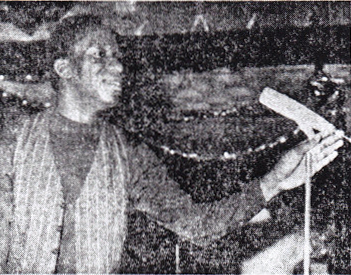
Financial Breakdown
Asset Distribution
Assets vs Liabilities
Assets
Disclaimer: These financial estimates are based on publicly available information and should be considered approximate. Last updated: 12/31/2025
Biography
Introduction: The Voice of a Continent
In the pantheon of African music giants, few names shine as brightly as Tabu Ley Rochereau†. Born Pascal-Emmanuel Sinamoyi Tabu in 1937, he ascended to become one of the most influential figures in 20th-century African Entertainment. As a pioneering composer, bandleader, and vocalist, Tabu Ley is credited with shaping and popularizing Soukous, the vibrant, guitar-driven dance music that originated in the Republic of the Congo (then Belgian Congo and later Zaire). His key achievement was not merely creating hits but modernizing Congolese rumba, infusing it with sophisticated orchestrations, poetic Lingala lyrics, and an irresistible kinetic energy that captivated audiences from Kinshasa to Paris and beyond. For over five decades, Tabu Ley Rochereau† was the elegant, innovative force whose work defined an era and inspired generations of musicians across the globe.
Early Life & Education: The Foundations of a Maestro
Tabu Ley Rochereau† was born on November 13, 1937, in Bagata, located in the Bandundu region of what was then the Belgian Congo. From an early age, he was immersed in the rich musical traditions of his community, but his path was also shaped by a rigorous formal education. He attended a Catholic seminary, where he received a classical education and was first exposed to European liturgical music and choral harmonies. This unique blend of indigenous rhythms and structured Western music theory would become a hallmark of his later compositions.
His formative years in the capital, Léopoldville (now Kinshasa), during the 1950s placed him at the epicenter of a musical revolution. The city was buzzing with the sounds of African jazz, Cuban rumba, and highlife. Young Tabu Ley, initially writing poetry, found his calling in songwriting. His big break came in 1956 when he successfully submitted his song, "Besoka ya Sika," to the already-established star Grand Kalle. This validation propelled him into the professional music scene. Adopting the stage name "Rochereau" from a French general, he soon joined Grand Kalle's legendary orchestra, L'African Jazz, where he served as a principal songwriter and vocalist, honing his craft alongside other greats.
Career & Major Achievements: Defining the Soukous Sound
The career of Tabu Ley Rochereau† is a chronicle of relentless innovation and towering success. In 1963, he made a pivotal move by co-founding African Fiesta with guitarist Dr. Nico. This band became a laboratory for a new, faster, more guitar-centric sound. After parting ways with Nico, he formed African Fiesta National in 1965, which launched him into superstardom. With this ensemble, Tabu Ley perfected the Soukous formula: intricate guitar harmonies, a powerful brass section, a driving rhythm, and his own smooth, eloquent vocals.
Innovations and International Breakthrough
Tabu Ley was a visionary bandleader. He is celebrated for introducing the sebene—the extended, hypnotic guitar-driven instrumental section that became the heart of Soukous dance floors. He also pioneered the use of the full, modern orchestra in Congolese music, integrating synthesizers and drum machines in the 1970s and 80s to keep the sound contemporary. His discovery and mentorship of the "voice of gold," M'bilia Bel, in 1980 marked another milestone, making her one of African music's first major female stars and incorporating a powerful feminine dimension into his work.
His international impact was profound. Following a landmark performance at the 1970 Pan-African Cultural Festival in Algiers, he toured the world. He recorded the seminal album "Africa Worldwide" in Paris and became one of the first African artists to sign with an international major label, Island Records, in the late 1980s. His catalog is immense, with classic anthems like "Mokolo Nakokufa," "Kaful Mayay," "Sorozo," and "Haffi Deo" remaining timeless.
Political Engagement and Later Career
Beyond music, Tabu Ley Rochereau† navigated the complex political landscape of Zaire. After a period of exile due to tensions with the Mobutu regime, he returned in the 1990s and served as a member of parliament and even as Vice-Governor of Kinshasa. Despite these roles, music remained his primary passion. He continued to perform and record into the 2000s, adapting his sound for new generations while maintaining his signature elegance and musical integrity.
Personal Life & Legacy: The Enduring Spirit of Rochereau
Offstage, Tabu Ley's life was as vibrant as his music. He was known for his sharp intellect, polyglot abilities (speaking Lingala, French, and English fluently), and his dapper, stylish appearance. His personal life, including his relationships and large family, was often the subject of public fascination. He fathered many children, several of whom, like the rapper Tabu G, have pursued careers in Entertainment, continuing his artistic lineage.
The legacy of Tabu Ley Rochereau† is immeasurable. He passed away on November 30, 2013, in Brussels, but his music lives on as the foundational grammar of modern Congolese and Pan-African pop. He was a Soukous Pioneer who:
- Elevated Lingala lyrics to high poetry, addressing love, society, and philosophy.
- Mentored countless musicians who shaped African music, including Sam Mangwana, and M'bilia Bel.
- Provided a blueprint for artistic innovation and professionalism that transcends the Republic of the Congo.
- His influence is directly audible in the works of contemporary African megastars and global music genres.
He is remembered not just as a singer, but as a complete auteur of African music.
Net Worth & Business Ventures: The Economics of Stardom
While precise figures are rarely disclosed in the African music industry of his era, Tabu Ley Rochereau† was undoubtedly one of its most financially successful figures. His wealth was generated through multiple streams. Prolific recording and international touring, especially in Europe and North America, formed his primary revenue base. As a savvy bandleader and owner of his orchestras, he controlled the economics of his extensive performances. He also founded his own record label, Genidia, in the 1970s, which gave him greater artistic and financial control over his music and that of his protégés.
His foray into politics in the 1990s and 2000s, while driven by a desire for public service, also likely came with its own financial dimensions. Furthermore, his vast catalog of hundreds of songs represents a significant, enduring intellectual property asset for his estate. The business acumen of Tabu Ley Rochereau†, combined with his unparalleled artistic output, cemented his status as both a cultural and commercial titan in African Entertainment.
Sources and Further Reading: The life and work of Tabu Ley Rochereau are documented in numerous music histories and archives. Credible information can be found through resources like the Encyclopædia Britannica, Rock & Roll Hall of Fame's African Music Legends features, and dedicated world music publications such as Songlines Magazine.
Frequently Asked Questions
What is Tabu Ley Rochereau†'s estimated net worth?
Tabu Ley Rochereau† has an estimated net worth of $5.0 Million.
What is Tabu Ley Rochereau†'s role and nationality?
Tabu Ley Rochereau† is a Soukous Pioneer (Congo heritage) from Republic of the Congo.
How did Tabu Ley Rochereau† make their money?
Tabu Ley Rochereau† built their fortune primarily through Tabu Ley Rochereau was a legendary musician, not a business magnate, and his wealth was derived from his music career and cultural influence, not industrial or corporate holdings..
How old is Tabu Ley Rochereau†?
Tabu Ley Rochereau† was born in 1937 (89 years old).
Which category is Tabu Ley Rochereau† listed under?
Tabu Ley Rochereau† is featured under the Entertainment category on NetWorth Africa.
How is Tabu Ley Rochereau†'s net worth calculated?
NetWorth Africa estimates financial valuations using publicly available stock equity holdings, company ownership records, real estate assets, and verified market data.
Net Worth Analysis
Tabu Ley Rochereau was a legendary musician, not a business magnate, and his wealth was derived from his music career and cultural influence, not industrial or corporate holdings.
Quick Stats

Related People

2Baba (Innocent Idibia)
Veteran Artist & Activist • Nigeria
Aar Maanta
Singer & Composer • Somalia

Abdel Aziz al-Mubarak
Oud Master • Sudan
Abdel Halim Hafez†
Legend; “Nightingale”; “The Dark-Skinned Nightingale” • Egypt