Financial Breakdown
Asset Distribution
Assets vs Liabilities
Assets
Disclaimer: These financial estimates are based on publicly available information and should be considered approximate. Last updated: 12/29/2025
Biography
Introduction: The Intellectual Architect of Post-Apartheid South Africa
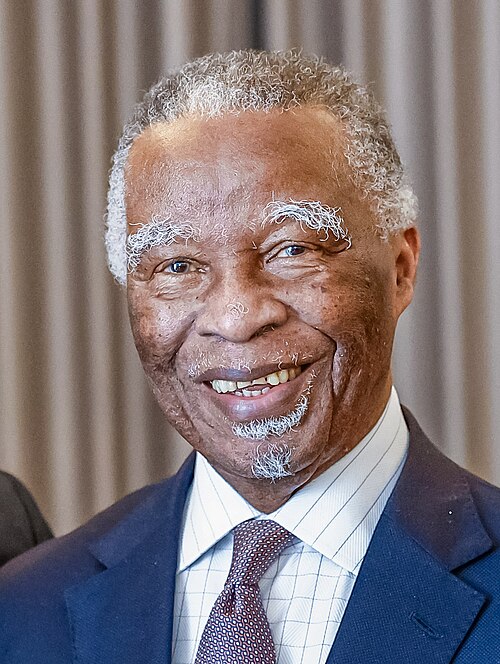
Thabo Mvuyelwa Mbeki stands as one of the most significant and complex figures in modern African history. Serving as the second Executive President of a democratic South Africa from 1999 to 2008, Mbeki's legacy is deeply intertwined with the nation's transition from apartheid and its re-emergence on the global stage. A lifelong activist, diplomat, and intellectual, he is renowned not just as a national leader but as a profound Pan-Africanist who championed the African Renaissance. His presidency was marked by ambitious economic policy, pivotal international diplomacy, and controversial stances on HIV/AIDS. Understanding Thabo Mbeki is essential to understanding the evolution of Politics & Government in contemporary South Africa and the continent at large.
Early Life & Education: Forging a Revolutionary Mind
Born on June 18, 1942, in Idutywa, Transkei (now Eastern Cape), Thabo Mbeki was immersed in political activism from childhood. Both his parents, Govan Mbeki and Epainette Mbeki, were esteemed teachers and stalwarts of the anti-apartheid movement. His father was a senior leader of the African National Congress (ANC) and the South African Communist Party (SACP). This environment shaped young Thabo's worldview, leading to his membership in the ANC Youth League at just 14 years old.
His formal education was consistently interrupted by political imperatives. After completing high school through correspondence, he began studying economics at the University of Fort Hare but was expelled in 1962 for political activities. Under instruction from the ANC, he went into exile, continuing his studies abroad. He earned a Master's degree in Economics from the University of Sussex in the United Kingdom in 1966. This period of exile, which lasted nearly three decades, was formative. Mbeki rose through the ANC's ranks, receiving military training and, more importantly, honing his skills as a diplomat and negotiator in various ANC offices across Africa and Europe. This unique blend of revolutionary heritage, academic economics, and diplomatic exile crafted the sophisticated political operator who would later help steer South Africa.
Career & Major Achievements: From Exile to the Presidency
Thabo Mbeki's career is a chronicle of South Africa's journey from pariah state to democratic leader.
Diplomat and Negotiator in the Transition
In the late 1980s and early 1990s, Mbeki was instrumental in the secret talks that led to the unbanning of the ANC and the release of Nelson Mandela. As apartheid crumbled, he became a key negotiator in the constitutional talks that birthed the "new South Africa." Following the first democratic elections in 1994, President Mandela appointed him as the first Deputy President. In this role, Mbeki was often the day-to-day manager of government, earning him the moniker "the de facto president."
The Mbeki Presidency (1999-2008)
Elected President in his own right in 1999, Thabo Mbeki set an ambitious course. His major achievements include:
- Economic Policy (GEAR): He championed the Growth, Employment and Redistribution (GEAR) strategy, a market-friendly policy that stabilized the economy, attracted foreign investment, and fostered sustained growth, but was criticized for not sufficiently addressing poverty and inequality.
- African Renaissance and Diplomacy: A visionary Pan-Africanist, Mbeki spearheaded the transformation of the Organisation of African Unity (OAU) into the African Union (AU) in 2002. He played a critical mediating role in conflicts across the continent, including in the Democratic Republic of Congo, Burundi, and Côte d'Ivoire.
- Institution Building: He oversaw the establishment of pivotal institutions like the New Partnership for Africa's Development (NEPAD) and the Peer Review Mechanism, aiming for good governance and development.
However, his tenure was also marred by profound controversy, most notably his government's approach to HIV/AIDS. Mbeki's public skepticism of the scientific consensus linking HIV to AIDS led to policies that delayed the rollout of life-saving antiretroviral drugs, a decision later widely condemned as a tragic failure with catastrophic human costs.
Recall from Office
Political tensions within the ANC, particularly following his narrow victory over Jacob Zuma in the 2007 party leadership election, culminated in the ANC's National Executive Committee recalling him from the presidency in September 2008. He resigned voluntarily, succeeded by Kgalema Motlanthe.
Personal Life, Legacy & Lasting Impact
Thabo Mbeki is known for his reserved, intellectual demeanor, a stark contrast to the charismatic style of his predecessor. He is an avid reader and a prolific writer, often communicating through lengthy, philosophical online newsletters even after leaving office. He is married to Zanele Dlamini Mbeki, a notable academic and businesswoman.
His legacy is decidedly mixed but undeniably significant. As a Pan-Africanist, he elevated Africa's agenda globally and provided a coherent intellectual framework for its renewal. Domestically, he consolidated the post-apartheid state and oversaw a period of economic growth, but his presidency is shadowed by the HIV/AIDS crisis and accusations of an aloof leadership style that failed to connect with the poor. Today, through the Thabo Mbeki Foundation and his role as Chancellor of the University of South Africa, he continues to influence debate on African development, governance, and the ongoing project of liberation. He remains a respected, if sometimes contentious, elder statesman in South African and continental Politics & Government.
Net Worth & Post-Presidential Activities
Unlike some of his contemporaries, Thabo Mbeki has not been associated with significant personal business ventures or allegations of corruption during his tenure. His wealth is considered modest by global standards for former heads of state. His income is derived from his presidential pension, speaking engagements, and his work with the Thabo Mbeki Foundation. The Foundation, established in 2010, is his primary vehicle for ongoing intellectual and political engagement, focusing on African leadership, governance, and development issues. Mbeki has maintained a relatively low-profile commercial life, positioning himself more as a thought leader and diplomatic troubleshooter for the continent rather than a business figure. He occasionally serves as a mediator in African conflicts under the auspices of the AU, a role that leverages his extensive experience and networks built over decades in South African and African Politics & Government.
For further reading on Thabo Mbeki's life and policies, credible sources include the Nelson Mandela Foundation, the University of South Africa where he serves as Chancellor, and the official archives of the South African Government.
Frequently Asked Questions
What is Thabo Mbeki's estimated net worth?
Thabo Mbeki has an estimated net worth of $10.0 Million.
What is Thabo Mbeki's role and nationality?
Thabo Mbeki is a Ex-President & Pan-Africanist from South Africa.
How did Thabo Mbeki make their money?
Thabo Mbeki built their fortune primarily through Thabo Mbeki is a career politician and public servant, not a business figure; his wealth stems from presidential pensions, salaries, and speaking engagements, not corporate ownership..
How old is Thabo Mbeki?
Thabo Mbeki was born in 1942 (84 years old).
Which category is Thabo Mbeki listed under?
Thabo Mbeki is featured under the Politics & Government category on NetWorth Africa.
How is Thabo Mbeki's net worth calculated?
NetWorth Africa estimates financial valuations using publicly available stock equity holdings, company ownership records, real estate assets, and verified market data.
Net Worth Analysis
Thabo Mbeki is a career politician and public servant, not a business figure; his wealth stems from presidential pensions, salaries, and speaking engagements, not corporate ownership.
Quick Stats
Related People
Aaron Motsoaledi
LP; Minister of Home Affairs • South Africa
Abane Ramdane†
FLN Leader & Strategist • Algeria
Abdalla Hamdok
Ex-Prime Minister • Sudan
Abdallah Kigoda
Ex-Minister of Natural Resources • Tanzania