$100M
Estimated Net Worth
As of 2024 • low confidence
Financial Breakdown
Asset Distribution
Assets vs Liabilities
Assets
Disclaimer: These financial estimates are based on publicly available information and should be considered approximate. Last updated: 12/30/2025
Biography
Introduction: The Soldier-Turned-President
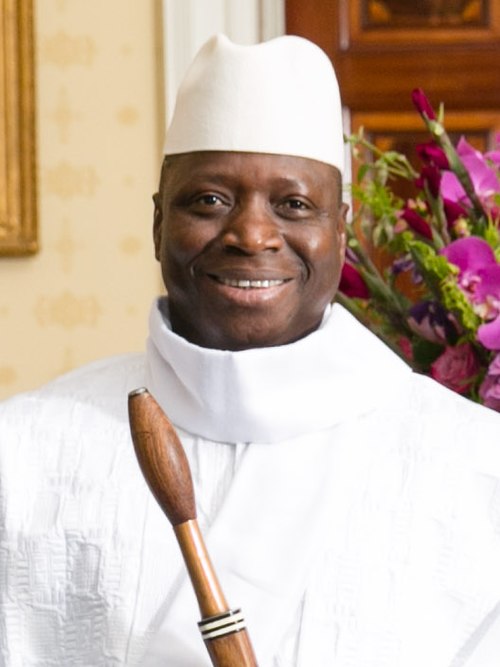
Yahya (Abdul-Aziz Jemus Junkung) Jammeh is a former military officer who served as the President of The Gambia for nearly 23 years, from July 1994 until January 2017. He rose to prominence through a bloodless military coup that ousted the nation's founding president, Sir Dawda Jawara. Yahya Jammeh's rule is a defining and controversial chapter in the modern history of The Gambia, marked by a complex mix of populist policies, claims of spiritual authority, and severe allegations of human rights abuses. His tenure transformed the small West African nation's political landscape, shifting it from a post-colonial democracy to an authoritarian state under his self-styled title of "His Excellency Sheikh Professor Alhaji Dr. Yahya AJJ Jammeh." His eventual refusal to accept electoral defeat in 2016 triggered a regional crisis, cementing his legacy as a polarizing figure in Politics & Government.
Early Life & Education: From Kanilai to the Military
Yahya Jammeh was born on May 25, 1965, in Kanilai, a village in the Foni Kansala district of The Gambia, to a family of the Jola ethnic group. His early life was rooted in rural Gambia, which later became a central part of his political identity. After completing his primary and secondary education, including attending Gambia High School, Yahya Jammeh pursued a career in the military. He joined The Gambia National Gendarmerie in 1984, which was later integrated into The Gambia National Army.
His formative military training was a key period. He attended the Nigerian Military Training School in Kaduna and the United States Army's Military Police School at Fort McClellan, Alabama. These experiences provided him with technical skills and, crucially, exposure to military discipline and hierarchy. By 1992, he had risen to the rank of lieutenant and was appointed the head of the Gambian National Gendarmerie's Military Police. It was during this time that he, along with other junior officers, grew increasingly discontented with the perceived corruption and inefficiency of President Jawara's government, setting the stage for a dramatic seizure of power.
Career & Major Achievements: The 1994 Coup and 22-Year Presidency
The 1994 Military Coup and Transition to Civilian Rule
On July 22, 1994, Lieutenant Yahya Jammeh, then just 29 years old, led a small group of soldiers in a bloodless coup d'état while President Jawara was abroad. The Armed Forces Provisional Ruling Council (AFPRC) was established, with Jammeh as its chairman and head of state. He suspended the constitution, banned political activity, and promised to root out corruption. After two years of military rule, a new constitution was drafted, and Jammeh retired from the army, founded the Alliance for Patriotic Reorientation and Construction (APRC) party, and won presidential elections in 1996, beginning his formal civilian presidency.
Domestic Policies and Reported Achievements
Throughout his rule, President Jammeh's government highlighted several infrastructure and social initiatives. Key projects included:
- The construction of roads, hospitals (like the Sheikh Zayed Regional Hospital), and schools across the country.
- The establishment of the University of The Gambia in 1999.
- Agricultural initiatives aimed at achieving food self-sufficiency.
- Controversial claims of discovering "herbal cures" for HIV/AIDS and asthma, which were widely rejected by the international medical community.
His rule was characterized by a strong nationalist rhetoric, renaming the country from "The Gambia" to the "Islamic Republic of The Gambia" in 2015, and frequently criticizing Western powers and international institutions.
Authoritarian Control and Human Rights Allegations
Alongside reported development projects, Jammeh's regime was consistently accused of severe human rights violations. International organizations, including Amnesty International and Human Rights Watch, documented a pattern of repression:
- The suppression of free press and political opposition, with journalists and activists facing arbitrary detention, torture, and forced disappearance.
- Laws criminalizing homosexuality with harsh penalties.
- Alleged state-sanctioned killings, including the 2005 murder of journalist Deyda Hydara and the 2016 torture and killing of opposition activist Solo Sandeng.
- The establishment of the National Intelligence Agency (NIA), a feared instrument of state repression.
Elections during his tenure were widely criticized as neither free nor fair, with the state apparatus heavily leveraged to ensure victories for the APRC and Yahya Jammeh.
The 2016 Election and Constitutional Crisis
The pivotal moment in Jammeh's career came after the December 1, 2016, presidential election. After initially conceding defeat to opposition coalition candidate Adama Barrow, Yahya Jammeh shocked the nation and the world one week later by rejecting the results, claiming "unacceptable irregularities." This triggered a six-week constitutional crisis. The Economic Community of West African States (ECOWAS) intervened, deploying military forces (ECOMIG) to ensure a peaceful transition. On January 21, 2017, as regional troops entered The Gambia, Jammeh finally relinquished power and went into exile, initially in Equatorial Guinea, where he remains.
Personal Life, Legacy, and Exile
Yahya Jammeh cultivated a public persona blending military authority with religious and traditional symbolism. He often appeared in flowing white robes, carrying a prayer bead or a Quran, and claimed to have divine guidance. He was married to two wives, including Alima Sallah, and has children. His personal interests included farming and wrestling, a traditional sport in The Gambia which he heavily promoted.
The legacy of Yahya Jammeh is profoundly contested. Supporters, particularly in his native Foni region, point to infrastructure projects and his strongman image. However, his lasting impact is largely defined by the establishment of a brutal authoritarian system. Since his exile, The Gambia has established a Truth, Reconciliation, and Reparations Commission (TRRC) which, from 2019 to 2021, uncovered extensive testimony detailing killings, torture, and rape allegedly committed under his orders. The commission recommended he be prosecuted for crimes against humanity. His exile continues to be a significant issue in regional Politics & Government, with the current government seeking his return to face justice.
Net Worth & Business Ventures
The exact net worth of Yahya Jammeh remains unclear but is believed to be substantial, accumulated during his 22-year presidency. The Gambian government, post-2017, has accused him of looting state coffers. Investigations revealed a vast network of assets allegedly acquired through illicit means. These include:
- Multiple luxury properties in The Gambia and abroad.
- Substantial holdings in banks and businesses within The Gambia.
- Ownership of large tracts of agricultural land.
- A fleet of luxury vehicles and aircraft.
Notably, the government has sought to recover millions of dollars from accounts linked to him and his associates. His business empire was deeply intertwined with the state, allowing him to control key sectors of the Gambian economy, a classic feature of authoritarian patronage. The recovery of these assets remains an ongoing challenge for the nation he once led.
Net Worth Analysis
Estimates are speculative as his wealth is not publicly verified; he is widely accused of looting state assets during his 22-year rule, with investigations suggesting hundreds of millions were stolen, but his accessible liquid net worth is uncertain.
Quick Stats
Related People
Aaron Motsoaledi
LP; Minister of Home Affairs
Abane Ramdane†
FLN Leader & Strategist
Abdalla Hamdok
Ex-Prime Minister
Abdallah Kigoda
Ex-Minister of Natural Resources