$13B
Estimated Net Worth
As of 2024 • medium confidence
Financial Breakdown
Asset Distribution
Assets vs Liabilities
Assets
Liabilities
Disclaimer: These financial estimates are based on publicly available information and should be considered approximate. Last updated: 12/30/2025
Biography
Introduction: The Rise and Fall of a Tunisian Leader
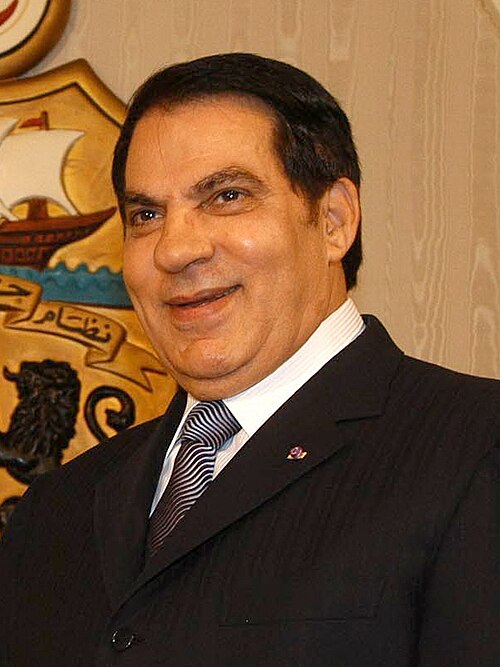
Zine El Abidine Ben Ali† was a pivotal figure in modern Tunisian history, serving as the nation's Ex-President of Tunisia from November 7, 1987, until his dramatic ousting on January 14, 2011. His ascent to power, known as the "medical coup" or "Jasmine Revolution" of 1987, positioned him as a leader promising reform, stability, and a break from the authoritarianism of his predecessor, Habib Bourguiba. For over two decades, Ben Ali presided over a period of significant economic growth and modernization in Tunisia. However, his rule became synonymous with pervasive corruption, severe political repression, and a brutal security apparatus. The very term "Jasmine Revolution" was repurposed in 2011 to describe the popular uprising that ended his regime, marking the beginning of the Arab Spring. The legacy of Zine El Abidine Ben Ali† is thus profoundly dualistic, encompassing both development and despotism.
Early Life & Education: The Making of a Security Chief
Zine El Abidine Ben Ali was born on September 3, 1936, in Hammam Sousse, a coastal town in the French protectorate of Tunisia. Hailing from a modest background, his early education took place in local secular schools. Demonstrating academic promise, he pursued higher technical studies before his career path took a definitive turn towards the military and security sectors, a common route for social mobility in the post-colonial state.
His formative professional training was extensive and international. Ben Ali attended the renowned French military academy of Saint-Cyr, followed by the school of applied artillery in Châlons-sur-Marne, France. He further honed his skills in the United States, studying at the Senior Intelligence School in Fort Holabird, Maryland, and the school for anti-aircraft artillery at Fort Bliss, Texas. This diverse education provided him with a strong technical and intelligence background. Upon returning to Tunisia after its independence in 1956, he quickly rose through the ranks of the newly formed national security apparatus. In 1964, he founded and became the first director of the Military Security Department, embedding himself at the heart of the state's surveillance and control mechanisms. His reputation for efficiency and loyalty led to his appointment as head of National Security in 1977, a role that placed him in direct control of the police force.
Career & Major Achievements: From Interior Minister to Presidency
Ben Ali's political career accelerated in the 1980s. After serving as ambassador to Poland, he was recalled in 1984 to quell deadly bread riots. His successful, albeit harsh, crackdown led to his appointment as Minister of the Interior, a position of immense power. In October 1987, he was further promoted to Prime Minister by the aging and increasingly erratic President Habib Bourguiba.
The 1987 "Medical Coup" and Early Reforms
On November 7, 1987, citing medical reports that declared Bourguiba mentally unfit to govern, Zine El Abidine Ben Ali† assumed the presidency. This bloodless transition was initially welcomed by a populace weary of Bourguiba's autocracy. Ben Ali introduced a "National Pact," promised political pluralism, and initially fostered a more relaxed political climate. He abolished the presidency-for-life title, instituted a constitutional two-term limit (a rule he would later circumvent), and oversaw the drafting of a new electoral code.
Economic Modernization and Social Policy
Economically, the Ben Ali era is noted for a period of sustained growth. His government implemented liberal economic policies that attracted foreign investment, boosted tourism, and developed the country's infrastructure. Key sectors like telecommunications, manufacturing, and services expanded significantly. Socially, his regime continued and amplified Bourguiba's progressive stance on women's rights, with the Code of Personal Status remaining one of the most advanced in the Arab world. Literacy rates improved, and a sizable middle class emerged, particularly in coastal urban areas.
Descent into Authoritarianism and Corruption
Despite early promises, Ben Ali's regime rapidly consolidated authoritarian control. By the early 1990s, following a strong electoral showing by the Islamist Ennahda Movement in 1989, a severe crackdown began. Political repression became systemic:
- All meaningful opposition was stifled through coercion, electoral manipulation, and imprisonment.
- The Constitutional Democratic Rally (RCD) party became the sole dominant political vehicle.
- The security and intelligence services, answerable directly to the president, monitored and persecuted dissidents, journalists, and human rights activists.
- Control over the media was absolute, cultivating a personality cult around the president and his wife, Leila Trabelsi.
Personal Life, Exile, and Complex Legacy
Zine El Abidine Ben Ali was married twice. His second marriage in 1992 to Leila Trabelsi, a former hairdresser, became a symbol of the regime's nepotism and greed. Her family's brazen accumulation of wealth fueled widespread public resentment. Ben Ali presented himself as a modern, secular leader, but his personal life was shrouded in the opulence of his palaces and compounds.
The end of his rule was swift and historic. In December 2010, the self-immolation of street vendor Mohamed Bouazizi in protest of police humiliation and economic despair ignited nationwide protests. On January 14, 2011, after failing to quell the uprising, Ben Ali and his family fled to Saudi Arabia. In absentia, he was tried and convicted multiple times by Tunisian courts for corruption, embezzlement, and murder. He lived in exile in Jeddah until his death on September 19, 2019. The legacy of Zine El Abidine Ben Ali† is indelibly tied to the Arab Spring. He left behind a nation with a developed infrastructure and educated populace, but also one deeply scarred by political trauma, institutionalized corruption, and stark regional inequalities—challenges that the nascent Tunisian democracy continues to grapple with today.
Net Worth, Business Interests, and Financial Corruption
While no official verified net worth for Zine El Abidine Ben Ali was ever published, investigations after the 2011 revolution revealed a staggering scale of illicit wealth. International bodies, including the World Bank, and Tunisian investigative commissions estimated that the Ben Ali-Trabelsi family conglomerate controlled perhaps 50% of the Tunisian economy. Their business interests spanned banking, telecommunications, real estate, car dealerships, airlines, and major industries. This was not traditional business success but a systematic looting of the state through coercion and graft. A 2017 report by the World Bank's Stolen Asset Recovery Initiative detailed a complex web of offshore holdings and shell companies. In 2019, a Tunisian court ordered the confiscation of all properties and assets belonging to Ben Ali, his wife, and several relatives, valued in the billions of dollars, marking a formal but incomplete attempt to reclaim the nation's stolen wealth.
Net Worth Analysis
Swiss court documents from 2021 revealed he and his family amassed a fortune of approximately $13 billion through corruption during his rule, though much was seized or frozen.
Quick Stats
Related People

Aaron Motsoaledi
LP; Minister of Home Affairs
Abane Ramdane†
FLN Leader & Strategist
Abdalla Hamdok
Ex-Prime Minister
Abdallah Kigoda
Ex-Minister of Natural Resources