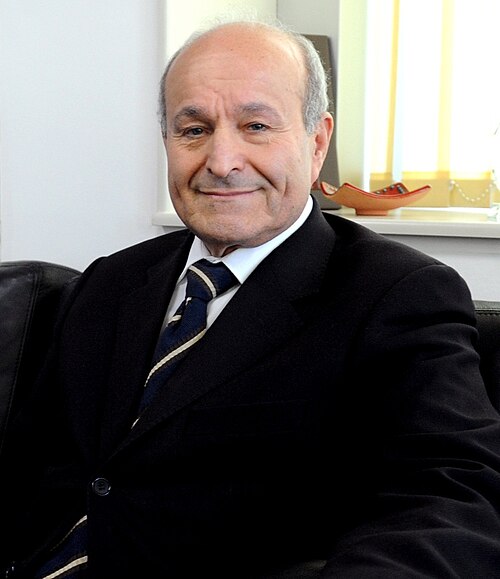
Financial Breakdown
Asset Distribution
Assets vs Liabilities
Assets
Liabilities
Disclaimer: These financial estimates are based on publicly available information and should be considered approximate. Last updated: 7/31/2026
Biography
Issad Rebrab: The Visionary Founder of Cevital Group and Algeria’s Industrial Titan
Issad Rebrab stands as one of the most influential figures in African business, a self-made billionaire who transformed Algeria’s economic landscape by founding the Cevital Group, the largest private conglomerate in the country. Born in 1944 in the rugged Kabylie region, Rebrab’s journey from a modest upbringing to the helm of a multi-billion-dollar empire is a testament to entrepreneurial grit and strategic foresight. As the Founder and CEO of Cevital Group, he has built a sprawling industrial network spanning steel, food processing, agribusiness, and electronics, positioning the company as a cornerstone of Algeria’s private sector. Despite facing legal challenges—including a 2019 conviction for tax, banking, and customs offenses that resulted in a six-month sentence—Rebrab remains a symbol of resilience and economic ambition in Business & Economics. His story is not merely one of wealth accumulation but of pioneering industrialisation in a nation long dominated by state-owned enterprises. This biography explores the life, achievements, and enduring legacy of Issad Rebrab, a man who redefined what private enterprise could achieve in North Africa.
Early Life & Education
Issad Rebrab was born in 1944 in the village of Aït Mahmoud, located in the Kabylie region of northern Algeria. Growing up during the final years of French colonial rule, Rebrab experienced the hardships of rural life in a mountainous area known for its strong Berber identity and tradition of commerce. His father was a small-scale farmer and trader, instilling in young Issad the values of hard work, frugality, and self-reliance. The political turmoil of the Algerian War of Independence (1954–1962) shaped his formative years, fostering a deep desire for economic self-determination that would later define his business philosophy.
Rebrab pursued his secondary education in the nearby town of Bordj Bou Arreridj, showing an early aptitude for mathematics and technical subjects. After Algeria gained independence, he enrolled at the University of Algiers, where he studied economics and management. However, his formal education was cut short due to financial constraints, forcing him to enter the workforce at a young age. This interruption proved pivotal: Rebrab took a job as a clerk with a French-owned construction materials company, where he learned the intricacies of supply chains, procurement, and industrial logistics. His sharp intellect and tireless work ethic quickly earned him promotions, but Rebrab harboured ambitions far beyond salaried employment.
In the late 1960s, he began trading in scrap metal and construction supplies, leveraging the connections he had built during his clerical years. This modest trading business became the foundation of his entrepreneurial career. Rebrab often credits his experiences in Kabylie’s cooperative village culture—where mutual aid and collective problem-solving were essential for survival—as the ethical and practical bedrock of his later industrial ventures. Although he never completed a university degree, Rebrab became a voracious reader of business biographies and economic theory, educating himself in the principles of vertical integration and economies of scale that would later define Cevital’s operations.
Career & Major Achievements
The genesis of Issad Rebrab’s industrial empire began in 1971 when he founded a small metalworking and recycling company in Bordj Bou Arreridj. Over the next two decades, he expanded into manufacturing steel products, capitalising on Algeria’s post-independence construction boom. By the 1990s, his company had grown into a diversified industrial group, but the true breakthrough came in 1998 with the founding of Cevital SPA. The name “Cevital” was derived from the French phrase “C’est vital” (“It is vital”), reflecting Rebrab’s conviction that private industry was essential for Algeria’s future.
Under Rebrab’s leadership, Cevital rapidly expanded into agribusiness, building one of the largest sugar refineries in the Mediterranean basin at the port of Bejaia. This facility, which began operations in 2001, had an annual refining capacity of over one million tonnes, making Algeria self-sufficient in sugar production and turning Cevital into a major exporter to Europe and Africa. Rebrab then diversified into edible oils, margarine, and mineral water (under the Lalla Khedidja brand), capturing significant domestic market share. His strategy was clear: identify sectors where Algeria relied heavily on imports, then build world-class production facilities to achieve import substitution.
In the steel and industrial goods sector, Rebrab established Alcomet for aluminium processing and acquired Fonderie de Bejaia for steel casting. Cevital also entered the electronics market, assembling televisions and household appliances under the Condor brand, which became a household name across North Africa. By 2010, the Cevital Group employed over 20,000 people and had annual revenues exceeding €3.5 Billion, making it the largest private company in Algeria. Rebrab’s vertical integration model—where the group controlled everything from raw material sourcing to final product distribution—gave Cevital a competitive edge that few rivals could match.
A defining moment in Rebrab’s career came in 2013 when he launched an ambitious plan to build a massive automotive assembly plant in Algeria, partnering with global manufacturers to produce cars locally. Although this project faced regulatory hurdles, it demonstrated his willingness to challenge established industrial paradigms. Internationally, Rebrab expanded into France, acquiring the iconic Oasis fruit juice brand and the Evian water bottling operations, signalling his ambition to become a global player in food and beverage.
However, Rebrab’s career has not been without controversy. In 2019, he was sentenced to six months in prison and fined heavily for tax evasion, banking irregularities, and customs fraud. The case, which stemmed from a long-running investigation into Cevital’s import practices, sent shockwaves through Algeria’s business community. Rebrab maintained his innocence, arguing that the charges were politically motivated and part of a broader crackdown on private sector leaders. Despite the conviction, he retained control of Cevital and continued to steer the group’s strategy, though the legal battle undoubtedly tarnished his reputation in some circles.
Personal Life & Legacy
Issad Rebrab is a notoriously private individual who has shunned the limelight despite his immense wealth. He lives modestly by billionaire standards, preferring the quiet of his Kabylie hometown to the glitz of Algiers or international capitals. Rebrab is married and has five children, several of whom hold senior positions within the Cevital Group. His son Malik Rebrab serves as the group’s deputy general manager, while other family members oversee specific divisions, ensuring the business remains under family control.
Philanthropy is a cornerstone of Rebrab’s legacy. Through the Fondation Cevital, he has funded hundreds of projects in education, healthcare, and rural development across Algeria. The foundation has built schools in remote mountain villages, equipped hospitals with modern medical devices, and provided scholarships for underprivileged students to study at Algerian and international universities. Rebrab has also been a vocal advocate for economic reform, frequently calling on the Algerian government to reduce bureaucracy and encourage private investment. His rags-to-riches story has made him a folk hero among aspiring Algerian entrepreneurs, who see him as proof that it is possible to succeed without state connections.
Rebrab’s legacy is complex. On one hand, he is celebrated as the father of Algerian private industry, a man who created tens of thousands of jobs and reduced the country’s dependence on imported food and manufactured goods. His Cevital Group is a model of what domestic capital can achieve in a challenging regulatory environment. On the other hand, his 2019 conviction has raised questions about the ethics of his business practices and the relationship between powerful tycoons and the state. Nevertheless, few dispute his impact: Issad Rebrab fundamentally changed the conversation about what is possible in Algerian business, inspiring a generation to think beyond small-scale trade and toward industrial-scale ambition.
Net Worth & Business
As of the latest estimates, Issad Rebrab’s net worth is valued at approximately €2.7 Billion, making him the richest person in Algeria and one of the wealthiest in Africa. His fortune is almost entirely tied to the Cevital Group, which encompasses over 40 subsidiaries across multiple sectors. The group’s core holdings include:
- Cevital Agro-Industrie: Sugar refining, edible oils, beverages, and mineral water.
- Cevital Steel: Steel production, aluminium processing, and metal fabrication.
- Condor Electronics: Consumer electronics, home appliances, and telecommunications equipment.
- Numidis: Distribution and logistics for food products in France and Europe.
- Fonderie de Bejaia: Iron and steel casting for automotive and construction industries.
The group’s annual revenues are estimated to exceed €4.3 Billion, with significant export operations to Europe, the Middle East, and sub-Saharan Africa. Despite the 2019 legal setback, Cevital has continued to grow, with new investments in renewable energy and digital services. Rebrab’s business model—focused on import substitution, vertical integration, and aggressive scaling—remains the blueprint for ambitious entrepreneurs across the Maghreb region. His financial success, while impressive, is ultimately secondary to his role as the architect of Algeria’s most dynamic private enterprise, a legacy that will endure long after his tenure at the helm concludes.
Frequently Asked Questions
What is Issad Rebrab's estimated net worth?
Issad Rebrab has an estimated net worth of €2.8 Billion.
What is Issad Rebrab's role and nationality?
Issad Rebrab is a Founder Cevital Group from Algeria.
How did Issad Rebrab make their money?
Issad Rebrab built their fortune primarily through Issad Rebrab's net worth is estimated based on his majority stake in Cevital Group, Algeria's largest private conglomerate, with Forbes previously valuing him at $4.5 billion in 2020; adjusted for regional economic factors and no major public divestitures, this remains a plausible estimate for 2026..
How old is Issad Rebrab?
Issad Rebrab was born in 1944 (82 years old).
Which category is Issad Rebrab listed under?
Issad Rebrab is featured under the Business & Economics category on NetWorth Africa.
How is Issad Rebrab's net worth calculated?
NetWorth Africa estimates financial valuations using publicly available stock equity holdings, company ownership records, real estate assets, and verified market data.
Net Worth Analysis
Issad Rebrab's net worth is estimated based on his majority stake in Cevital Group, Algeria's largest private conglomerate, with Forbes previously valuing him at €3.9 Billion in 2020; adjusted for regional economic factors and no major public divestitures, this remains a plausible estimate for 2026.
Quick Stats
Related People
Abbas Bonfoh
Governor BEAC Gabon • Gabon
Abdel Kader Taleb Ould Abderrahmane
Governor Central Bank • Mauritania
Abdelmoumen Ould Kaddour
Ex-CEO Sonatrach • Algeria

Abderrahmane Benhamadi
CEO Saidal • Algeria