Biography
Introduction: A Footballing Colossus
In the pantheon of African football, few names resonate with the profound mix of brilliance and tragedy as that of Marc-Vivien Foé†. A midfield powerhouse for both club and country, Foé embodied the spirit, strength, and skill that made Cameroon's Indomitable Lions a global force. His career, tragically cut short at its peak, left an indelible mark on the world of sports. Born in 1975 in Nkolo, Cameroon, Foé rose to prominence as a complete midfielder—combining physical dominance with technical grace. His most notable achievement came in the colors of his nation, but his club journey across France and England showcased a player of immense adaptability and quality. The defining moment of his career, scoring the goal that sent Cameroon to the 2002 FIFA World Cup, is forever intertwined with the heartbreak of his untimely passing on the pitch during the 2003 FIFA Confederations Cup. This biography explores the life, career, and enduring legacy of a true Cameroon football legend.
Early Life & Education: Roots in Nkolo
Marc-Vivien Foé† was born on May 1, 1975, in the small village of Nkolo, located in the Centre Region of Cameroon. From a young age, his athletic prowess was evident. He grew up in a nation passionate about football, where the success of the Indomitable Lions in the 1990s inspired a generation. Foé's formal education was pursued alongside his burgeoning football talent. He attended local schools where he balanced academics with his first organized football. His raw talent and imposing physical frame quickly set him apart from his peers.
His formative football education began at the renowned Canon Yaoundé academy, one of the most successful and historic clubs in Cameroonian football. Canon Yaoundé served as the perfect incubator for young talent, instilling discipline and tactical understanding. It was here that Foé's potential was honed and his professional path was charted. His performances at the youth level were so compelling that he made his senior debut for Canon Yaoundé at just 17 years old in 1992. This early exposure to top-level domestic football in Cameroon was the critical first step, showcasing his ability to control a midfield and drive his team forward. This formative period in Cameroon laid the unshakeable foundation for the resilient and powerful player he would become on the international stage.
Career & Major Achievements: A Journey of Strength and Success
The professional career of Marc-Vivien Foé† was a testament to his consistency, power, and leadership. After two seasons with Canon Yaoundé, European scouts took notice. In 1994, he made the pivotal move to France, joining RC Lens. Over five seasons with Lens, Foé developed into a formidable Ligue 1 midfielder, winning the French league title in the 1997-98 season. His performances attracted the attention of England's West Ham United, where he spent the 1999-2000 season on loan, becoming a popular figure at Upton Park.
A permanent move to Olympique Lyonnais followed in 2000. At Lyon, Foé reached new heights, playing a central role in a dominant team. He won back-to-back Ligue 1 titles in 2002 and 2003, and also lifted the Trophée des Champions. In 2003, he joined Manchester City on loan, where he enjoyed a standout season in the Premier League, admired for his commanding presence in midfield.
International Stardom with the Indomitable Lions
It was with the Indomitable Lions of Cameroon that Marc-Vivien Foé† achieved his most iconic moments. He earned his first cap in 1993 and became a fixture in the side. His career coincided with a golden era for Cameroonian football.
- 2000 AFCON & Olympic Gold: Foé was instrumental in Cameroon's victorious 2000 Africa Cup of Nations campaign. Later that year, he starred as Cameroon won the Olympic Gold Medal at the Sydney Games, defeating Spain in a thrilling final.
- The Legendary Goal (2001): His most celebrated moment came on November 11, 2001. In a tense World Cup qualifier against Senegal, Foé scored a stunning, powerful long-range goal in the 39th minute. This solitary strike secured Cameroon's qualification for the 2002 FIFA World Cup and is eternally replayed in African football history.
- 2002 FIFA Confederations Cup: In 2003, Foé captained Cameroon to the final of the FIFA Confederations Cup. His performances were outstanding, but tragedy struck during the semi-final against Colombia on June 26, 2003. In the 72nd minute, Foé collapsed in the center circle. Despite desperate medical efforts, he was pronounced dead later that day. The cause was later identified as hypertrophic cardiomyopathy, an undiagnosed heart condition.
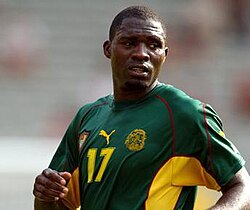
His number 17 jersey was retired by both Manchester City and the Cameroonian national team in his honor. The entire football world mourned the loss of a great player and a humble man.
Personal Life & Legacy: The Man Behind the Number
Off the pitch, Marc-Vivien Foé† was known as a gentle giant—a devoted family man, a loyal friend, and a deeply religious person. He was married to Marie-Louise Foé and was a father to three children. His humility and warm smile contrasted with his fierce competitive nature on the field, endearing him to teammates, opponents, and fans alike. In the wake of his passing, the depth of his character was revealed through countless tributes that spoke of his kindness and professionalism.
The legacy of Marc-Vivien Foé† is multifaceted. He is remembered as a symbol of African footballing excellence—a powerful, skillful midfielder who succeeded at the highest levels in Europe and led his country to its greatest triumphs. The tragic circumstances of his death brought global attention to cardiac screening in athletes, leading to improved medical protocols in football. Annually, memorial matches are held in his honor. The most poignant legacy is the "Marc-Vivien Foé Prize" (Prix Marc-Vivien Foé), awarded each year to the best African player in France's Ligue 1. This award, presented since 2009, ensures his name continues to be associated with celebrating African football talent. His spirit remains woven into the fabric of the Indomitable Lions, a constant reminder of talent, triumph, and profound loss.
Net Worth & Business Ventures
During his professional career, which spanned nearly a decade at the top level in Europe, Marc-Vivien Foé† earned a substantial income through his football contracts with clubs like Lens, Lyon, West Ham United, and Manchester City. While exact figures of his net worth at the time of his passing are not publicly documented, it is estimated to have been in the range of several million dollars, accrued from salaries, bonuses, and endorsements commensurate with his status as a key player for club and country.
His primary focus remained on his football career, and there is little public record of significant personal business ventures outside the sport. His most enduring "venture," in a symbolic sense, is the charitable and commemorative work done in his name. The foundation established by his family and the legacy of the prize awarded in his honor serve as a continuing tribute, focusing on supporting young athletes and remembering his contributions to football, rather than on commercial enterprise. His true value was measured in respect, admiration, and the lasting impact he left on the game.
Sources: Information compiled from FIFA.com official archives, BBC Sport coverage of the 2003 Confederations Cup, Olympique Lyonnais historical records, and the official website of the Prix Marc-Vivien Foé.
Net Worth Analysis
Marc-Vivien Foé was a professional footballer who passed away in 2003; he is not a living business figure and has no applicable net worth for 2024.
Quick Stats
Related People

AB de Villiers
Proteas Legend
Abdallahi Mahmoud
Mourabitounes Midfielder

Abderrahmane Hammad
High Jump World Champion

Abdi Bile
1500m World Champion