Biography
Introduction: The Architect of African Historical Consciousness
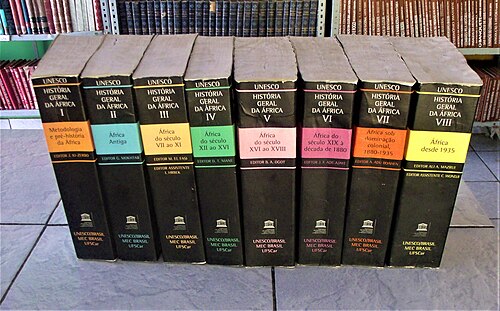
Prof. Joseph Ki-Zerbo† (1922-2006) stands as a monumental figure in the intellectual and political landscape of post-colonial Africa. A preeminent historian, prolific author, and unwavering Pan-Africanist, his life's work was dedicated to reclaiming and reconstructing Africa's narrative from an African perspective. His most renowned contribution is his pivotal role in the UNESCO General History of Africa, a groundbreaking project that systematically challenged Eurocentric historical paradigms. As the lead editor of Volume I, Methodology and African Prehistory, Prof. Joseph Ki-Zerbo† helped lay the foundational methodology for writing African history using African sources. Beyond Academia & Research, he was a committed political activist in Burkina Faso, advocating for democracy, social justice, and the continent's autonomous development. His enduring question, "Does Africa have a history?" was answered resoundingly through his scholarship and activism.
Early Life & Education: Forging an Intellectual Path
Born on June 21, 1922, in Toma, in what was then Upper Volta (now Burkina Faso), Joseph Ki-Zerbo was raised in a family that valued both traditional Mossi culture and formal education. His father, a colonial interpreter, ensured his son attended primary school in Toma and later at the William Ponty School in Dakar, Senegal, a prestigious institution that educated many future African leaders. These formative years exposed him to the contradictions of colonial rule, planting the seeds of his future political consciousness.
His academic prowess earned him a rare opportunity to pursue higher education in France. He studied at the Sorbonne in Paris, where he earned a degree in History in 1954, becoming one of the first West Africans to achieve this feat. He continued his studies at the Institute of Political Studies (Sciences Po) in Paris. Immersed in the vibrant intellectual and anti-colonial circles of 1950s Paris, Prof. Joseph Ki-Zerbo† engaged with thinkers like Frantz Fanon and Alioune Diop, founder of Présence Africaine. This period was crucial, solidifying his belief that Africa's liberation was inextricably linked to the decolonization of its history and the assertion of its own intellectual sovereignty.
Career & Major Achievements: Scholar, Activist, Visionary
The career of Prof. Joseph Ki-Zerbo† was a seamless blend of rigorous scholarship and active political engagement, both aimed at African emancipation.
Revolutionizing African Historiography
As a historian, his magnum opus is undoubtedly his leadership in the UNESCO General History of Africa project, launched in 1964. Appointed as the editor of the first volume, he faced the monumental task of establishing credible methodologies for a continent whose history had been largely dismissed or distorted. The eight-volume series, completed over decades, became a cornerstone of African studies. His own seminal work, Histoire de l'Afrique Noire (1972), translated as History of Black Africa, was a landmark textbook used across the continent, presenting a comprehensive, Africa-centered historical narrative.
Political Engagement and Advocacy
Parallel to his academic work, Ki-Zerbo was deeply involved in the politics of his homeland. He founded the Burkina Faso political party, the Parti pour la Démocratie et le Progrès / Parti Socialiste (PDP/PS). A staunch opponent of military rule, he was a critical voice against the regimes of both Thomas Sankara and Blaise Compaoré, which led to periods of exile. His political philosophy was encapsulated in his famous quote: "We must produce what we consume, and consume what we produce." He championed endogenous development, arguing that Africa's future must be built on its own cultural and material resources.
Key Accomplishments and Impact
- UNESCO General History of Africa: Editor of Volume I (1981), shaping the entire project's methodological framework.
- Authoritative Publications: Authored the influential Histoire de l'Afrique Noire (1972) and the insightful À quand l'Afrique? (2003).
- Educational Leadership: Taught at universities in Ouagadougou, Dakar, and Paris, mentoring generations of scholars.
- Civil Society Founding: Established the Centre d'Études pour le Développement Africain (CEDA) in 1979, a leading research institute.
- International Recognition: Recipient of the Right Livelihood Award (the "Alternative Nobel Prize") in 1997 for his work on African development alternatives.
Personal Life, Legacy, and Lasting Impact
Prof. Joseph Ki-Zerbo was married to Jacqueline Ki-Zerbo, a sociologist and fellow activist who was a pillar of support throughout his life. His personal integrity and modest lifestyle were as notable as his public achievements. He was a man of deep conviction, whose Christian faith coexisted with a profound respect for African spiritual traditions. Even during exile, his home remained a hub for intellectuals and activists discussing Africa's future.
The legacy of Prof. Joseph Ki-Zerbo† is immense and multifaceted. He is remembered as the "father of African history," who provided the intellectual tools for the continent to understand its past on its own terms. Politically, he is a symbol of democratic resistance and principled opposition in Burkina Faso. His ideas on endogenous development continue to influence economic and cultural debates across Africa. The Joseph Ki-Zerbo University in Ouagadougou bears his name, ensuring his scholarly contributions remain at the forefront of Academia & Research. He passed away on December 4, 2006, in Ouagadougou, but his question—"À quand l'Afrique?" (When will Africa rise?)—remains a powerful call to action for new generations.
Net Worth, Recognition, and Enduring Influence
While the precise net worth of Prof. Joseph Ki-Zerbo† is not publicly documented, his wealth was measured not in financial capital but in immense intellectual and moral currency. His career was in public service, academia, and political activism—fields not typically associated with vast personal fortune. His true "value" lies in the enduring impact of his publications, the institutions he built, and the minds he shaped. The financial support for his work came from academic positions, research grants, and awards like the Right Livelihood Award, which included a monetary prize to further his causes.
His most significant "venture" was the intellectual project of African historical and cultural reclamation. This non-commercial enterprise has yielded incalculable returns in pride, identity, and scholarly direction for the continent. Today, his works are essential texts in universities worldwide, and his institute, CEDA, continues its research. In this context, the legacy of Prof. Joseph Ki-Zerbo is priceless, cementing his status as one of Africa's most important 20th-century thinkers and a foundational pillar of modern historical Academia & Research.
Net Worth Analysis
Prof. Joseph Ki-Zerbo was a renowned historian and academic, not a business figure; he passed away in 2006 and his wealth was not of a commercial billionaire scale.
Quick Stats
Related People
Abdullahi Ahmed An-Na'im
Professor Emory University
Adame Ba Konaré
Historian & Ex-First Lady
Adelaide Casely-Hayford†
Feminist & Educator
Amadou Hampâté Bâ†
Writer & Ethnologist